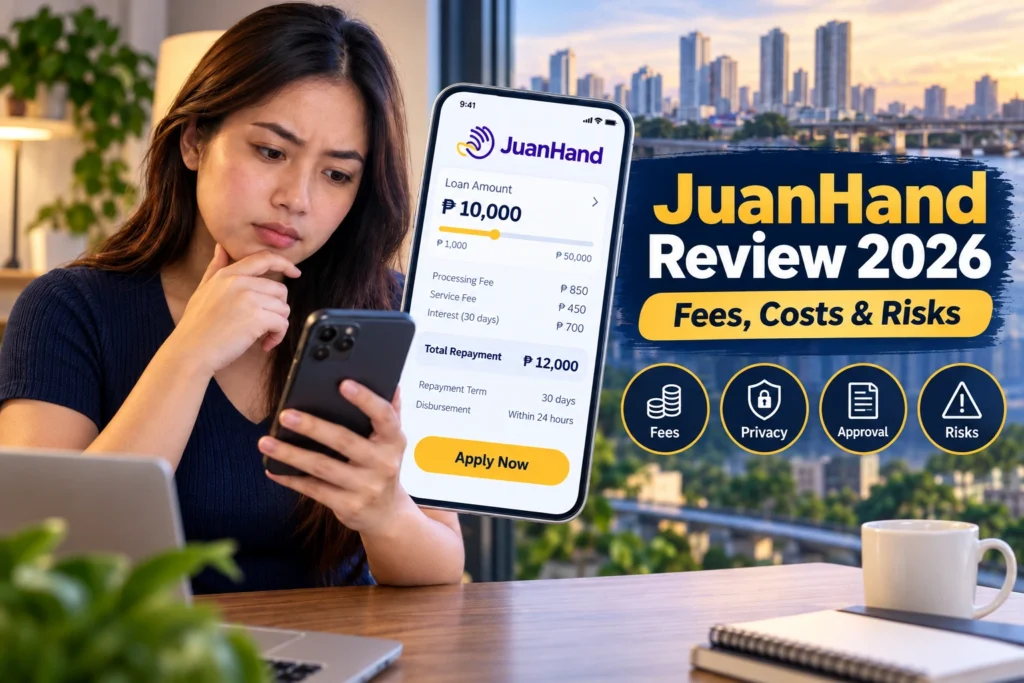
A ₱10,000 loan can look manageable when the screen emphasizes a low interest rate. The more important question is what happens after interest, service fees, repayment timing, and late-payment charges are included. With JuanHand, that distinction matters because its current public disclosures use several different numbers depending on where you look.
This JuanHand review examines the legal entity behind the platform, published 2026 product terms, loan agreements, privacy disclosures, Philippine lending rules, and recent Google Play borrower feedback. It is not presented as a hands-on borrowing test; no live loan was accepted for this review. That distinction avoids turning marketing claims or public documentation into invented personal experience.
JuanHand is operated by WeFund Lending Corp., which appears in SEC records with SEC Registration No. CS201825672 and Certificate of Authority No. 2844. Its July 2026 Google Play listing advertises ₱2,000 – ₱50,000 loans for 91 – 180 days, while JuanHand’s website shows broader calculator ranges and says final terms appear in the app. The biggest cost issue is the service fee: Google Play’s own ₱10,000 example adds a 10% service fee on top of interest. Borrowers should therefore judge an offer by the Disclosure Statement, net proceeds, total repayment, and actual lender – not by the headline rate alone.
| Borrower question | Current finding | Why it matters |
|---|---|---|
| Who operates JuanHand? | WeFund Lending Corp.; SEC No. CS201825672; CA No. 2844 | Confirms an identifiable Philippine lending company in SEC records. |
| Is WeFund always the actual lender? | Not necessarily. Published agreements identify Lightning Financing, SeaBank, and Maya Bank in different lending structures. | Check the lender named on your own Disclosure Statement. |
| Published cash-loan range | Google Play: ₱2,000 – ₱50,000 | The maximum is not a guaranteed approved amount. |
| Published term | Google Play: 91 – 180 days | Actual offer and installment dates can differ. |
| Headline APR | Google Play states maximum APR of 30% | This should not be read without considering service fees. |
| Service fee | Published ₱10,000 example includes a 10% service fee | Materially raises the peso cost beyond stated interest. |
| Approval speed | JuanHand advertises approval as fast as five minutes | A marketing best case is not a guaranteed cash-received time. |
| Late-payment ceiling | For covered small loans, current SEC rules cap penalties at 5% monthly on the outstanding scheduled amount | Scope matters: the cap applies to defined loan categories. |
| Privacy | Current policy says JuanHand will not access the phone’s contact list | Borrowers should still review permissions and privacy terms before applying. |
Is JuanHand legitimate and properly authorized in the Philippines?
JuanHand has an identifiable regulatory and corporate trail. SEC records list WeFund Lending Corp. with Registration No. CS201825672 and Certificate of Authority No. 2844, while earlier SEC online-lending-platform records specifically associate JuanHand with WeFund. Registration, however, does not mean every loan offer is affordable.
The distinction between company registration and lending authority matters. A corporation merely appearing in SEC registration records is not enough by itself to prove that it can lawfully operate as a lending company. WeFund’s published Certificate of Authority is therefore more relevant than simply saying JuanHand is “SEC registered.”
JuanHand’s current website continues to identify WeFund Lending Corp. and displays the same registration and Certificate of Authority numbers.
That still does not make the SEC a guarantor of the loan, its pricing, or its suitability for a particular borrower. Regulatory status and affordability are separate questions.
Who actually provides a JuanHand loan?
This is more complicated than the brand name suggests.
One published JuanHand agreement identifies Lightning Financing Company Inc. as the lender and WeFund Lending Corp. as facility manager. A separate SeaBank agreement identifies SeaBank Philippines Inc. as lender and WeFund as facility manager. Another agreement identifies Maya Bank as lender, Lightning Financing as facility manager, and WeFund as the JuanHand app owner.
JuanHand also announced a SeaBank loan-channeling partnership in July 2026.
For a borrower, the practical rule is simple: read the lender name on the contract and Disclosure Statement attached to your actual offer. Do not assume that every JuanHand loan has identical pricing, collection rights, late-payment terms, or funding arrangements.
How much can you actually borrow from JuanHand in 2026?
The clearest current app-store disclosure says ₱2,000 to ₱50,000 with a 91- to 180-day term. JuanHand’s website contains broader calculator settings, so borrowers should treat the amount and repayment schedule displayed in the approved in-app offer – not a website slider – as the relevant figures.
The July 29, 2026 Google Play listing states a ₱2,000 – ₱50,000 loan range, a 91 – 180 day term, maximum APR of 30%, and zero “transaction fee.” It also states that applicants should be at least 18, Filipino citizens, have one government-issued ID, and have stable income.
JuanHand’s main website similarly promotes borrowing of up to ₱50,000. Yet its public Borrow page currently has a calculator that can be moved between ₱1,000 and ₱100,000 and between one and 12 months, while warning that final amount and repayment details will be shown in the app.
That inconsistency is worth noticing. It does not prove that ₱100,000 is an available standard cash-loan limit. The more specific 2026 Play disclosure and JuanHand’s primary promotional copy currently point to ₱50,000.
Your approved amount can also be lower than the advertised maximum because loan approval remains subject to underwriting. The published Lightning agreement expressly says approval depends on submitted documents, credit-approval processes, guidelines, and the final credit decision.
What does a JuanHand loan really cost?
The headline interest rate does not tell the whole story. JuanHand’s current Google Play example combines interest with a 10% service fee. On its published ₱10,000 example, total repayment reaches ₱11,299.17 – meaning ₱1,299.17 of borrowing cost over roughly three months.
The example deserves more attention than the marketing headline.
For a ₱10,000, 91-day loan, Google Play uses a 12% annual interest-rate assumption. It calculates approximately ₱299.17 interest, then adds a ₱1,000 service fee, producing ₱11,299.17 total repayment, or ₱3,766.39 if divided into three monthly payments.
| Published example | Amount |
|---|---|
| Principal | ₱10,000.00 |
| Interest shown | ₱299.17 |
| Service fee | ₱1,000.00 |
| Total borrowing cost | ₱1,299.17 |
| Total repayment | ₱11,299.17 |
| Cost relative to ₱10,000 principal | 12.99% |
The service fee is therefore more than three times the peso amount of interest in this example.
There is another useful calculation. If ₱10,000 is actually received on day one and the borrower then pays three equal monthly installments of ₱3,766.39, the implied monthly internal rate of return is about 6.37%. Compounded for comparison purposes, that is roughly 109.7% effective annualized cost.
That annualized figure should not be confused with the app listing’s stated “maximum APR 30%.” The two figures may be using different definitions or calculation conventions. The important borrower takeaway is not that one label must automatically be wrong; it is that fees can make the effective cost substantially different from the headline interest rate.
JuanHand’s website also promotes interest “as low as 0.025%” daily. That is a starting-rate marketing claim, not a promise that every borrower will receive that rate.
What about the website saying there are no processing fees?
JuanHand’s FAQ says it charges zero processing fees, and a fraud warning states it will not ask borrowers for processing fees or service charges “in processing your loan.” At the same time, the current Google Play worked example explicitly contains a contractual 10% service fee.
Those statements can refer to different things – particularly an upfront payment demanded by a scammer versus a service fee built into a legitimate loan contract. Borrowers should not assume “no processing fee” means “no other fees.”
The decisive document is the specific Disclosure Statement immediately before acceptance.
How fast is JuanHand approval and disbursement?
JuanHand advertises approval as fast as five minutes, but that should be treated as a best-case claim rather than a guaranteed time to cash. Approval, transfer initiation, and the receiving bank or e-wallet actually posting the funds are separate stages.
JuanHand says approved funds can be sent through supported e-wallets and banks, including GCash, Maya, GrabPay and numerous Philippine banks.
Application approval can still depend on identity verification, credit assessment, document completeness and the lender’s internal underwriting. The platform does not publicly disclose its complete scoring algorithm.
That means “five minutes” should not become the basis for promising a landlord, hospital, utility provider or another creditor that cash will definitely arrive within five minutes.
How does repayment work, and what if a payment is not posted?
JuanHand provides in-app repayment instructions and multiple payment channels, but borrowers should keep proof of every payment until the account balance is updated. A recent Google Play reviewer specifically reported payment-posting problems, and JuanHand’s developer response asked for payment details so the transaction could be verified.
JuanHand instructs borrowers to review the amount and due date in the app, use an authorized payment channel, check the account after payment, and retain proof of payment. Its website identifies channels including GCash, 7-Eleven, RD Pawnshop and M. Lhuillier.
A July 2026 Google Play reviewer reported that QR payments sometimes failed or did not immediately appear in the app and said calls continued while the payment remained unposted. JuanHand replied that the borrower should contact customer service with payment details for verification. This is one anecdotal report, not proof that the problem affects borrowers generally.
It nevertheless points to a sensible precaution: save the payment reference number, timestamp, receipt and screenshot until the lender confirms posting.
What happens if you pay JuanHand late?
Late payment can result in additional charges, collection activity and possible credit consequences. For loans covered by the current SEC small-loan ceiling, penalties are capped at 5% per month of the outstanding scheduled amount due. The exact consequences of your loan still depend on its agreement and Disclosure Statement.
Since April 1, 2026, SEC Memorandum Circular No. 14, Series of 2025 applies to unsecured general-purpose lending- and financing-company loans of ₱10,000 or less with a tenor of up to four months. For those covered loans, the rules provide a nominal interest ceiling of 6% per month, an effective interest-rate ceiling of 12% per month including applicable fees, a 5% monthly late-payment penalty cap, and a total-cost cap of 100% of the amount borrowed.
The scope is important. It is inaccurate to describe those ceilings as applying automatically to every consumer loan of every amount and tenor.
JuanHand’s published Lightning agreement separately contains a late-payment field capped at 5% per month on the outstanding overdue amount. It also provides for collection activity and possible reporting of default to a government or public credit registry.
Philippine rules do not give collectors unlimited freedom. SEC Memorandum Circular No. 18 prohibits unfair debt-collection practices, while NPC rules restrict abusive processing of personal information for collection.
And ordinary unpaid civil debt does not by itself mean imprisonment. Article III, Section 20 of the 1987 Constitution states that no person shall be imprisoned for debt. That rule does not erase the debt, prevent lawful civil collection, or protect someone from liability for a separately criminal act.
How much personal data does JuanHand collect?
JuanHand’s current privacy policy covers extensive identity, financial, device and credit-related information, but it expressly says the company will not access or collect the borrower’s phone contact list. Google Play also says users can request deletion of their data.
The current privacy notice describes information that can include identity and biometric information, photographs, addresses, financial and creditworthiness data, character references, approximate location, device information, telecommunications usage data and other information associated with granted permissions.
It also explicitly states that JuanHand will not access the phone’s contact list, WhatsApp contacts, social-media friends list or other third-party contacts for collection purposes.
This aligns with NPC rules. Philippine privacy guidance prohibits online lenders from harvesting phone, email or social-media contact lists for debt collection or harassment and restricts app permissions to purposes that are suitable, necessary and proportionate.
What happened in JuanHand’s historical NPC privacy case?
This history should neither be hidden nor presented as though it were a current ban.
The National Privacy Commission imposed a temporary ban on JuanHand’s processing of personal data in 2021 over app-permission and privacy issues. On January 13, 2022, the NPC lifted the temporary ban after JuanHand made compliance changes, although the regulator continued to require remediation of specified issues.
The relevant conclusion for a 2026 review is therefore: there was a real historical privacy enforcement action, but the temporary ban was lifted in 2022.
What are borrowers saying about JuanHand in 2026?
Recent Google Play feedback is mixed. Some reviewers describe a fast or straightforward application process and responsive service, while another recent review reports payment-posting and QR problems. These individual experiences are useful warning signals, but they are not statistical evidence of the experience every borrower will have.
Google Play showed millions of downloads and a high aggregate rating when reviewed, but star averages are less useful than the specific issues borrowers describe.
The July payment-posting complaint is particularly relevant because a borrower who has already paid can face unnecessary stress if the account has not yet updated. Other 2026 reviewers praised application speed or customer-service responsiveness.
The sensible interpretation is neither “all reviews prove JuanHand is excellent” nor “one complaint proves the system is unreliable.” App-store feedback is anecdotal evidence best used to identify what borrowers should document and verify.
What are JuanHand’s main advantages and disadvantages?
| Potential advantage | Limitation or risk |
|---|---|
| Identifiable operator with published SEC registration and Certificate of Authority | Regulatory status does not make an individual loan inexpensive. |
| Current app-store listing publishes an actual worked cost example | The 10% service fee in that example materially exceeds the peso interest charge. |
| Multiple bank and e-wallet disbursement channels | Approval speed does not necessarily equal cash-received speed. |
| Published contracts identify lender/facility-manager relationships | The actual lender can differ depending on the product. |
| Current privacy policy explicitly rejects phone-contact-list harvesting | The company has a historical NPC enforcement case, though the temporary ban was lifted. |
| Repayment channels are publicly documented | A recent borrower report highlights the importance of confirming payment posting. |
Who should be especially cautious before accepting a JuanHand loan?
The product deserves extra caution when the repayment date does not match reliable income, when another loan would be needed to make the installment, or when the borrower has looked only at the interest rate instead of the full repayment amount.
A short-term loan becomes much harder to manage when the repayment source is uncertain. The same is true when service fees materially raise the cost or when several digital loans are being used to repay one another.
Before accepting, verify these seven items in the live offer: legal lender, cash actually received, all interest, every service or platform fee, total repayment, exact installment dates, and late-payment terms. Then compare the installment with income that is already expected – not income that might arrive.
FAQ
Can you repay a JuanHand loan early and save interest?
Do not assume so. JuanHand’s published Lightning agreement says a full prepayment includes outstanding interest and fees and states that prepayment does not reduce amounts due under that agreement. A bank-partner product may have different provisions, so inspect the contract attached to your particular loan.
Can JuanHand access everyone in your phone contacts?
Its current privacy policy says no: JuanHand states that it will not access, collect or use the phone contact list, WhatsApp contacts or social-media friend lists. NPC rules also prohibit harvesting contact lists for collection or harassment.
Can you ask JuanHand to delete your personal data?
Google Play currently states that users can request data deletion. The right is not necessarily equivalent to immediate deletion of every record because lawful retention requirements can still apply.
Can an unpaid JuanHand loan send you to jail?
Ordinary debt alone does not lead to imprisonment in the Philippines. Article III, Section 20 of the Constitution prohibits imprisonment for debt. The lender may still pursue lawful collection, contractual remedies and other civil consequences, and separate fraudulent conduct can raise different legal issues.
What should you do if a payment does not appear in the app?
Keep the payment receipt and transaction reference, check the app’s repayment status, and contact JuanHand through its official support channels. JuanHand itself advises borrowers to retain proof of payment, and its response to a 2026 Google Play complaint requested payment details for verification.
A practical decision framework before you borrow
JuanHand has an identifiable Philippine operator, published regulatory details and unusually useful public cost information. Those facts answer the identity question, but they do not answer the affordability question for you.
The most revealing number in this review is not ₱50,000, five minutes or 0.025%. It is ₱11,299.17 – the total repayment in JuanHand’s own ₱10,000 example.
Before tapping Accept, ignore the advertising for a moment and look at the Disclosure Statement. Confirm who is lending the money, how much actually reaches your account, every fee charged, the total pesos leaving your pocket, each due date and the late-payment exposure.
If those numbers fit comfortably within income you already expect, you can compare the offer with other credit options on that basis. If repayment would require another loan, the warning sign is already visible before the money is disbursed.
References
- SEC Registered Lending Companies
Organization: Securities and Exchange Commission Philippines
Resource: List of Registered Lending Companies as of 31 August 2024
URL: SEC registered lending companies list - JuanHand Google Play Listing
Organization: Google Play / WeFund Lending Corp.
Resource: JuanHand-online cash loan App – product terms, worked repayment example and data-safety disclosure
URL: JuanHand on Google Play - JuanHand Official Website
Organization: WeFund Lending Corp.
Resource: JuanHand – Fast Loans Made Easy
URL: JuanHand official website - JuanHand Privacy Policy
Organization: WeFund Lending Corp.
Resource: Privacy Policy
URL: JuanHand privacy policy - JuanHand Published Loan Agreements
Organization: JuanHand / participating lenders
Resource: Published agreements involving Lightning Financing, SeaBank Philippines and Maya Bank
URL: Lightning loan agreement - NPC Decision – WeFund Lending Corporation
Organization: National Privacy Commission
Resource: NPC SS 21-006, In re: WeFund Lending Corporation (JuanHand)
URL: NPC JuanHand decision - NPC Loan-Related Data Guidelines
Organization: National Privacy Commission
Resource: NPC Circular No. 20-01 – Guidelines on the Processing of Personal Data for Loan-Related Transactions
URL: NPC Circular No. 20-01 - Philippine Interest and Fee Ceilings
Organization: Securities and Exchange Commission Philippines
Resource: SEC Memorandum Circular No. 14, Series of 2025 – recalibrated ceilings effective April 1, 2026
Supporting current SEC information: SEC Philippines - 1987 Philippine Constitution
Organization: The LawPhil Project
Resource: Article III, Section 20
URL: 1987 Philippine Constitution
Disclaimer:This article contains affiliate links. We may earn a small commission if you apply for a loan through our links, at no extra cost to you. The information provided is for educational purposes only and does not constitute professional financial advice. Please borrow responsibly.
Last Updated on September 19, 2026 by Elena Reyes
