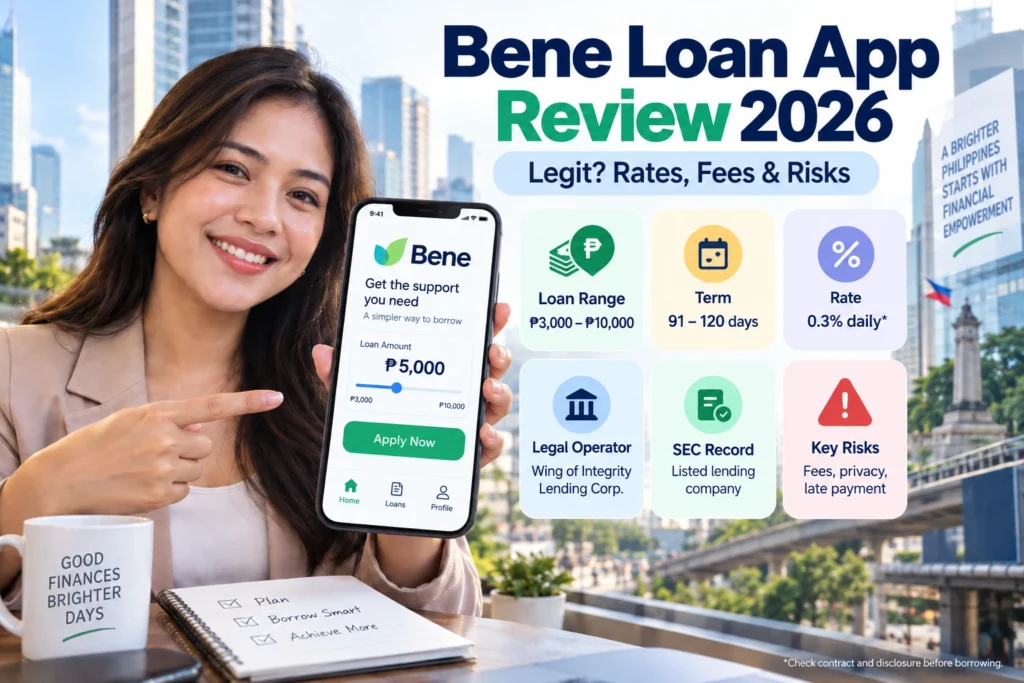
Bene presents itself as a fast microloan app for Filipinos who need a relatively small amount of cash. The current Google Play listing advertises loans from ₱3,000 to ₱10,000, repayment periods of 91 to 120 days, and direct disbursement to channels such as GCash and Maya. The bigger question in 2026, however, is not simply whether Bene can release money quickly. Borrowers need to know who legally provides the loan, whether the published pricing is consistent with current Philippine lending rules, what data the app handles, and what happens when repayment becomes difficult.
One issue deserves attention immediately. Bene’s current Google Play disclosure describes a 0.3% daily interest rate and demonstrates it by multiplying 0.3% by the principal for every day of the loan. Since April 1, 2026, SEC Memorandum Circular No. 14, Series of 2025 has capped the nominal interest rate on covered small loans at 6% per month, approximately 0.2% per day, while the effective interest rate is capped at 12% per month, approximately 0.4% per day. Bene compares its 0.3% figure with the 0.4% EIR ceiling, even though these are different measures. That creates a disclosure question borrowers should resolve before accepting an offer.
Bene is operated by Wing of Integrity Lending Corp., which appears in the SEC’s official August 31, 2024 register of lending companies under registration number CS201916097 and Certificate of Authority 3103. The current app lists the same legal operator. Bene advertises ₱3,000 – ₱10,000 loans for 91 – 120 days, but its published 0.3% daily interest example appears difficult to reconcile with the 2026 SEC nominal-rate ceiling applicable to loans of this size and tenor. This does not by itself prove that an individual Bene contract violates the rules, because the actual disclosure statement and contract must be examined. Borrowers should verify the net proceeds, nominal rate, EIR, all deductions, total repayment and due dates before accepting an offer.
| Borrower question | Current finding | Why it matters |
|---|---|---|
| Who operates Bene? | Wing of Integrity Lending Corp. | The consumer-facing app and legal lending company should not be confused. |
| SEC details | CS201916097; CA No. 3103 appears in the SEC’s August 2024 lending-company register | A Certificate of Authority is more relevant than corporate registration alone. |
| Current advertised amount | ₱3,000 – ₱10,000 | These amounts fall within the ₱10,000 threshold of the current small-loan rate cap. |
| Current advertised tenor | 91 – 120 days | This falls within the four-month regulatory threshold, depending on the exact contract dates. |
| Advertised daily interest | 0.3% per day | Bene’s own example appears to treat this as interest on principal, creating an important comparison issue with the 0.2%-per-day approximate nominal cap. |
| Published maximum APR | 108% including applicable fees | The listing does not provide enough detail to independently reconstruct the EIR for every offer. |
| Approval claim | Usually about 5 minutes | This is Bene’s marketing disclosure, not a guaranteed processing time. |
| Disbursement claim | Within 60 minutes after approval | Actual settlement may depend on the receiving channel and individual application. |
| Data disclosure | Google Play says the app may share personal, financial and other data categories with third parties | Review permissions and the privacy notice before submitting sensitive information. |
| Debt collection | Philippine rules prohibit harassment, public shaming and debt collection through unrelated phone contacts | Several online borrower reports raise collection concerns, but these reports remain anecdotal. |
Is Bene Loan App legitimate and properly authorized in the Philippines?
Bene has an identifiable legal operator. The SEC’s official register dated August 31, 2024 lists Wing of Integrity Lending Corp. under registration number CS201916097 with Certificate of Authority No. 3103. Bene’s current Google Play listing identifies the same company as its developer and operator.
Who legally operates Bene?
The legal entity disclosed by Bene is:
Wing of Integrity Lending Corp.
SEC Registration No.: CS201916097
Certificate of Authority No.: 3103
The company’s current app listing gives an address at the W Fifth Avenue Building in Bonifacio Global City, Taguig, together with the support email [email protected] and telephone number +63 907 391 9159.
The distinction between an SEC registration number and a Certificate of Authority matters. Under the Lending Company Regulation Act, a lending company cannot legally conduct lending business merely because it is incorporated; it must have authority from the SEC to operate as a lending company.
The official SEC register we could verify is dated August 31, 2024. We did not find a searchable 2026 SEC record specifically establishing Bene’s present status as a recorded online lending platform. The SEC has also been updating its online-lending-platform recording procedures in 2026. For that reason, it would be more precise to say that Wing of Integrity Lending Corp. has documented SEC lending authority in the official register we reviewed, rather than using the looser phrase “SEC-approved app.”
Is Bene a bank supervised by the BSP?
No evidence reviewed indicates that Bene is a bank or digital bank. Its disclosed operator is a lending company regulated by the SEC, not a deposit-taking bank.
This matters because phrases such as “BSP registered,” “SEC registered,” “licensed lending company” and “digital bank” describe different regulatory relationships. They should not be treated as interchangeable.
How does Bene Loan App work?
Bene’s current public application flow requires a Filipino applicant aged 18 – 65, a valid government-issued ID and a stable source of income. The app says applicants provide personal, contact, employment and identification information before their application is assessed.
Bene describes the process as:
- Download the app.
- Register an account.
- Submit personal, contact, employment and ID information.
- Wait for assessment.
- If approved, receive funds through GCash, Maya or another supported e-wallet.
Bene says approval “usually” takes around five minutes and funds can be released within 60 minutes after approval. These should be treated as company claims rather than guaranteed service levels. Eligibility checks, identity verification, incomplete information, account mismatches or receiving-channel problems can affect the actual timeline.
An older Bene website indexed on the web previously stated that loan review could generally take one to two days, with some stronger-credit applicants approved in as little as 30 minutes. The difference illustrates why borrowers should rely on the offer and disclosure currently shown inside the application rather than historical marketing pages.
How much can you currently borrow from Bene?
The August 2026 Google Play listing advertises Bene loans of ₱3,000 to ₱10,000 with terms of 91 – 120 days. It does not promise that every applicant will receive ₱10,000.
The amount displayed to an individual borrower can depend on underwriting. Bene does not publicly disclose its complete scoring model, so it would be misleading to claim that a certain salary level, occupation or repayment history guarantees a specific credit limit.
This is also an area where old third-party pages can be unreliable. Some websites still show much larger Bene limits or older tenors. The current official Google Play disclosure is the stronger source for the presently advertised product.
Before accepting any offer, distinguish four different numbers:
Requested amount → approved principal → net amount actually received → total repayment.
They are not necessarily identical.
If, for example, a loan agreement approves ₱10,000 but deducts a fee before disbursement, the borrower might receive less than ₱10,000 while still having repayment calculated using the contractual principal. Bene currently states that it has “no hidden fees,” but its public listing does not provide enough itemized information to independently verify the net proceeds for every possible offer.
What does a Bene loan really cost in 2026?
Bene advertises a 0.3% daily interest rate and a maximum APR of 108%. Its own ₱10,000, 100-day example produces ₱3,000 of interest and ₱13,000 total repayment. The way this figure is presented raises an important regulatory question under the SEC’s 2026 rate ceilings.
What does Bene’s published example show?
The app listing currently gives the following calculation:
- Principal: ₱10,000
- Term: 100 days
- Daily interest: 0.3%
- Daily peso interest: ₱30
- Total interest: ₱3,000
- Total repayment: ₱13,000
The arithmetic is straightforward:
₱10,000 × 0.3% = ₱30 per day
₱30 × 100 days = ₱3,000
₱10,000 + ₱3,000 = ₱13,000
That means the stated borrowing cost is 30% of the principal over 100 days, before considering any additional charges.
Why does the 0.3% daily rate deserve closer scrutiny?
For loans entered into, restructured or renewed from April 1, 2026, SEC Memorandum Circular No. 14, Series of 2025 covers unsecured general-purpose loans of ₱10,000 or less with a tenor of up to four months.
For covered loans, the ceilings are:
- Nominal interest rate: 6% per month, approximately 0.20% per day;
- Effective interest rate: 12% per month, approximately 0.40% per day, including applicable fees and charges but excluding late-payment penalties;
- Late/non-payment penalties: 5% per month on the outstanding scheduled amount due; and
- Total cost cap: 100% of the amount borrowed, including interest, fees, charges and penalties over the life of the debt.
Bene’s published products – ₱3,000 to ₱10,000 for 91 – 120 days – appear designed within those amount and tenor thresholds.
The disclosure concern is that Bene calls 0.3% per day its “Daily Interest Rate” and its example calculates that amount directly on principal. A straight-line 0.3% daily rate corresponds to roughly 9% per 30 days, whereas the current SEC nominal ceiling for a covered loan is 6% per month.
At the same time, Bene states that 0.3% is “well below the SEC ceiling of 0.4% daily EIR.” That comparison mixes the disclosed daily interest figure with the effective-interest-rate ceiling, which includes a broader definition of borrowing cost.
This article cannot establish from the public listing alone whether an individual Bene loan contract violates the circular. That would require the actual disclosure statement, contractual nominal rate, fee breakdown, net proceeds, repayment schedule and regulatory EIR calculation.
But from a borrower’s perspective, the discrepancy is important enough that it should be clarified before pressing Accept.
Ask Bene to show, in writing:
- the contractual nominal interest rate;
- the effective interest rate;
- all processing, service, disbursement or other fees;
- the exact cash you will receive;
- every scheduled payment; and
- total repayment in pesos.
If the numbers in the contract differ from the advertisement, rely on the legally required disclosure and consider asking the lender to explain the difference before continuing.
How fast are Bene approval and disbursement?
Bene advertises approval in about five minutes and disbursement within 60 minutes after approval. These are stated processing targets, not a guarantee that every qualified applicant will have usable money within an hour.
The distinction between approval time and money available in your wallet is important.
A loan can be approved while disbursement remains pending. Problems such as incorrect account information, failed wallet validation, service outages or additional identity review can introduce delays.
For an emergency borrower, this means Bene should not be treated as a guaranteed one-hour source of cash simply because its listing advertises fast processing.
How does repayment work?
The current Google Play description does not provide a sufficiently detailed public repayment-channel or payment-posting policy. Borrowers should therefore verify the exact payment method and when a payment is considered received before the due date.
Older Bene material mentioned over-the-counter and online banking repayment, but that information should not automatically be assumed to describe the current 2026 product.
Before borrowing, check inside the app or contract for:
- official repayment account or payment gateway;
- whether partial payments are accepted;
- payment cut-off time;
- whether weekends or holidays affect posting;
- what proof of payment should be retained;
- whether early repayment changes the interest due; and
- how long account balances take to update.
A borrower who pays on the due date but uses a channel with delayed posting can still face a dispute unless the contract explains how payment timing is determined.
What happens if you pay Bene late?
The public Bene listing we reviewed does not clearly state its specific late-payment charge. For covered loans, however, current SEC rules cap late or non-payment penalties at 5% per month on the outstanding scheduled amount due. The actual contract may charge less.
Late payment can involve more than a penalty. The lender may undertake lawful collection activity, send reminders, pursue a civil claim or take other steps allowed by the loan agreement and applicable law.
What a lender or collector cannot do is use prohibited threats, harassment, unlawful public shaming or improper use of personal information.
For ordinary debt itself, the 1987 Philippine Constitution states that no person shall be imprisoned for debt. This does not mean borrowers can ignore valid obligations, and it does not protect independently criminal conduct such as fraud. Ordinary inability to repay a loan and a separate criminal offense are different legal issues.
How does Bene handle personal information?
Google Play currently states that Bene may share personal information, financial information and other categories of data with third parties. It also states that the app collects financial information, app activity and app-performance information, encrypts data in transit, and allows users to request data deletion.
Bene says it complies with Republic Act No. 10173, the Data Privacy Act, and uses encryption to protect personal data. That is the company’s disclosure; it should not be interpreted as independent proof that every data-processing activity is compliant.
Can a loan app contact everyone in your phone?
Philippine regulators have been unusually clear on this subject.
A March 2026 joint advisory from the DICT, National Privacy Commission and SEC reiterates that online lenders may not engage in unnecessary, excessive or disproportionate processing of borrowers’ personal data. It specifically states that contacting people in a borrower’s contact list for debt collection is prohibited except for persons who were declared as guarantors.
NPC rules also prohibit lenders from requiring unnecessary app permissions and restrict how contact information can be used. Character references and guarantors have specific protections, and consent does not give a lender unlimited authority to harvest or use an applicant’s phonebook.
That makes phone permissions an important checkpoint before using Bene – or any other online lender.
What are borrowers saying about Bene in 2026?
Public feedback is mixed. Google Play contains positive comments about the application’s simple loan process, while other reviews and independent borrower discussions allege aggressive collection communications, threats and public-shaming tactics. These allegations are anecdotal and should not be treated as proven regulatory findings against Bene.
A Google Play review dated April 13, 2026 complained about repeated calls and allegedly threatening messages around the due date. Wing of Integrity Lending Corp. responded publicly in June, apologizing for the distressing communication and asking the reviewer to contact its support address. The same Play page also contains a September 2026 review praising the simple application process and fast experience.
Separate Reddit discussions during May and June 2026 contain multiple allegations involving repeated calls, threatening messages, social-media comments and attempts at public shaming. Other users describe different experiences, and anonymous posts cannot establish whether every allegation is accurate or whether the reported communication came from authorized Bene personnel.
The appropriate conclusion is therefore not that harassment has been legally proven against the company, but that collection conduct is a recurring theme in publicly available borrower feedback and deserves due diligence.
If you receive a message you believe violates Philippine collection or privacy rules, preserve screenshots, call logs, emails and account records rather than deleting them immediately.
What are Bene’s main advantages and disadvantages?
The main potential advantages are identifiable from the current product disclosures. Bene names its legal operator, publishes SEC registration and Certificate of Authority details, gives a peso repayment example, states an advertised loan range and tenor, and offers digital disbursement through commonly used Philippine e-wallet channels.
The material concerns are more specific. The 0.3%-per-day pricing example requires clarification against the current 6%-per-month nominal-rate ceiling for covered loans. Public documentation available without entering the app also does not provide enough detail on actual net proceeds, payment posting, late fees and the complete contractual EIR. Finally, multiple borrower reports raise concerns about collection communications, although these reports remain allegations rather than adjudicated findings.
Who may find Bene relevant, and who should be especially cautious?
Bene’s small-loan format may be relevant to a borrower who needs a limited amount, has a clearly identified source of repayment and can verify the entire peso cost before accepting the contract.
Extra caution is warranted if the repayment will require another online loan, the due dates fall before predictable income, or the borrower cannot identify the difference between the approved principal and the money actually received.
A ₱10,000 approval is not automatically affordable because the peso amount looks small. Bene’s own published 100-day example requires ₱13,000 in total repayment, which is ₱3,000 above principal.
Repeatedly refinancing one short-term loan with another can turn a temporary liquidity problem into a larger debt cycle.
What should you verify before accepting a Bene loan?
Do not base the decision on the approved amount or five-minute approval claim alone. Check the disclosure statement and compare what enters your wallet with what leaves your wallet over the full term.
For a Bene offer issued in 2026, verify these figures on the final contract:
- Legal lender: Does the agreement actually name Wing of Integrity Lending Corp.?
- Principal: What amount does the contract say you borrowed?
- Net proceeds: Exactly how much will arrive in your GCash, Maya or other account?
- Nominal interest rate: Is it clearly stated and consistent with the rules applicable to the loan?
- EIR: What effective interest rate is disclosed after applicable fees?
- Fees: Are there processing, verification, service, transfer, insurance or other deductions?
- Total repayment: What is the final peso amount if paid on time?
- Payment schedule: What are the exact dates and amounts?
- Late charges: What penalty does the contract impose, and on what base amount?
- Privacy permissions: Does the app request access that appears unnecessary for the stated purpose?
For Bene’s advertised ₱3,000 – ₱10,000, 91 – 120-day product, the nominal-rate disclosure is particularly important because the current public example and the 2026 regulatory ceiling appear to use figures that should be reconciled before borrowing.
FAQ
Can I cancel a Bene loan after approval?
The public materials reviewed do not provide enough detail to confirm a universal cancellation procedure. Check the final agreement and any applicable cooling-off provisions before accepting or disbursement occurs. Do not assume that uninstalling the app cancels a loan.
Can Bene contact my friends if I am late?
Philippine privacy rules prohibit lenders from contacting people in a borrower’s contact list for debt collection merely because their numbers are stored on the phone. The March 2026 DICT-NPC-SEC advisory states that, for debt collection, persons other than declared guarantors must not be contacted.
Can Bene have me arrested because I cannot repay?
Ordinary debt is not itself a basis for imprisonment. Article III, Section 20 of the 1987 Constitution states that no person shall be imprisoned for debt. This does not prevent lawful civil collection and does not cover an independently established criminal offense such as fraud.
Can I ask Bene to delete my personal data?
Google Play states that users can request deletion of Bene data. A deletion request does not necessarily require immediate erasure of every record where information must legally be retained for an outstanding obligation, dispute, regulatory requirement or another lawful purpose.
What should I do if I receive threatening collection messages?
Keep screenshots, phone numbers, dates, emails, call records and proof of your loan and payments. Philippine regulators expressly prohibit harassment, intimidation, public shaming and unauthorized use of personal data in online-loan collection. Complaints involving lending-company conduct can be directed to the SEC, while personal-data misuse may also fall within the NPC’s jurisdiction.
Borrower decision framework
The most useful way to evaluate Bene is not to ask only whether the app can release cash quickly.
Start with the legal lender. Confirm that the company named on your actual contract is the same entity whose authority you verified.
Then ignore the headline loan limit for a moment and focus on net proceeds. If the contract says ₱10,000 but you receive less, calculate your borrowing cost using the amount you actually obtain as well as the contractual principal.
Next, check the interest disclosure carefully. Bene’s current 0.3%-daily example deserves clarification because current SEC rules distinguish a 6%-per-month nominal ceiling from a 12%-per-month effective ceiling for covered small loans. Do not accept a verbal explanation where the written disclosure remains unclear.
Finally, look beyond the on-time scenario. Ask whether your income can cover every scheduled payment without another loan, what happens if salary arrives late, what data permissions you are granting, and what complaint channels are available if collection conduct crosses the line.
The safest number to understand before borrowing is not the amount Bene says you can get. It is the exact amount you will receive, the exact amount you must repay, and the exact date that repayment must come from money you already expect to have.
References
- Securities and Exchange Commission – Registered Lending Companies
Organization: Securities and Exchange Commission Philippines
Resource: List of Registered Lending Companies as of 31 August 2024
URL: https://www.sec.gov.ph/wp-content/uploads/2024/09/2024List_Registered-Lending-Companies-31-August-2024.pdf - Google Play – Bene
Organization: Google / Wing of Integrity Lending Corp.
Resource: Bene – Official Google Play Listing
URL: https://play.google.com/store/apps/details?id=com.wings.bene.ph - Bene Official Website
Organization: Wing of Integrity Lending Corp.
Resource: Bene – Official Product Website
URL: https://www.benephapp.com/ - SEC Memorandum Circular No. 14, Series of 2025
Organization: Securities and Exchange Commission Philippines
Resource: Recalibrated Ceilings on Interest Rates and Other Fees Charged by Financing Companies and Lending Companies – reproduced regulatory text
URL: https://regalert.today/document/sec-memorandum-circular-no-14-series-of-2025-recalibrated-ceilings-on-interest-r-2355d3fb-9836-4eb6-9b88-d45d4ca4891b - SEC Interest-Rate Update
Organization: GMA Integrated News
Resource: SEC lowers interest rate caps for loans up to P10,000
URL: https://www.gmanetwork.com/news/money/economy/969232/sec-lowers-interest-rate-caps-for-loans-up-to-p10-000/story/ - Joint Advisory on Online Lending Platforms
Organization: Department of Information and Communications Technology, National Privacy Commission and Securities and Exchange Commission
Resource: Advisory on Online Lending Platforms to the Public
URL: https://privacy.gov.ph/wp-content/uploads/2026/03/DICT-NPC-SEC-Public-Advisory-on-Online-Lending-Platforms.pdf - NPC Loan-Related Data Processing Guidance
Organization: National Privacy Commission
Resource: NPC amends Circular on the processing of personal data for loan-related transactions
URL: https://privacy.gov.ph/npc-amends-circular-on-the-processing-of-personal-data-for-loan-related-transactions/ - Philippine Constitution
Organization: The LawPhil Project
Resource: 1987 Constitution of the Republic of the Philippines
URL: https://lawphil.net/consti/cons1987.html - Borrower Discussion – Bene
Organization: Reddit / r/ola_harassment
Resource: Bene victim meron po ba? – borrower discussion, May 2026
URL: https://www.reddit.com/r/ola_harassment/comments/1t76cko/bene_victim_meron_po_ba/
Disclaimer:This article contains affiliate links. We may earn a small commission if you apply for a loan through our links, at no extra cost to you. The information provided is for educational purposes only and does not constitute professional financial advice. Please borrow responsibly.
Last Updated on September 19, 2026 by Elena Reyes
