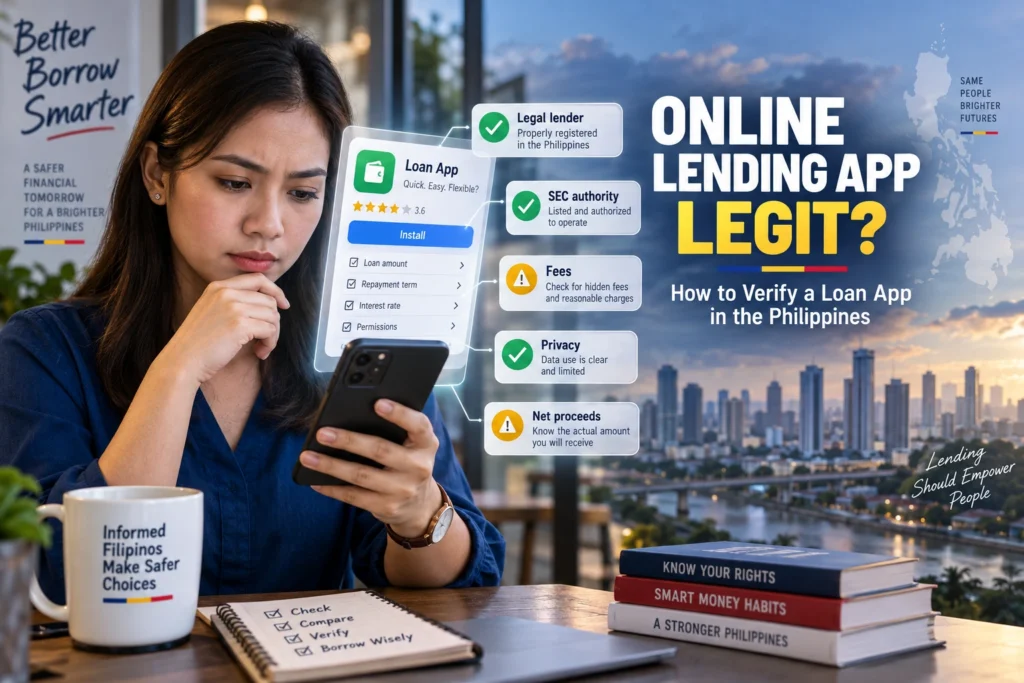
A polished loan app, thousands of downloads, an “SEC registered” badge, or a fast approval message does not by itself prove that an online lender is authorized to offer loans in the Philippines. The more useful question is: Who is legally lending the money, does that company have the required authority, and is the digital platform properly connected to that company?
That distinction matters more in 2026. The Securities and Exchange Commission (SEC) lifted the nearly five-year moratorium on new online lending platforms effective August 1, 2026 under Memorandum Circular No. 20, Series of 2026. The reopening does not mean every newly launched lending app is automatically authorized. Financing and lending companies remain subject to licensing, disclosure, operational, capitalization, consumer-protection, and platform-recording requirements. (GMA Network)
Because the supplied topic does not identify one specific lending brand, this review evaluates how to determine whether an online lending app is legit in the Philippines, rather than declaring an unnamed app legitimate.
A Philippine online lending app should not be treated as legitimate merely because its operator has an SEC registration number. For a non-bank lender, verify the legal company, confirm that it has authority from the SEC to conduct lending or financing activities, and match the app or website to the company’s recorded online lending platform information. Then inspect the disclosure statement, total peso repayment, upfront deductions, privacy permissions, and collection rules. Small, short-term unsecured loans meeting specific conditions remain subject to special interest, fee, and late-payment ceilings. Before accepting any offer, calculate how much cash you actually receive – not merely the headline loan amount.
| Borrower question | Current finding | Why it matters |
|---|---|---|
| Is an SEC registration number enough? | No. A lending company must also have SEC authority to operate. | Corporate existence and lending authority are different things. (SEC Appointment) |
| Does an app-store listing prove legitimacy? | No. Regulators advise borrowers to use verified sources and check whether the operator is duly registered and licensed. | Fake or unauthorized apps can imitate legitimate brands. |
| Are new lending apps allowed in 2026? | The SEC moratorium was lifted effective August 1, 2026, subject to the new regulatory framework. | A new app still needs to satisfy applicable SEC requirements. (GMA Network) |
| Is there one interest-rate ceiling for every Philippine loan? | No. The BSP’s specific digital-lending ceilings apply only to defined small, short-term unsecured loans. | Do not apply the 6%/15% figures to every consumer loan. |
| Can a lender freely use your phone contacts? | No. Unnecessary, excessive, or disproportionate processing is prohibited. | Contact-list access is a major privacy checkpoint. |
| Can collectors contact everyone in your phonebook? | For debt collection, the 2026 joint advisory says they may not contact people in the borrower’s contact list other than declared guarantors. | Character references are not automatically guarantors. |
| Can ordinary unpaid debt send you to jail? | The Constitution states that no person shall be imprisoned for debt. | This does not erase the debt or prevent lawful civil remedies, collection, or consequences arising from independently criminal conduct. (Lawphil) |
Is an online lending app legit if it says “SEC registered”?
Not necessarily. An SEC company registration can establish that a corporation exists, but a lending company must also obtain authority from the SEC to conduct lending activities. The borrower should then verify that the digital platform is genuinely connected to that authorized entity. (SEC Appointment)
This is one of the most important distinctions in Philippine digital lending.
The SEC describes a lending company as a stock corporation engaged in granting loans under the Lending Company Regulation Act. It expressly states that no lending company may conduct business unless granted authority to operate by the SEC. (SEC Appointment)
That means a borrower should distinguish at least three different records:
| Record | What it tells you | What it does not prove by itself |
|---|---|---|
| SEC corporate registration | The corporation legally exists | That it may legally engage in lending |
| Certificate of Authority | The company has SEC authority to conduct the applicable lending/financing business | That every app using its name is genuine |
| OLP disclosure/recording | Connects a digital lending platform with the regulated company’s operations | That a particular loan offer is inexpensive, appropriate, or risk-free |
The SEC’s current lending and financing pages continue to maintain resources for recorded online lending platforms, revoked or suspended companies, advisories, and complaints. In July 2026, the SEC also issued a new 2026 OLP Disclosure Guide for disclosure and recording of online lending platforms through its iMessage system. (Securities and Exchange Commission)
A strong legitimacy check therefore follows the company behind the app, not merely the logo on your phone.
What changed for online lending apps in 2026?
The SEC reopened the market to new online lending platforms from August 1, 2026 under Memorandum Circular No. 20, Series of 2026. The change ended the 2021 moratorium, but it did not create automatic authorization for any app that appears after that date. (GMA Network)
This is an important 2026 update because an old article saying “no new online lending platforms can be registered” may now be outdated.
Reporting on MC No. 20 indicates that the SEC shifted toward a framework covering prudential standards, disclosure, operations, consumer protection, and market conduct. New platforms may enter the market, but they remain connected to regulated financing or lending companies and are subject to SEC requirements. (Mondaq)
The SEC’s own advisories page also shows continuing 2026 implementation activity, including the July 31 OLP Disclosure Guide and the August 26 Business Plan Guide. (Securities and Exchange Commission)
For borrowers, the practical implication is simple: do not use an old screenshot of an SEC list as permanent proof. Regulatory status can change.
How should you verify a loan app before uploading your ID?
Start with the legal entity, then match the platform to that company. Do this before submitting a government ID, selfie, employment information, bank account, e-wallet details, or contact references.
A useful verification sequence is: identify the exact corporate lender shown in the loan agreement or privacy notice; verify its SEC status and authority; check the SEC’s online lending platform records; inspect current SEC advisories and revocation or suspension information; then compare the official website, app-store developer, domain, support details, and payment instructions.
These details should make sense together. A company called “ABC Lending Corporation,” for example, should not suddenly instruct you to send a “verification fee” to an unrelated personal e-wallet account.
The SEC’s borrower advisory specifically tells consumers to verify registered lending companies, financing companies, and online lending platforms through SEC resources before transacting. It also warns about advance-fee scams. (Securities and Exchange Commission)
A particularly serious warning sign is an app using the name, address, or credentials of a real company without actually belonging to it. SEC enforcement material has documented instances in which an unauthorized online lending operation appeared to use information belonging to an unrelated registered corporation. (Securities and Exchange Commission)
So a copied Certificate of Authority screenshot is not enough. Match the company, app name, developer, domain, agreement, and payment recipient.
What does a legitimate online loan really cost?
The number labelled “interest rate” is only one part of borrowing cost. The useful calculation starts with cash actually received and ends with total pesos you must repay, including applicable service, processing, verification, or other charges.
For certain loans, Philippine rules impose specific ceilings. BSP Circular No. 1133 covers unsecured, general-purpose loans offered by lending companies, financing companies, and their OLPs where the amount does not exceed ₱10,000 and the tenor is no more than four months.
For those covered loans, Circular No. 1133 provides:
| Cost component | Ceiling for covered loans |
|---|---|
| Nominal interest | 6% per month, approximately 0.2% per day |
| Effective interest including specified fees and charges | 15% per month, approximately 0.5% per day |
| Late/non-payment penalty | 5% per month on the outstanding scheduled amount due |
| Total cost | Maximum 100% of the total amount borrowed, including interest, applicable fees and penalties |
These ceilings are not a universal Philippine interest-rate limit. They apply to the specific loan category defined in the circular.
The SEC’s more general FAQ still explains that interest must be expressly stipulated and put in writing, while the statutory framework permits regulators to prescribe ceilings for particular products or circumstances. (SEC Appointment)
Why net proceeds matter more than the advertised principal
Consider a hypothetical one-month offer – not an actual lender quotation:
Approved principal: ₱8,000
Upfront processing charge deducted: ₱500
Cash received: ₱7,500
Interest charged: ₱480
Amount due: ₱8,480
The borrower did not really obtain ₱8,000 of usable cash. The usable amount was ₱7,500.
Total peso borrowing cost is therefore:
₱8,480 − ₱7,500 = ₱980
Relative to the cash actually received:
₱980 ÷ ₱7,500 ≈ 13.1%
This simplified example shows why comparing only the nominal interest rate can understate the economic burden of an online loan. It should not be treated as a formal regulatory effective-interest-rate calculation for any real product.
Before tapping “Accept,” record four figures: approved amount, deductions, net proceeds, and total repayment.
How fast should a legitimate lending app approve and release money?
There is no single legitimate approval or disbursement time for Philippine lending apps. Without a specific lender and current published terms, claims such as “approved in five minutes” or “cash instantly” should be treated as marketing claims rather than guaranteed outcomes.
Real processing can depend on identity verification, the lender’s underwriting process, completeness of documents, bank or e-wallet settlement, and whether the transaction requires additional review.
A legitimate operator should be able to tell you what it needs before approval and identify the legal lender before money is released.
Fast release is therefore not a legitimacy test. An unauthorized lender can also release money quickly.
The stronger test is whether the borrower receives transparent contractual terms and actively agrees to them.
The 2026 SEC framework, as reported when MC No. 20 was issued, places increased emphasis on clear disclosure before approval or disbursement and on affirmative borrower consent rather than automatic loan release or renewal. (GMA Network)
What phone permissions should make you cautious?
An online lender does not have unlimited permission to inspect your phone. Philippine privacy rules prohibit unnecessary processing and excessive permissions, and contact-list processing must remain limited to legitimate, proportionate purposes.
The March 18, 2026 joint advisory of the DICT, NPC, and SEC is especially relevant. Regulators said they had received numerous reports involving harassment, intimidation, public shaming, and unlawful use of personal data by online lending platforms.
The advisory states that app permissions should be necessary for a specified purpose. Camera or photo-gallery access, for example, may be legitimate for KYC or identity verification, but the permission should not remain unnecessarily available after that purpose has been completed.
Contact-list access is even more sensitive. The 2026 advisory says OLPs may access the contact list only in limited circumstances such as allowing borrowers to select character references or guarantors, or to derive proportional metadata where necessary for a specified legitimate purpose. Unbridled processing of contact lists is prohibited.
The NPC’s amended loan-transaction rules also distinguish a character reference from a guarantor. A character reference does not automatically become responsible for the debt. A guarantor must expressly consent to that obligation. (National Privacy Commission)
Can a lending app contact your family, friends, or co-workers if you pay late?
The 2026 DICT-NPC-SEC advisory states that for debt collection, lending and financing companies may not contact people in the borrower’s contact list other than persons who were declared as guarantors. Harassment, intimidation, public shaming, and disproportionate use of personal data are not legitimate collection methods.
This does not mean a valid debt disappears.
A lender can pursue lawful collection remedies, and unpaid obligations can have financial and potentially credit-related consequences. What it cannot do is convert collection into unrestricted public humiliation or abuse of your personal data.
SEC Memorandum Circular No. 18, Series of 2019 addresses unfair debt-collection practices by lending and financing companies, and the 2026 joint advisory expressly reiterates those protections. (SEC Appointment)
If you receive threatening messages, keep the loan agreement, disclosure statement, screenshots, call logs, payment receipts, collector names, phone numbers, and dates. The March 2026 advisory directs complaints concerning unfair collection practices to the SEC’s Financing and Lending Companies Department through SEC iMessage and identifies separate cybercrime channels for harassment, threats, fraud, and scams.
Can an unpaid online loan affect your credit record?
Potentially, yes. Philippine credit reporting is not limited to banks. The Credit Information Corporation receives and consolidates credit information from covered submitting entities, including financing companies and other credit providers. Whether a specific online lender currently reports your account should be checked with that lender and against current CIC information. (Credit Information Corporation)
The CIC describes itself as the country’s central repository for standardized information on borrowers’ credit history and financial condition. Its records of submitting entities have included lending companies. (Credit Information Corporation)
Do not therefore assume that an online loan is “off the books” simply because it was obtained through a mobile app.
At the same time, it would be inaccurate to claim that every loan app automatically reports every delinquency to the CIC. Reporting status has to be verified for the exact lender.
Can you be jailed for not paying an online loan?
The 1987 Philippine Constitution states that no person shall be imprisoned for debt or non-payment of a poll tax. Ordinary inability to repay a civil debt is therefore not, by itself, a basis for imprisonment. (Lawphil)
That protection should not be misunderstood as permission to ignore a valid loan.
The lender may still pursue lawful civil remedies, assess valid charges subject to applicable rules, undertake lawful collection, and potentially submit credit information where legally applicable.
It also does not shield independently criminal conduct. A dispute involving alleged fraud or another criminal act is legally different from simple non-payment caused by inability to pay.
Collectors who send messages implying automatic imprisonment merely because a loan is overdue should therefore be treated cautiously. Ask what specific legal proceeding they are referring to and preserve the communication.
What borrower complaints matter most in 2026?
Because there is no specific app being reviewed here, individual app-store complaints cannot responsibly be attributed to the entire industry. At sector level, however, Philippine regulators said in March 2026 that they had received numerous reports concerning harassment, intimidation, public shaming, and unlawful personal-data use.
SEC enforcement history also shows why current verification matters. Its lending and financing press-release archive includes actions involving unauthorized online lending operations and revocations or cancellations of company registrations and secondary licenses. (Securities and Exchange Commission)
A borrower researching a particular app should therefore separate three types of complaints.
A technical complaint such as OTP failure is different from a pricing complaint alleging undisclosed charges. Both are different again from an allegation of threats, contact-list abuse, or public shaming.
Recent app-store reviews can help reveal patterns, but anonymous reports are anecdotal evidence. They should prompt closer investigation rather than automatically prove misconduct.
What are the advantages and risks of legitimate online lending apps?
Digital lending can provide access to small, short-term credit without a traditional branch visit, but regulatory authorization does not automatically make a loan cheap, affordable, or suitable. The key risk is accepting a high-cost short-term obligation because the app makes borrowing feel easier than repayment.
| Potential advantage | Corresponding borrower risk |
|---|---|
| Remote application process | Easy access may encourage repeated short-term borrowing |
| Smaller loan sizes may be available | Small principal does not necessarily mean small effective cost |
| Electronic documents create a record | Borrowers may still accept without reading disclosures |
| Regulated lenders must follow consumer-protection requirements | Licensed lenders can still offer expensive credit |
| Digital repayment can be convenient | Payment-posting or account errors can create disputes |
| 2026 rules strengthen OLP disclosure and market-conduct requirements | Borrowers still need to verify that the specific app belongs to the claimed operator |
The most important distinction is between legitimacy and suitability.
An authorized lender can offer a perfectly legal loan that still makes little economic sense for a borrower whose next salary is already committed elsewhere.
Who should be especially cautious before using an online loan app?
Extra caution is warranted when repayment depends on taking another loan, when income is uncertain before the due date, when significant fees are deducted before disbursement, or when the app will not clearly identify the legal lender and full repayment amount.
A short-term loan becomes especially dangerous when the borrower looks only at the amount arriving today and not at the amount leaving the next payday.
Before accepting, make a simple cash-flow test. Write down your expected income before the due date, unavoidable household expenses, the loan repayment, and the amount remaining afterward.
If the calculation requires another loan just to make the first repayment, the problem is not whether the app is “legit.” The problem is that the repayment structure may be financially unsustainable.
What should you check immediately before pressing “Accept”?
Do not accept until you can answer four questions without guessing: Who is the legal lender? How much cash will reach you? Exactly how much must you repay and when? What happens to your data and your account if you are late?
The strongest pre-acceptance check combines regulatory verification with peso arithmetic.
Confirm the corporation and its authority, verify the online platform, save the disclosure statement and agreement, compare the approved principal with actual net proceeds, identify every charge, inspect the payment schedule, check the late-payment clause, read the privacy notice, and make sure the repayment can come from income rather than another loan.
If even one major number is hidden until after disbursement, stop before accepting.
A loan app can be properly authorized and still be too expensive for your situation. Conversely, an attractive rate does not rescue an app whose legal operator cannot be identified.
The safest borrower decision is therefore based on identity, authority, disclosure, total cost, privacy, and repayment capacity together – not on a single “SEC registered” badge.
FAQ
Is an online lending app legitimate just because it is on Google Play or the Apple App Store?
No. App-store availability is not a substitute for regulatory verification. The March 2026 government advisory tells borrowers to download OLPs from official or verified sources and ensure they are operated by duly registered and licensed entities.
What if a loan app asks for money before releasing the loan?
Treat that as a major warning sign. The SEC’s borrower advisory specifically warns consumers about advance-fee scams and advises borrowers to verify the lender through SEC resources before paying or proceeding. (Securities and Exchange Commission)
Can I cancel an online loan after accepting it?
Cooling-off rights depend on the applicable regulatory framework and the lender’s policy. The Financial Products and Services Consumer Protection Act provides for cooling-off policies where required by the relevant regulator and says consumers may cancel during an applicable cooling-off period without penalty, subject to permitted processing-cost recovery. Do not assume every short-term product has the same cancellation window; check the current agreement and lender policy. (Securities and Exchange Commission)
Should I trust an app showing a photo of an SEC certificate?
Not by itself. Certificates and registration details can be copied or used by impersonators. Verify the information through current SEC records and make sure the app, company, developer, website, loan agreement, and payment details all correspond.
Where can I complain about an abusive online lender?
For unfair collection practices involving lending and financing companies, the March 2026 joint advisory directs consumers to the SEC Financing and Lending Companies Department through SEC iMessage. It separately lists DICT, NBI Cybercrime Division, and PNP Anti-Cybercrime Group contacts for certain threats, fraud, scams, and cyber-related harassment.
References
- Securities and Exchange Commission – Lending Companies and Financing Companies
Organization: Securities and Exchange Commission Philippines
Resource: About Lending Companies and Financing Companies
URL: SEC – About Lending Companies and Financing Companies - Securities and Exchange Commission – 2026 Lending and Financing Advisories
Organization: Securities and Exchange Commission Philippines
Resource: Advisories and Notices
URL: SEC – Advisories and Notices - Bangko Sentral ng Pilipinas Circular No. 1133
Organization: Bangko Sentral ng Pilipinas
Resource: Ceiling/s on Interest Rates and Other Fees Charged by Lending Companies, Financing Companies, and their Online Lending Platforms
URL: BSP Circular No. 1133 - Public Advisory on Online Lending Platforms
Organization: Department of Information and Communications Technology, National Privacy Commission, and Securities and Exchange Commission
Resource: Advisory on Online Lending Platforms, March 18, 2026
URL: 2026 Joint Advisory on Online Lending Platforms - NPC Circular Amendment on Loan-Related Data Processing
Organization: National Privacy Commission
Resource: NPC amends Circular on the processing of personal data for loan-related transactions
URL: NPC – Loan-Related Data Processing Rules - Financial Products and Services Consumer Protection Act
Organization: Securities and Exchange Commission Philippines
Resource: Republic Act No. 11765 / Financial Products and Services Consumer Protection Act
URL: SEC – Financial Products and Services Consumer Protection Act - Credit Information Corporation
Organization: Credit Information Corporation
Resource: Get Your Credit Report / CIC Mandate
URL: Credit Information Corporation – Credit Report Information - 1987 Philippine Constitution
Organization: The LawPhil Project
Resource: Article III, Section 20 – No imprisonment for debt
URL: LawPhil – 1987 Philippine Constitution - SEC Memorandum Circular No. 20, Series of 2026 Coverage
Organization: GMA News Online
Resource: SEC lifts moratorium on new online lending platforms
URL: GMA News – SEC Lifts OLP Moratorium - SEC Memorandum Circular No. 20, Series of 2026 Legal Analysis
Organization: SyCip Salazar Hernandez & Gatmaitan
Resource: SEC Lifts Five-Year Moratorium on Online Lending Platforms and Issues New Regulatory Framework
URL: SyCipLaw – SEC 2026 Online Lending Framework
Disclaimer:This article contains affiliate links. We may earn a small commission if you apply for a loan through our links, at no extra cost to you. The information provided is for educational purposes only and does not constitute professional financial advice. Please borrow responsibly.
Last Updated on September 18, 2026 by Elena Reyes
