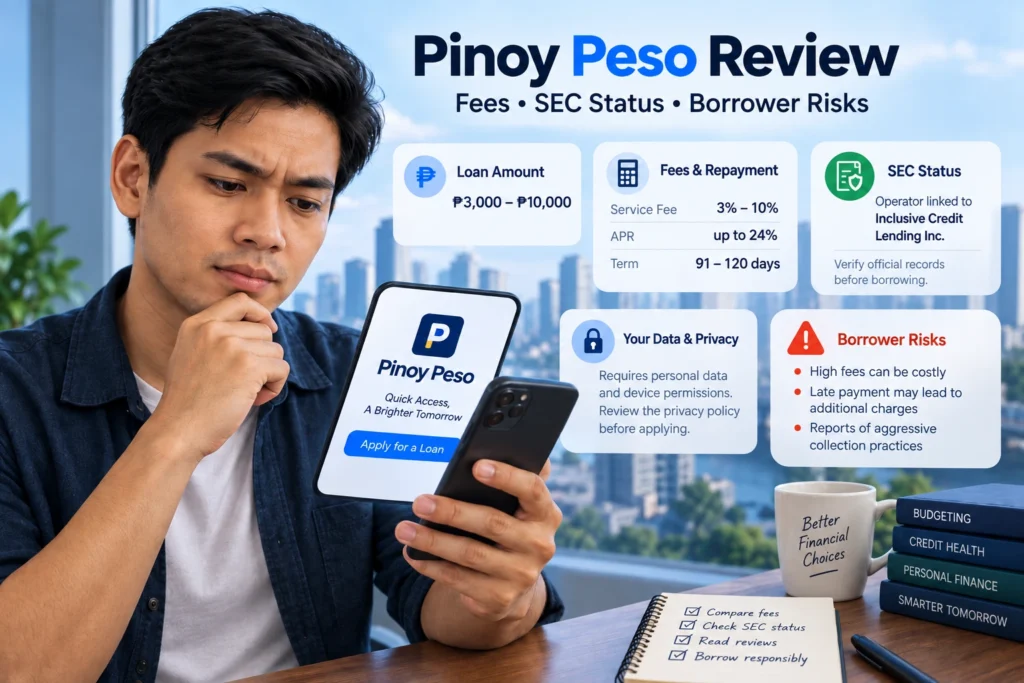
Pinoy Peso presents a difficult question for Filipino borrowers in 2026. The app is connected to an identifiable Philippine lending company with an SEC Certificate of Authority, and its current Google Play listing publishes loan amounts, terms, interest, and service fees. Yet the operator was also penalized in a July 2026 SEC enforcement case involving excessive loan charges and unfair debt-collection practices.
That distinction matters. Being operated by a registered lending company does not mean every loan offer, fee structure, or collection practice should automatically be accepted without scrutiny.
This Pinoy Peso review examines its legal operator, current advertised terms, real peso borrowing cost, the recent regulatory action, privacy practices, borrower reports, and the checks a borrower should complete before accepting an offer.
Pinoy Peso is currently published on Google Play by Inclusive Credit Lending Inc., which identifies SEC Registration No. CS201909928 and Certificate of Authority No. 3007. The app currently advertises ₱3,000 – ₱10,000 loans, 91 – 120-day terms, a maximum 24% APR, and a 3% – 10% service fee. However, reports citing a July 21, 2026 SEC order say Inclusive Credit was fined ₱1.03 million after regulators found excessive charges and unfair collection practices involving Pinoy Peso. For any new loan, compare the amount actually credited to you with the exact contractual repayment – not merely the headline loan amount.
| Borrower question | Current finding | Why it matters |
|---|---|---|
| Who operates Pinoy Peso? | Inclusive Credit Lending Inc. | The lender behind the brand is identifiable. |
| SEC registration | CS201909928 | Confirms the registered corporation. |
| Certificate of Authority | No. 3007 | SEC records identify the company as a lending company with lending authority. |
| Pinoy Peso recorded as its OLP | Yes, in the SEC’s published OLP records | Connects the consumer-facing app to Inclusive Credit. |
| Advertised amount | ₱3,000 – ₱10,000 | The maximum is not a guaranteed approval amount. |
| Advertised term | 91 – 120 days, including renewal time | Compare this with the exact term shown before accepting your individual loan. |
| Maximum advertised APR | 24% | Interest alone does not show the full borrowing cost. |
| Service fee | 3% – 10% | This must be included when assessing the peso cost. |
| Recent regulatory issue | ₱1.03 million fine reported from a July 21, 2026 SEC order | Registration does not erase conduct or pricing violations. |
| Current privacy scope | Identity, biometric, device, financial and – with consent – certain SMS/app-install/location data | Borrowers should inspect permissions before proceeding. |
| Collection/privacy rule | Contact-list harvesting and contacting people other than properly declared guarantors for collection are restricted | Borrowers retain privacy protections even when a debt is unpaid. |
Is Pinoy Peso legitimate and properly authorized in the Philippines?
Pinoy Peso is linked to an identifiable SEC-authorized lending company. SEC records list Inclusive Credit Lending Inc. under Registration No. CS201909928 and Certificate of Authority No. 3007, while published SEC online-lending records identify Pinoy Peso as the company’s platform. That establishes regulatory identity, but not a clean conduct record.
Who legally operates Pinoy Peso?
The current Google Play listing names Inclusive Credit Lending Inc. as the developer and provides:
- SEC Registration No. CS201909928
- Certificate of Authority No. 3007
- Unit 2704, 27th Floor, Tycoon Centre Office Condominium, Pearl Drive, San Antonio, Pasig
- Support number: 0906 667 6870
The company’s own privacy policy also states that Pinoy Peso is operated by Inclusive Credit Lending Inc. under the same registration and Certificate of Authority numbers.
This is more meaningful than merely seeing an SEC registration number in an advertisement. Under Philippine rules, a lending company needs authority from the SEC to engage in lending business.
Is Pinoy Peso itself the lender?
The evidence reviewed points to Inclusive Credit Lending Inc. as the lending-company operator behind Pinoy Peso, rather than Pinoy Peso being an unrelated marketplace that simply refers borrowers to another lender.
An SEC-published list of online lending platforms explicitly paired Inclusive Credit Lending Inc., CA No. 3007, with “Pinoy Peso.”
That distinction is useful if you need to examine a contract, dispute a charge, or file a complaint: look for Inclusive Credit Lending Inc. on the disclosure statement and loan agreement rather than relying only on the app’s brand name.
Why does the July 2026 SEC case matter?
Reports quoting a July 21, 2026 SEC Financing and Lending Companies Department order state that Inclusive Credit Lending Inc. was fined ₱1.03 million for excessive charges and unfair collection practices involving Pinoy Peso. The findings are materially more important than app-store ratings when evaluating lending risk.
The case reportedly arose from a borrower complaint alleging that 38% of the principal was deducted before disbursement.
The SEC investigation found that the charge structure in the transaction examined produced a 61.29% effective interest rate over seven days, equivalent to 262.67% per month, according to the regulator’s calculation. Reports of the order also say collection communications were sufficiently attributable to the collection of Pinoy Peso obligations, including public shaming and publication of the borrower’s identity and photograph.
This does not establish that every Pinoy Peso borrower in 2026 receives those same terms. It does establish that the regulator found serious violations in a documented case involving the platform.
That is why the correct borrower question is not simply:
“Is Pinoy Peso SEC registered?”
It is also:
“What exactly does my disclosure statement say, how much money will actually reach me, and how much will I be required to repay?”
What are Pinoy Peso’s advertised loan terms in 2026?
The current Google Play listing advertises loans from ₱3,000 to ₱10,000, terms of 91 to 120 days including renewal time, maximum APR of 24%, and service fees between 3% and 10%. Eligibility listed on the page includes being over 18, having at least one main ID, and having stable income.
These are published product parameters, not guaranteed individual offers.
The listing was updated on August 6, 2026 and currently shows more than one million downloads.
There is also an important disclosure inconsistency worth noticing. Inclusive Credit’s corporate website says repayment periods “typically” range from 90 to 180 days, while the newer app-specific Google Play disclosure states 91 to 120 days. For someone evaluating the current Android product, the specific loan agreement and final disclosure should take priority over either marketing page.
What does a Pinoy Peso loan really cost?
Do not evaluate Pinoy Peso by the 24% advertised APR alone. The current listing separately permits a service fee of 3% – 10%, so the total peso cost can be higher than the interest figure suggests. The decisive numbers are net proceeds, all fees, payment dates, and total repayment.
What does Pinoy Peso’s own example show?
Google Play currently gives the following example:
| Item | Pinoy Peso example |
|---|---|
| Principal | ₱6,000 |
| Term | 100 days |
| Advertised interest calculation | ₱400 |
| Example service fee | ₱300 |
| Total repayment | ₱6,700 |
| Total peso cost | ₱700 |
The ₱700 cost is 11.67% of the ₱6,000 principal over 100 days.
The listing calculates the ₱400 interest using 24% annually:
₱6,000 × 24% ÷ 360 × 100 = ₱400
It then adds a 5% service fee:
₱6,000 × 5% = ₱300
So:
₱6,000 + ₱400 + ₱300 = ₱6,700
The practical lesson is that APR and total borrowing cost are not interchangeable when a separate service charge applies.
Net proceeds can change the economics dramatically
Suppose an app displays a ₱10,000 principal.
If the borrower actually receives ₱10,000 and later repays ₱11,000, the cost is ₱1,000 against ₱10,000 of usable cash.
But if several thousand pesos are deducted before release and the borrower receives only ₱6,500 while contractual repayment is still based on ₱10,000, the effective cost is radically higher.
That is the issue highlighted by the SEC enforcement case. Reports of the July order state that a 38% upfront deduction meant a hypothetical ₱10,000 principal would leave only ₱6,200 in usable proceeds before considering the repayment obligation.
Before pressing a final confirmation button, record these figures from the actual offer:
Approved principal → deductions → cash actually received → total repayment → exact due date
If any one of those numbers is missing, the cost is not yet transparent enough to evaluate properly.
What interest-rate rules apply to a new Pinoy Peso loan in 2026?
For covered unsecured, general-purpose loans of ₱10,000 or less with terms up to four months, SEC Memorandum Circular No. 14, Series of 2025 applies to loans entered into, restructured, or renewed beginning April 1, 2026. It sets a 6% monthly nominal-rate ceiling and a 12% monthly EIR ceiling.
The current framework for a qualifying loan also provides for:
- nominal interest of no more than 6% per month;
- effective interest rate of no more than 12% per month, including applicable non-penalty fees;
- late/nonpayment penalties capped at 5% per month on the outstanding scheduled due amount; and
- a 100% total-cost cap, covering interest, charges, and penalties over the life of the loan.
This is particularly relevant to Pinoy Peso because its advertised maximum principal is ₱10,000 and its advertised maximum term is 120 days – parameters that can fall squarely within this covered-loan category.
There is a regulatory timing point that can otherwise cause confusion. Reports about the July 2026 Inclusive Credit enforcement order reference the older 15% monthly EIR limit under SEC MC No. 3, Series of 2022 because that was the rule applied to the transactions examined in the case. The recalibrated rule took effect for covered loans entered into, restructured, or renewed from April 1, 2026.
For a new qualifying Pinoy Peso loan taken in September 2026, the 12% monthly EIR ceiling is therefore the current benchmark to check.
How fast are approval and disbursement?
Pinoy Peso markets relatively fast processing, but its own public sources are not fully consistent. Google Play says borrowers may receive funds within hours, while Inclusive Credit’s website mentions both disbursement in as fast as three minutes after approval and application processing that can take 24 – 48 hours. Treat all such timelines as marketing estimates rather than guarantees.
Actual timing can depend on underwriting, identity verification, account details, payment-network processing, and whether the application is referred for further review.
The lender does not publicly disclose its complete scoring algorithm.
Its current published eligibility criteria are relatively basic: Filipino applicants over 18, at least one principal ID, and stable income. The privacy disclosure indicates that identity, financial, credit, device, and fraud-prevention information can also be processed as part of service delivery and risk assessment.
Approval of the maximum ₱10,000 should therefore never be assumed.
What personal information does Pinoy Peso collect?
Pinoy Peso’s current corporate privacy policy describes extensive data processing. It includes government-ID data, facial recognition, financial information, device identifiers and network information, and – subject to the policy’s stated consent conditions – certain SMS, installed-app, location, and contact information.
The policy says it may process:
| Data category | Examples disclosed by Pinoy Peso |
|---|---|
| Identity | Government ID, ID number, legal name, occupation |
| Biometrics | Facial recognition / verification images |
| Contact/account details | Mobile/SIM number, email, residence details |
| Device information | Model, OS, IP address, Android ID, device fingerprint, network information |
| Location | GPS/cell-tower or approximate location information |
| Financial information | Bank/card details, transactions and payment activity |
| Optional SMS information | Certain financial transaction-related message content |
| Installed apps | Package names and installation/update information |
| Contacts | Emergency contact information explicitly provided |
The policy also says information may be disclosed to credit or financial agencies, relevant financial-service providers, legal/regulatory authorities, third-party collection agencies, and parties authorized by the borrower.
Google Play separately states that the app may share financial information and app activity with third parties, may collect location, personal information and other categories, encrypts data in transit, and allows users to request deletion.
These disclosures are a reason to review phone permissions before applying rather than automatically accepting every requested permission.
Can Pinoy Peso contact people in your phone if you are late?
Philippine privacy rules do not allow lenders to freely harvest a borrower’s contacts for collection. A March 2026 joint DICT-NPC-SEC advisory reiterates that contacting people in a borrower’s contact list for debt collection is prohibited except for persons properly identified as guarantors.
The NPC’s amended loan-data rules also expressly prohibit a lending or financing company from contacting people in the borrower’s contact list for collection other than declared guarantors.
The same rules should not be misunderstood as eliminating the debt. A lender may pursue a valid obligation through lawful collection methods.
What the lender cannot do is treat indebtedness as permission for uncontrolled disclosure, humiliation, threats, or indiscriminate contact with third parties.
That distinction is especially important in light of the July 2026 SEC case, where the regulator reportedly found that collection conduct involving public identification and humiliation violated rules against unfair debt collection.
What happens if you pay Pinoy Peso late?
Late payment can lead to contractual penalties, collection activity, and potentially adverse credit consequences if the account is reported through applicable credit-information channels. However, Pinoy Peso’s publicly accessible materials reviewed here do not establish the exact penalty that will apply to every individual contract, so your signed disclosure statement controls.
For a loan covered by the current SEC ceiling, late-payment and nonpayment penalties may not exceed 5% per month of the outstanding scheduled due amount. The overall cost cap also applies to covered loans.
Inclusive Credit’s privacy policy states that information may be shared with credit bureaus and credit-reporting agencies. The Credit Information Corporation explains that entities offering credit facilities may fall within its submitting-entity framework and that borrowers have rights regarding access to and disputes over their credit information.
I could not verify from current public material that every Pinoy Peso loan is presently submitted to the CIC. It is therefore better to say that late payment can create credit-reporting risk rather than claiming that every overdue Pinoy Peso balance will necessarily appear on a CIC report.
What are borrowers saying about Pinoy Peso in 2026?
Public feedback is mixed, but recent complaints deserve attention because some echo issues documented in the SEC enforcement case. Borrower posts are anecdotal and cannot establish that all customers receive the same terms or treatment.
Google Play currently shows a 3.8 rating with more than 200,000 reviews. Some visible August 2026 reviews praise reminders, ease of application, and the repayment period.
Negative reports paint a different picture.
Recent borrower posts in 2026 have alleged receiving much less cash than the displayed principal, being shown much shorter repayment periods than the 91 – 120 days advertised publicly, receiving intense collection messages, and facing threats of social-media exposure.
One Google Play review surfaced in May 2026 similarly complained about collection pressure and a large service-fee deduction.
These reports should not be treated as statistical proof of typical borrower experience. However, the themes of large upfront deductions and abusive collection cannot simply be dismissed as anonymous internet allegations either, because the SEC’s July 2026 enforcement case independently documented related conduct in at least one investigated Pinoy Peso case.
That regulatory finding gives substantially more evidentiary weight to those risk areas than ordinary app-store complaints would have on their own.
What are Pinoy Peso’s main advantages and disadvantages?
Pinoy Peso has identifiable corporate ownership, a current app listing with published basic pricing parameters, and an entirely online application process. Against that, borrowers must weigh a significant recent SEC enforcement action, broad data processing, service fees beyond the advertised interest rate, and public reports of inconsistencies between advertised and experienced loan terms.
Potential advantages include the ability to identify the legal lender, published headline pricing on Google Play, a relatively small maximum principal, and online identity/application processing. The official example also makes the basic relationship between principal, interest, service fee, and repayment easier to see than a rate alone.
The major drawback is not theoretical: Inclusive Credit’s recent regulatory record matters. A ₱1.03 million SEC penalty involving excessive charges and unfair collections is a substantial consumer-protection signal that should affect how carefully any offer is reviewed.
Another issue is inconsistency across public disclosures. The corporate site mentions terms extending to 180 days, while the current app listing says a maximum of 120 days. Public claims about approval/disbursement also range from minutes to 24 – 48 hours.
Who should be especially cautious before borrowing?
Pinoy Peso’s small principal range can make the loan appear manageable, but a ₱3,000 – ₱10,000 balance can still create serious pressure if salary timing is uncertain or another loan must be taken to repay it.
A borrower should be especially cautious when repayment depends on taking another OLA loan, when the actual proceeds are materially lower than the principal shown on screen, when the final due date is different from the term expected from the advertisement, or when fees are not displayed in pesos before confirmation.
If you cannot explain the offer using one sentence –
“I will receive ₱___ today, and I must pay a total of ₱___ on these exact dates” –
do not rely on the headline interest rate to make the decision.
What should you verify before accepting a Pinoy Peso loan?
Before giving final consent, save or screenshot the disclosure statement and check the legal lender’s name, approved principal, exact amount to be credited, every deduction and service charge, total repayment, repayment schedule, late-payment terms, cancellation or early-payment rules, and permissions requested by the app.
Compare the final numbers against the current SEC rules applicable to your specific loan.
If a displayed ₱10,000 loan results in substantially less than ₱10,000 arriving in your account, calculate the cost against the cash actually received, not only against the nominal principal.
Keep evidence of disbursement, payment receipts, emails, chat messages, collection messages, and screenshots. These records become important if a repayment is not posted correctly or if a fee or collection practice later needs to be disputed.
What can you do if you have a complaint?
SEC complaints relating to lending and financing companies can be submitted through the Commission’s complaint process, including its iMessage ticketing system. Privacy complaints involving misuse of personal data can be raised with the National Privacy Commission.
For suspected unlawful contact-list use or public disclosure of personal information, preserve the messages, screenshots, caller details, social-media posts, dates, and the original loan documents.
Do not delete evidence merely because the messages are distressing.
The March 2026 DICT-NPC-SEC advisory specifically reiterates prohibitions on excessive data processing, harassment-related use of personal information, and contacting people outside properly declared guarantors for debt collection.
FAQ
Can I repay Pinoy Peso early?
Inclusive Credit’s corporate website states that early repayment is allowed without penalties or additional charges and says it may reduce interest costs. Because the individual contract governs the actual obligation, confirm the payoff amount inside your disclosure or obtain it from an official support channel before paying.
Does Pinoy Peso require collateral?
The current Google Play description presents the product as a microloan and does not list physical collateral among its eligibility requirements. Applicants are instead told they need identification and stable income.
Is approval guaranteed?
No. Pinoy Peso’s advertising about fast processing should not be interpreted as guaranteed approval. Inclusive Credit states that borrowing limits may depend on factors including creditworthiness, income, and repayment history, and its complete underwriting model is not publicly disclosed.
Can Pinoy Peso demand payment legally?
A lender may lawfully pursue payment of a valid debt. However, collection activity remains subject to Philippine rules against unfair collection practices and unlawful processing or disclosure of personal data.
Can I request deletion of my data?
Google Play says users can request deletion, while Inclusive Credit’s privacy policy provides a right to request removal of information that is no longer necessary or was unlawfully processed. Data that must legally be retained may be treated differently.
Borrower decision framework
The most important fact about Pinoy Peso in 2026 is not simply that it is connected to a registered lending company, nor simply that it has attracted complaints.
Both facts need context.
Inclusive Credit Lending Inc. is identifiable in SEC records and holds Certificate of Authority No. 3007. At the same time, its recent regulatory history includes a significant enforcement action involving Pinoy Peso. That makes verification of an individual offer particularly important.
Before borrowing, answer six questions from the actual disclosure – not from an advertisement:
How much cash will reach me? What is the total repayment? When exactly is it due? What happens if I am late? What data will the app process? Can I repay this from income without borrowing again?
If those answers are not clear before money is released, the problem is not merely the interest percentage. It is that you do not yet have enough information to assess the obligation safely.
References
- SEC List of Registered Lending Companies
Organization: Securities and Exchange Commission Philippines
Resource: List of Registered Lending Companies as of 31 August 2024
URL: SEC registered lending companies list - SEC Online Lending Platform Records
Organization: Securities and Exchange Commission Philippines
Resource: List of Financing and Lending Companies Registered with the SEC and their Online Lending Platforms
URL: SEC online lending platform list - Pinoy Peso Google Play Listing
Organization: Google Play / Inclusive Credit Lending Inc.
Resource: Pinoy Peso – Loan Information, Developer Details and Data Safety
URL: Pinoy Peso on Google Play - Inclusive Credit Lending Privacy Policy
Organization: Inclusive Credit Lending Inc.
Resource: Privacy Policy
URL: Inclusive Credit Lending privacy policy - Inclusive Credit Lending Official Website
Organization: Inclusive Credit Lending Inc.
Resource: Pinoy Peso Product and Application Information
URL: Inclusive Credit Lending website - Recalibrated Interest-Rate Ceilings
Organization: Securities and Exchange Commission Philippines
Resource: SEC Memorandum Circular No. 14, Series of 2025 – Recalibrated Ceilings on Interest Rates and Other Fees Charged by Financing and Lending Companies
URL: Supported by the published circular and 2026 SEC public guidance. - NPC/DICT/SEC Joint Advisory on Online Lending Platforms
Organization: National Privacy Commission, DICT and SEC
Resource: Advisory on Online Lending Platforms
URL: Joint online lending advisory - NPC Loan-Related Data Rules
Organization: National Privacy Commission
Resource: Guidelines on the Processing of Personal Data for Loan-Related Transactions and amendments
URL: NPC loan-data privacy guidance - Inclusive Credit Enforcement Reporting
Organization: Daily Tribune
Resource: Online lender fined P1.03-M for excessive rates, unfair collections
URL: Daily Tribune report on the July 2026 SEC order - Inclusive Credit Enforcement Reporting
Organization: Manila Bulletin
Resource: SEC fines Pinoy Peso operator over excessive rates, harassment
URL: Manila Bulletin report on the SEC enforcement action - Credit Information Consumer Rights
Organization: Credit Information Corporation
Resource: Privacy Notice and Borrower Credit Information Rights
URL: CIC privacy notice and borrower rights - Editorial Scope Supplied for This Review
Resource: Pinoy Peso 2026 fintech review brief
Disclaimer:This article contains affiliate links. We may earn a small commission if you apply for a loan through our links, at no extra cost to you. The information provided is for educational purposes only and does not constitute professional financial advice. Please borrow responsibly.
Last Updated on September 18, 2026 by Elena Reyes
