
Take a deep breath. If you are frantically searching for exactly 1,500 pesos to settle a looming utility bill and avoid a disconnection today, please know that you are not alone. The anxiety that comes from financial pressure is heavy, but panic often leads to clicking the wrong links and falling into predatory lending traps. Let us clear up one major relief right now: you cannot and will not go to jail for unpaid civil debts in the Philippines.
Right now, you need factual, practical answers about which platforms actually disburse the money they promise. Many digital platforms run aggressive advertisements claiming you can borrow up to PHP 25,000 instantly. The reality for a first-time borrower is starkly different. We are going to look strictly at what you can realistically expect from a 1000 peso loan app philippines search, stripping away the marketing noise to focus on exact payouts, hidden deductions, and legitimate SEC-registered platforms.
Summary: For first-time borrowers, digital lending apps typically approve micro-loans between PHP 1,000 and PHP 3,000, regardless of the advertised PHP 25,000 maximum limits. You must factor in upfront processing fees – often ranging from 10% to 20% – which are deducted before the cash hits your e-wallet. To avoid predatory lenders, only use SEC-registered platforms like Digido, Tala, or JuanHand.
Key Takeaways: Realistic Starter Loan Expectations
| SEC-Registered App | Advertised Maximum | Realistic Starter Limit | Upfront Fees / Deductions | First-Time User Promo |
| Digido | PHP 25,000 | PHP 1,000 – PHP 3,000 | PHP 250 fixed processing fee | 0% interest for the first 7 days |
| JuanHand | PHP 50,000 | PHP 2,000 – PHP 3,000 | ~10% upfront service fee | Standard daily interest rates |
| Tala | PHP 25,000 | PHP 1,000 – PHP 2,000 | Varies by chosen tenor (up to 61 days) | Transparent fixed fees |
| MocaMoca | PHP 50,000 | PHP 2,000 – PHP 3,000 | ~10% upfront service fee | Standard daily interest rates |
Why Do Apps Advertise 25,000 Pesos But Only Approve a 1,000 Peso Starter Loan?
Summary: Digital lenders use high maximum limits purely for marketing to attract a wide user base. In reality, all new users are placed in a low-risk testing tier – usually capped at PHP 1,000 to PHP 3,000 – until they prove their ability to repay on time.
The bait-and-switch feeling is one of the most common complaints among new digital borrowers. You see an ad promising PHP 25,000, you download the app, submit your ID, and then receive a congratulatory message for a PHP 1,500 limit. This is not a glitch. Fintech companies operate on strict risk assessment models. Since digital loans require no collateral and no face-to-face meetings, the lender absorbs 100% of the risk. Providing a large sum to an untested profile would instantly bankrupt the platform.
Instead, they treat the first transaction as a paid test. They lend you a small amount to observe your repayment behavior. If you pay it back on time, you graduate to the next tier.
How Does the Trust-Building Algorithm Determine Your First Loan?
Summary: Algorithms assess your digital footprint, device data, and the consistency of your provided information. A first-time user with no prior borrowing history will always start at the absolute minimum tier to mitigate the lender’s default risk.
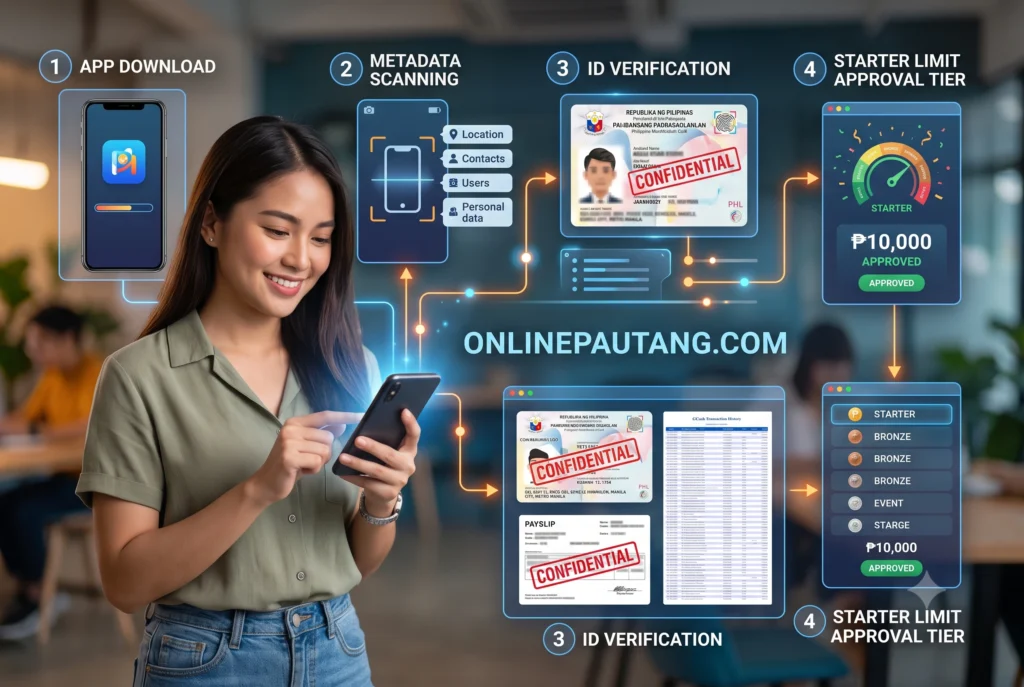
Unlike traditional banks that require income tax returns and certificates of employment, digital lenders rely on alternative credit scoring. When you apply, the app’s algorithm analyzes the metadata on your phone. Are there inconsistencies in your application? Did you fill out the form too quickly, suggesting automated behavior? Do the details on your ID match your exact input?
Even if you have a high-paying job, the algorithm does not know you yet. The system is programmed to build trust incrementally. A PHP 1,000 loan is the industry standard for testing a new user’s commitment to the repayment schedule.
Why Was My Application Approved for Only 1,500 Pesos Instead of My Request?
Summary: The platform automatically overrides your requested amount based on its internal risk cap for unverified income. Regardless of what you typed in the desired amount field, the system will only disburse the baseline starter limit.
Imagine you have a disconnection notice from Meralco for exactly PHP 3,200. You apply for a PHP 4,000 loan to cover the bill and the transfer fees. The app approves you, but only for PHP 1,500. This happens because the “desired loan amount” field in the application form is essentially a survey question for the lender’s data collection; it is not a guarantee.
Lenders cap the first disbursement because they have not yet verified your cash flow. Until you successfully complete a full loan cycle, the system views you as a high-risk entity. You must plan for this reality. If your emergency requires PHP 3,000, relying on a single first-time app application will leave you short.
How Much Cash Will You Actually Take Home After Processing Fees?
Summary: You rarely receive the full loan amount due to upfront processing fees and service charges. Always calculate a 10% to 20% deduction from the principal amount before expecting the cash in your GCash or Maya account.
When you are desperately short on funds, precise math is required. The most dangerous mistake a borrower can make is assuming a PHP 2,000 loan approval means PHP 2,000 will arrive in their wallet. Most Philippine digital lenders employ a front-loaded fee structure.
If JuanHand or MocaMoca approves you for PHP 2,000, they typically deduct a 10% service fee right at the disbursement stage. This means PHP 200 is subtracted immediately, leaving you with a take-home amount of PHP 1,800. However, when your due date arrives, you are still responsible for repaying the full PHP 2,000 principal plus the accrued interest. If you need exactly PHP 2,000 to pay a hospital bill, borrowing PHP 2,000 from an app with upfront deductions will fail to solve your problem.
Are There Legitimate Loan Apps That Don’t Deduct Fees Upfront?
Summary: Yes, some platforms like Digido offer zero-interest promotions for the first 7 days, while apps like Tala charge a transparent, fixed fee upon repayment rather than deducting it upfront. Always read the disbursement breakdown before hitting the final accept button.
Finding legitimate loan apps that do not slash your principal before disbursement requires careful reading of the disclosure statement. The Bangko Sentral ng Pilipinas (BSP) and the Securities and Exchange Commission (SEC) mandate that all registered lenders provide a clear Truth in Lending Act (TILA) disclosure before you finalize the contract.
Digido, for instance, often runs a promotion where first-time borrowers face 0% interest if they repay within 7 days. However, they may still apply a fixed PHP 250 processing fee. Tala is well-regarded because they usually disburse the exact principal you request, adding their service fees to your final repayment balance instead of cutting it from your payout. This structure is far more helpful when you need an exact peso amount to survive a daily crisis.
How Do Short-Term Tenors (7 vs. 15 vs. 30 Days) Affect Your Payout?
Summary: Shorter loan tenors often come with higher annualized interest rates and stricter penalty schedules. A 7-day loan provides fast cash but creates a dangerous cycle if your next payday is more than a week away.
The repayment window – known as the tenor – is a critical factor in micro-lending. Starter loans rarely offer the 6-month or 12-month installments advertised on the homepage. You will likely be restricted to 7, 14, or 30 days.
A 7-day tenor is extremely risky. If you borrow PHP 1,500 on a Monday, the platform expects full payment by the following Monday. If your salary is not scheduled until the 15th or 30th of the month, you will inevitably default. Defaulting on a 7-day loan triggers daily penalty fees that compound rapidly. Always match the loan tenor to your actual payroll schedule. If the app only offers a 7-day term and your payday is 12 days away, do not take the loan.
What Are the Real Reasons Why Applications Are Rejected for First-Time Users?
Summary: Applications are most commonly rejected due to automated KYC (Know Your Customer) failures, such as unreadable ID cards or mismatched data. Ensuring perfect lighting during the selfie check and submitting a pristine government ID are the most effective ways to secure approval.
Nothing is more frustrating than needing emergency funds, waiting for the system to load, and seeing a bright red “Application Denied” screen. When users ask why applications are rejected, they usually assume it has to do with their credit score. In the micro-lending space, rejections are almost entirely based on technical friction during the eKYC process.
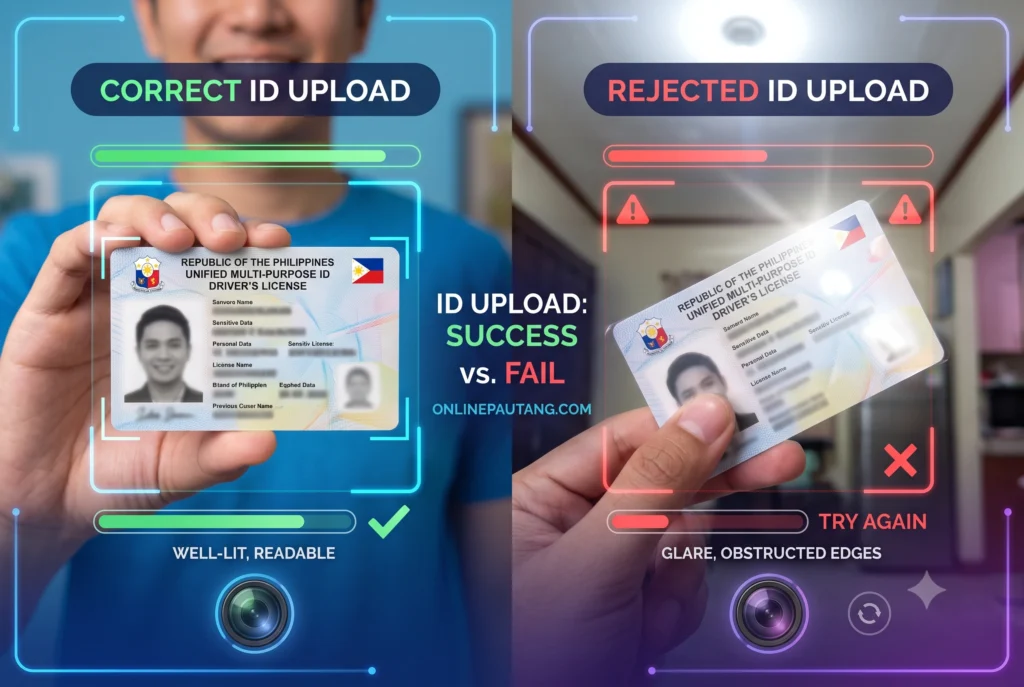
The system relies on Optical Character Recognition (OCR) to read your ID. If the OCR software cannot perfectly extract your name, birthdate, and ID number, the algorithm automatically denies the application to prevent fraud.
Can Faded IDs or Blurry Selfies Trigger Automatic Denials?
Summary: Yes, automated systems instantly reject applications if the ID text is faded or if the liveness selfie does not match the ID photo. Tala and JuanHand algorithms strictly require glare-free images where all four corners of the ID are visible.
Lending algorithms do not have human eyes. If your UMID card has faded borders from being kept in your wallet for five years, the system might flag it as a tampered document. If you take your liveness selfie in a dark room, the facial recognition software cannot map your features to the photo on your driver’s license.
To prevent this, place your ID on a dark, flat surface near a window during daylight hours. Ensure there is no flash glare obscuring the text. During the selfie phase, look directly at the camera with a neutral expression, ensuring your face is fully illuminated.
Does Freelance or Gig-Economy Income Cause Delays?
Summary: Freelancers and informal workers often face tighter initial limits because their cash flow is irregular. Stating your income accurately, even if it is gig-based, prevents the algorithm from flagging your profile for manual review.
Traditional banking penalizes the informal sector, and while fintech aims to bridge this gap, irregular income still triggers risk alerts. If you indicate you are a freelance graphic designer or a Grab driver, the system knows your daily earnings fluctuate.
Do not inflate your income hoping for a higher starter limit. If you claim to earn PHP 80,000 a month but are applying for a PHP 1,000 micro-loan at 2:00 AM on a Tuesday, the algorithm detects a behavioral mismatch and will flag your account for manual review. A manual review can delay disbursement by 24 to 48 hours, defeating the purpose of an instant emergency loan. Honesty aligns your data profile, resulting in faster automated approvals.
How Can You Safely Build Your Credit Limit Up to 25,000 Pesos?
Summary: You can only unlock higher tiers by establishing a flawless repayment history over multiple loan cycles. Consistently paying off your balance exactly on or slightly before the due date proves your reliability to the algorithm.
Reaching the coveted PHP 25,000 limit is a marathon, not a sprint. The lenders track your behavior meticulously. Every time you successfully close a loan contract, your internal trust score increases.
Will Paying Early Increase Your Limit Faster?
Summary: Paying exactly on time or a few days early positively impacts your credit tier, but paying off a loan within 24 hours of borrowing can actually trigger fraud alerts. Follow a natural borrowing cycle to show healthy financial habits.
Borrowers often think that taking a loan and paying it back the very next day will instantly boost their limit. Algorithms view this behavior as highly suspicious, often associating it with money laundering testing or account hijacking. The safest method is to hold the loan for at least half of the tenor. If you have a 15-day loan, paying it back on day 10 or day 12 demonstrates that you utilized the funds as intended and managed your cash flow effectively to settle the debt.
What Happens If You Default on a Micro-Loan?
Summary: Defaulting leads to aggressive compounding penalties, loss of access to the platform, and negative reporting to the Credit Information Corporation (CIC). Never borrow from a second app to pay off the first, as this creates an inescapable debt spiral.
If you fail to pay that initial PHP 1,500, the consequences escalate quickly. SEC-registered apps are legally permitted to apply late fees, which are capped by BSP regulations but can still double your debt over a few months. More importantly, reputable lenders submit data to the national Credit Information Corporation (CIC). A default on a tiny micro-loan today can prevent you from getting a car loan or a housing mortgage five years from now.
Protect your peace of mind. Only borrow exact amounts for absolute emergencies, calculate the upfront fees before accepting, and ensure your payday aligns with the app’s strict deadlines.
References
- Bangko Sentral ng Pilipinas (BSP)Organization: Bangko Sentral ng PilipinasResource: Regulations on Truth in Lending Act (TILA)URL: https://www.bsp.gov.ph/Pages/Regulations/TruthInLendingAct.aspx
- Securities and Exchange Commission (SEC)Organization: Securities and Exchange Commission PhilippinesResource: List of Registered Lending CompaniesURL: https://www.sec.gov.ph/lending-companies-and-financing-companies-2/list-of-registered-lending-companies/
- Tala PhilippinesOrganization: Tala Financing Philippines Inc.Resource: Tala Help Center – Loan Limits and FeesURL: https://tala.ph/help-center/
- DigidoOrganization: Digido Finance Corp.Resource: Digido First Loan Promo TermsURL: https://digido.ph/promo
Disclaimer:This article contains affiliate links. We may earn a small commission if you apply for a loan through our links, at no extra cost to you. The information provided is for educational purposes only and does not constitute professional financial advice. Please borrow responsibly.
Last Updated on July 4, 2026 by Elena Reyes
