A loan app can be legally identifiable and still deserve careful scrutiny over pricing, collection practices, and personal-data use. That distinction matters especially for Moca Moca because its operator has a documented regulatory history: the SEC cancelled Copperstone Lending Inc.’s lending license in 2024, but the regulator later lifted, modified, or reversed the relevant penalty and confirmed the company’s active registration and legal authority to operate. (SEC Philippines)
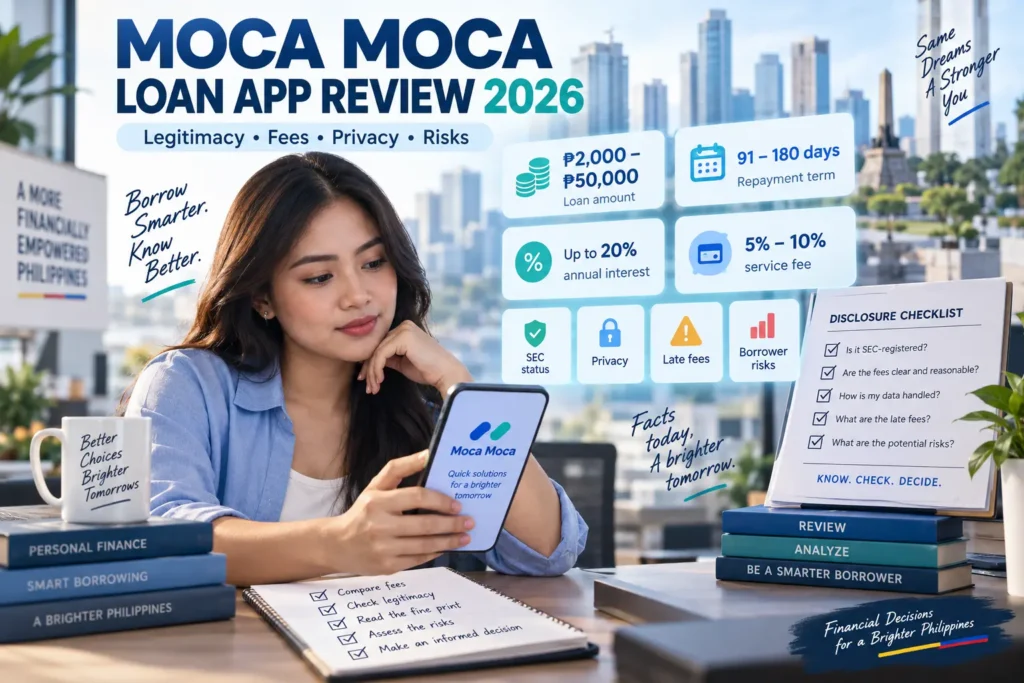
As of September 17, 2026, Moca Moca’s official website and current Google Play listing identify Copperstone Lending Inc. as the operator, with SEC Registration No. 2021050012959-04 and Certificate of Authority No. 3454. The current Play listing advertises loans from ₱2,000 to ₱50,000, terms of 91 to 180 days, annual interest of up to 20%, and a 5%-10% service fee charged upon repayment. (Mocamoca Tech)
This review does not claim a hands-on borrowing test. It uses an evidence-led methodology that separates regulator-confirmed information, lender disclosures, borrower reports, and independently calculated costs.
| Borrower question | Current finding | Why it matters |
|---|---|---|
| Who operates Moca Moca? | Copperstone Lending Inc.; SEC Registration No. 2021050012959-04; CA No. 3454. (Mocamoca Tech) | Moca Moca is a lending brand/platform, not a separate unidentified lender. |
| Is it currently authorized? | The SEC’s December 2025 action lifted, modified, or reversed prior penalties involving Copperstone and stated that the listed firms held active registrations and legal authority to operate, subject to continuing compliance. (Philstar) | This supersedes treating the 2024 revocation as the current status. |
| Advertised loan amount | ₱2,000-₱50,000. (Google Play) | Your actual approved amount can still differ from the advertised range. |
| Advertised term | 91-180 days, including renewal. (Google Play) | Regulatory interest caps depend partly on tenor. |
| Advertised interest | Maximum annual interest rate stated as 20%. (Google Play) | Interest alone does not show the total borrowing cost. |
| Service fee | 5%-10%, according to the current Play listing. (Google Play) | This materially raises the peso cost beyond interest. |
| Current small-loan cap | Certain unsecured general-purpose loans of ≤₱10,000 and ≤4 months are subject to the 2026 SEC ceilings. (RegAlert) | Not every Moca Moca loan falls inside the capped category. |
| Credit reporting | Copperstone appears in the CIC list of submitting entities, and its privacy policy provides for CIC reporting/access. (Credit Information Corporation) | Repayment behavior may become part of your credit data. |
| Privacy | The policy covers identity, employment, income, device, app, location, biometric and other data. (Mocamoca Tech) | Permission requests deserve careful review before proceeding. |
Is Moca Moca legit and properly authorized in the Philippines?
The current evidence supports an identifiable, legally authorized operator: Copperstone Lending Inc. The important qualification is that the company previously faced an SEC license revocation, which was later lifted or reversed. Authorization today does not erase the earlier regulatory history or guarantee that every loan offer is inexpensive.
Who legally operates Moca Moca?
Moca Moca’s official website identifies Copperstone Lending Inc. as the provider. It lists SEC Registration No. 2021050012959-04, registered business name MocaMoca, and Certificate of Authority No. 3454. Google Play displays the same operator and regulatory details. (Mocamoca Tech)
Older SEC records also connect Copperstone with Moca Moca and several other online lending platforms, including Peso Forrest, PocoCash, Blue Peso, Peso Buffet, Load Cash, and Quickla. (FOI Philippines)
This is more meaningful than simply finding a company name on an app store. Under the Lending Company Regulation Act, a corporation engaged in lending needs SEC authority to conduct the lending business; corporate registration alone is not the same thing as lending authority. (SEC Appointment System)
What happened to the 2024 SEC revocation?
This is the part many simplified Moca Moca reviews miss.
An SEC publication covering April-June 2024 said the regulator cancelled Copperstone Lending Inc.’s lending license following findings concerning unfair debt collection practices and failure to disclose the true and correct terms of loan contracts. The SEC publication specifically identified Moca Moca among Copperstone’s online lending platforms. (SEC Philippines)
The status later changed. A December 2025 SEC advisory, reported by The Philippine Star, stated that the Commission had lifted, modified, or reversed previously imposed cease-and-desist orders, revocations, and/or suspensions involving several firms, including Copperstone. The SEC said those entities held active registration and were legally authorized to operate, subject to continued compliance with applicable laws and SEC rules. (Philstar)
The SEC also made an important point: lifting a previous penalty does not remove borrowers’ rights to pursue complaints over violations. (Philstar)
For a 2026 borrower, that is the accurate way to frame Moca Moca’s status: authorized operator, but with a material prior enforcement history.
How does the Moca Moca loan application work?
Moca Moca markets a fully digital process requiring a mobile number, application details, identity verification and at least one valid government ID. Its website advertises cash in five minutes, but this should be treated as a marketing claim rather than a guaranteed approval or settlement time.
Moca Moca’s website describes four basic stages: download the Android application, register using a phone number, choose a loan amount and submit information, then receive funds if approved. The site says one government-issued ID is required and no collateral is necessary. (Mocamoca Tech)
The current Google Play listing says applicants must be Filipino citizens, over 18, possess a valid ID, and have a stable job or other source of income. Interestingly, the listing also says “no income proof required.” That means having a source of income is presented as an eligibility condition even though documentary income proof may not always be requested. (Google Play)
Copperstone does not publicly disclose the complete scoring algorithm used to determine approval, credit limits, pricing or repeat-loan limits. A first-time applicant therefore should not interpret the advertised ₱50,000 maximum as a promise that ₱50,000 will be offered.
How much can you actually borrow from Moca Moca?
The current public range is ₱2,000 to ₱50,000, with advertised terms from 91 to 180 days. The published range is a product limit, not an individual approval guarantee. (Google Play)
The most important number is not the maximum displayed in the store description. It is the amount shown in the actual disclosure statement immediately before you accept the contract.
That document should let you distinguish among the amount requested, amount approved, amount disbursed, finance charges, service fees, repayment schedule and total amount due. This distinction is particularly important because historical complaints involving Moca Moca included allegations of borrowers receiving substantially less cash than the nominal loan amount. Those allegations should not be treated as proof of current pricing, especially because the current app listing expressly says the service fee is charged upon repayment and gives an example in which the borrower receives the full ₱5,000 principal. (FOI Philippines)
The practical rule is simple: trust the current contractual disclosure for your specific loan, not an old screenshot, Facebook post, or another borrower’s previous offer.
What does a Moca Moca loan really cost?
Current public pricing lists annual interest of up to 20% plus a service fee of 5%-10%. Moca Moca’s own ₱5,000 example produces a ₱746 borrowing cost over 180 days, meaning the borrower repays ₱5,746 after receiving ₱5,000. (Google Play)
What does the official example show?
The Google Play listing uses a ₱5,000 loan with a 180-day term, 10% annual interest and a 10% service fee. It calculates ₱246 interest and ₱500 service fee, giving total repayment of ₱5,746. (Google Play)
That translates into:
Cash received: ₱5,000
Interest: ₱246
Service fee: ₱500
Total borrowing cost: ₱746
Total repayment: ₱5,746
Borrowing cost relative to cash received: 14.92% over 180 days
The useful insight here is that a “10% annual interest rate” does not mean the six-month loan costs only 5% of principal. Once the separate 10% service fee is included, the peso cost becomes significantly higher.
Moca Moca calls its annual rate “APR” in Google Play, but the SEC’s regulatory concept of an effective interest rate includes applicable fees and charges. A precise Truth in Lending Act EIR cannot be independently reconstructed from the store description alone without the exact contractual repayment dates and complete disclosure statement. (Google Play)
Do the 2026 Philippine interest caps apply?
This depends on the loan.
Effective April 1, 2026, SEC Memorandum Circular No. 14, Series of 2025 applies to unsecured, general-purpose loans from lending and financing companies when the principal does not exceed ₱10,000 and the tenor does not exceed four months. Covered loans are subject to a 6% monthly nominal-interest ceiling, a 12% monthly effective-interest ceiling including applicable fees, a 5% monthly ceiling on late-payment penalties applied to the outstanding scheduled amount due, and a total-cost ceiling of 100% of the amount borrowed. (RegAlert)
That scope matters. Moca Moca advertises terms from 91 to 180 days and loans up to ₱50,000. A qualifying small, short offer may fall under MC 14, while a ₱20,000 loan or a six-month loan would not fall within that specific small-loan ceiling merely because it comes from the same app. (Google Play)
The ₱5,000, 180-day example published by Moca Moca exceeds the four-month tenor threshold, so it should not automatically be tested against MC 14 as though it were a covered loan.
How fast are approval and disbursement?
Moca Moca markets a very fast process, but the public sources reviewed do not establish a guaranteed approval or bank-crediting time. Its website says “get your cash in 5 minutes,” while Google Play describes a 3-5 minute application process. (Mocamoca Tech)
Those are lender claims, not independently measured processing times.
Actual receipt of money can depend on identity checks, the completeness of submitted information, internal underwriting and the receiving bank or e-wallet. Moca Moca does not publish enough detail to guarantee how long these stages take in every case.
A borrower facing an urgent bill should therefore avoid making a financial commitment elsewhere based on an assumption that the money will arrive within exactly three or five minutes.
How does repayment work?
The current listing names several repayment channels, including GCash, Maya, ShopeePay, bank transfers, convenience-store channels and QR or online transfers. It does not clearly publish a universal payment-posting time. (Google Play)
That missing posting detail matters near a due date. A borrower paying close to the deadline should preserve the transaction reference, payment receipt, date and time, and a screenshot of the outstanding balance until the app reflects the payment.
This becomes more important because Copperstone is also part of the Philippine credit-reporting system. A CIC circular lists Copperstone Lending Inc., doing business under Moca Moca and its other brands, as a submitting entity in production. Moca Moca’s privacy policy likewise says information may be disclosed to the CIC and CIC-accredited bureaus for credit evaluation, monitoring and account management. (Credit Information Corporation)
If information in a CIC credit report is inaccurate, the CIC operates an Online Dispute Resolution System for erroneous, misleading, incomplete or outdated credit information. (Credit Information Corporation)
What happens if you pay Moca Moca late?
Moca Moca’s current Play description warns that additional charges can apply for late payment but does not publish a specific late-fee percentage in the listing. For loans covered by SEC MC 14, late-payment penalties are capped at 5% per month on the outstanding scheduled amount due. (Google Play)
This is an area where the actual disclosure statement and contract are essential.
Recent online borrower discussions contain allegations of rapidly increasing overdue balances and disagreements about penalties or restructuring. These are anecdotal accounts and cannot establish what every Moca Moca borrower will experience. (Reddit)
If the amount shown after delinquency does not match the written contract or applicable regulatory limits, ask for an account ledger showing principal, contractual interest, service fees, late charges, payments received and the remaining balance. Keep copies of every payment and communication.
How much personal information does Moca Moca collect?
The privacy policy describes collection well beyond a name and ID. It includes employment and income information, bank-account details, social-media account information, facial biometrics, location, installed-app information, device data and other permissions. (Mocamoca Tech)
The policy says KYC data may include full name, email, residential address, phone number, guarantor or co-maker details, employment, monthly income, birth date, gender, ID information, bank information, social-media account and facial-recognition data. It separately identifies location, installed applications, camera, calendar, files, device information and phone number among information or permissions collected during use. (Mocamoca Tech)
There are two disclosure issues borrowers should notice.
First, the detailed privacy-policy section names calendar access among collected permissions but the following purpose-by-purpose subsections explain location, guarantor information, installed apps, camera, files, device information and phone number without providing the same dedicated explanation for calendar access. (Mocamoca Tech)
Second, Google Play’s developer-provided Data Safety section currently says “No data shared with third parties,” while Moca Moca’s privacy policy expressly allows disclosure in defined circumstances to CIC/accredited bureaus, collection agencies, service providers, affiliates, lenders, payment partners, verification providers and call-out service providers. (Google Play)
Those statements are not necessarily describing identical technical definitions of “sharing,” but they do not line up cleanly from an ordinary borrower’s perspective. Reading only the Google Play badge would therefore give an incomplete picture of the policy.
There is another inconsistency worth noting: the policy repeatedly directs users to [email protected], but its “Privacy Controls” section gives a Hotmail address for exercising certain privacy rights. A borrower requesting deletion or correction should retain evidence of the request and may reasonably seek confirmation through the company’s official support channel. (Mocamoca Tech)
Can Moca Moca contact people in your phone?
Philippine privacy rules prohibit unrestricted harvesting or use of a borrower’s contact list for collection. A March 2026 joint DICT-NPC-SEC advisory specifically states that lenders may not contact persons in a borrower’s contact list for debt collection other than properly designated guarantors. (National Privacy Commission)
NPC rules also prohibit excessive or disproportionate processing of contacts and the use of borrower information for harassment or unfair collection. (National Privacy Commission)
Moca Moca’s current privacy policy says it obtains guarantor or co-maker information entered by the borrower. It does not state in the reviewed section that the company needs unrestricted access to the borrower’s full phone contact list. (Mocamoca Tech)
This distinction matters because historical borrower complaints concerning Moca Moca alleged calls to contacts who were not listed as references. Those complaints are allegations rather than regulatory findings by themselves, although Copperstone’s 2024 SEC enforcement history independently confirms that the regulator previously found unfair debt-collection and disclosure problems. (FOI Philippines)
What are borrowers saying about Moca Moca in 2026?
Current feedback is mixed. Some Google Play reviewers describe a simple application process and convenient payment methods, while other recent reviewers complain about the cost and repeated calls before the due date. Reddit discussions also contain unverified reports about overdue penalties and restructuring difficulties.
The Play Store showed a high aggregate rating at the time of review, but aggregate ratings should not replace analysis of individual contract terms. One August 2026 reviewer praised the clarity of the application and payment methods. Another August 2026 reviewer complained about high interest and said calls began two or three days before payment was due. These are individual experiences, not statistical evidence of how all accounts are handled. (Google Play)
Recent Reddit discussions contain borrowers alleging large increases in overdue balances and difficulties negotiating repayment arrangements. Other commenters report less aggressive collection experiences. Because these posts cannot be independently authenticated, they are best treated as signals of questions to ask rather than proof of misconduct. (Reddit)
For a prospective borrower, the recurring practical questions are therefore more useful than the star rating: What is the exact late fee? How soon before the due date can collection reminders start? Does an extension payment reduce principal or only extend the due date? How quickly does a payment post? What written restructuring options exist?
What are Moca Moca’s main advantages and drawbacks?
| Potential advantage | Important limitation |
|---|---|
| Identifiable legal operator with published SEC registration and Certificate of Authority details. (Mocamoca Tech) | Copperstone has a material SEC enforcement history, even though the prior revocation was later lifted or reversed. (SEC Philippines) |
| Public listing provides a numerical loan-cost example rather than only a headline rate. (Google Play) | A 5%-10% service fee can make total borrowing cost materially higher than the interest figure alone suggests. |
| Current example says the full approved ₱5,000 is received rather than deducting the service fee upfront. (Google Play) | The borrower still needs to confirm that the individual offer follows the same structure. |
| Several repayment methods are published. (Google Play) | A universal payment-posting timeframe is not clearly disclosed in the public listing. |
| Privacy policy gives detailed categories of collected data. (Mocamoca Tech) | The breadth of device and personal data collection deserves careful review, and some privacy disclosures are internally inconsistent. |
Who may find Moca Moca relevant, and who should be especially cautious?
Moca Moca may be relevant to a borrower who has compared the complete written offer with alternatives, knows exactly where the repayment money will come from, understands every due date, and can repay the loan without needing to borrow from another app.
More caution is warranted when repayment depends on taking a second online loan, when income is unpredictable, when several repayments fall before the next salary date, or when the borrower has not yet seen the complete disclosure statement.
The difference between “I can receive ₱5,000 today” and “I can repay ₱5,746 on this schedule without refinancing” is the difference between evaluating liquidity and evaluating affordability.
What should you check before accepting a Moca Moca loan?
- Confirm that the app identifies Copperstone Lending Inc. and matches the official website and Google Play developer information; verify the approved principal, actual cash to be received, service fee, interest, repayment dates, total amount due and every late-payment charge in the disclosure statement; check whether a loan of ₱10,000 or less and up to four months falls within the SEC’s 2026 capped-loan rules; review permissions before granting access to location, device, files, installed apps or other data; verify the repayment account inside the official app rather than sending money to an unverified person; and save the disclosure statement, payment receipts, account ledger and communications until the balance is confirmed closed. (Google Play)
FAQ
Does Moca Moca report loans to the Credit Information Corporation?
Copperstone Lending Inc. appears on a CIC list of submitting entities in production, specifically including the Moca Moca business name. The Moca Moca privacy policy also states that data may be disclosed to CIC or accredited credit bureaus. (Credit Information Corporation)
Can I request deletion of my Moca Moca data?
The Google Play listing says users can request data deletion, and the privacy policy describes rights to access, revoke consent and request deletion in circumstances where retention is not legally required. Loan and regulatory record-retention requirements may prevent immediate deletion of all information. (Google Play)
What should I do if my Moca Moca payment is not reflected?
Keep the payment reference and receipt and contact the official support channel immediately. If inaccurate credit information later appears in your CIC credit report, CIC provides a formal dispute process for erroneous, incomplete, misleading or outdated data. (Credit Information Corporation)
Is every Moca Moca loan covered by the 2026 SEC interest cap?
No. SEC MC 14 applies specifically to qualifying unsecured, general-purpose loans of no more than ₱10,000 and with a tenor no longer than four months, entered into, restructured or renewed from April 1, 2026. Moca Moca also advertises larger and longer loans that fall outside that defined scope. (RegAlert)
Borrower Decision Framework
Do not decide based only on whether the Moca Moca loan app is “legit.” The better decision test has several parts.
Confirm who the legal lender is. Check the cash that will actually enter your account. Compare it with the total peso amount you will repay. Map every installment against your salary or other income dates. Read the late-payment provision before, not after, missing a due date. Review the personal-data permissions and privacy policy. Make sure you could repay without opening another loan.
Moca Moca’s current regulatory status supports an identifiable authorized operator, but that answers only the first question. The individual loan offer still determines whether the transaction is affordable and whether its pricing and repayment structure make sense for the borrower.
References
- MocaMoca Official Website
Organization: Copperstone Lending Inc.
Resource: MocaMoca | Personal Loan App in the Philippines
URL: https://www.mocamocatech.com/ - MocaMoca Google Play Listing
Organization: Copperstone Lending Inc. / Google Play
Resource: MocaMoca – Safe and fast loan
URL: https://play.google.com/store/apps/details?id=com.mocamoca - MocaMoca Privacy Policy
Organization: Copperstone Lending Inc.
Resource: Privacy Policy
URL: https://www.mocamocatech.com/privacy.html - SEC Quarterly Publication
Organization: Securities and Exchange Commission Philippines
Resource: April-June 2024 SEC Publication — SEC revokes Copperstone Lending’s license
URL: https://www.sec.gov.ph/wp-content/uploads/2024/08/2024NewSECLetter_2024Q2_FINAL_Spread-1.pdf - SEC Advisories and Notices
Organization: Securities and Exchange Commission Philippines
Resource: Advisory on Previously Imposed Penalties Against Certain Financing and Lending Companies
URL: SEC Advisories and Notices - SEC Penalty Status Report
Organization: The Philippine Star, reporting Securities and Exchange Commission advisory
Resource: SEC modifies penalties vs certain lending firms
URL: https://www.philstar.com/business/2025/12/20/2495517/sec-modifies-penalties-vs-certain-lending-firms - SEC Memorandum Circular No. 14, Series of 2025
Organization: Securities and Exchange Commission Philippines
Resource: Recalibrated Ceilings on Interest Rates and Other Fees Charged by Financing Companies and Lending Companies
URL: SEC MC No. 14, Series of 2025 text - SEC Interest-Cap Report
Organization: GMA Integrated News
Resource: SEC lowers interest rate caps for loans up to P10,000
URL: https://www.gmanetwork.com/news/money/economy/969232/sec-lowers-interest-rate-caps-for-loans-up-to-p10-000/story/ - Joint Advisory on Online Lending Platforms
Organization: National Privacy Commission / DICT / SEC
Resource: Advisory on Online Lending Platforms
URL: NPC-DICT-SEC Joint Advisory PDF - CIC Submitting Entities List
Organization: Credit Information Corporation
Resource: List of Submitting Entities in Production as of 31 March 2024
URL: CIC Letter Circular No. 2024-03 PDF - CIC Dispute Resolution
Organization: Credit Information Corporation
Resource: Dispute Resolution / Online Dispute Resolution System
URL: https://www.creditinfo.gov.ph/dispute/
Disclaimer:This article contains affiliate links. We may earn a small commission if you apply for a loan through our links, at no extra cost to you. The information provided is for educational purposes only and does not constitute professional financial advice. Please borrow responsibly.
Last Updated on September 17, 2026 by Elena Reyes
