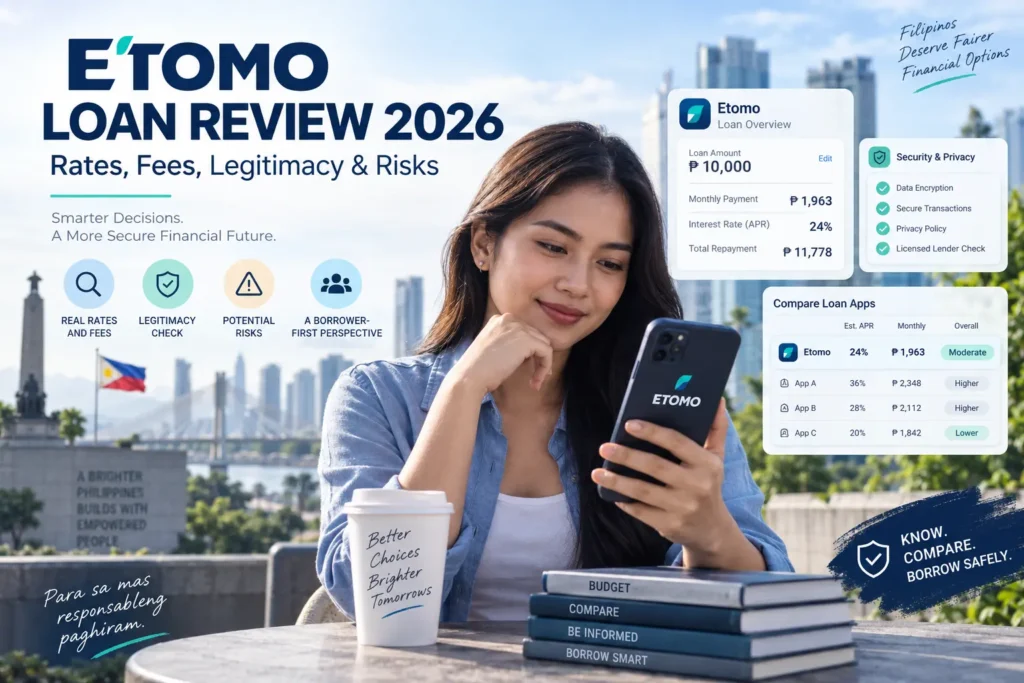
A loan app can advertise “no hidden charges” and still be expensive. That distinction matters with Etomo because its current published examples are unusually specific: the app shows both a revolving product and an installment loan, including interest figures and sample repayments. Those disclosures make it possible to examine the peso cost rather than judging the product from marketing language alone.
This Etomo review checks the company behind the app, its SEC authority trail, published loan terms, the 2026 Philippine interest-cap rules, repayment mechanics, privacy disclosures, CIC reporting, and recent App Store feedback. It is a documentary review, not a first-hand borrowing test; no application, approval, disbursement, or repayment was performed for this article. The review was prepared from the supplied editorial brief and independently checked public sources.
| Borrower question | Current finding | Why it matters |
|---|---|---|
| Who operates Etomo? | Etomo Financing Corporation | The lender is identifiable rather than an anonymous app operator. |
| SEC details | CS201840930; CA No. 1187 | A Certificate of Authority is more relevant to lending activity than corporate registration alone. |
| Main products | Term and Revo | They have very different repayment structures. |
| Term loan amount | Etomo advertises up to ₱100,000; actual approval can be lower | “Up to” is not a guaranteed first-loan limit. |
| Term tenor | 6 or 9 months initially; 12 months for later loans | First-time borrowers do not get the full advertised tenor range. |
| Revo minimum draw | ₱500 | Revo is a revolving credit structure, not a normal fixed-installment loan. |
| Published Term example | ₱6,000 becomes ₱8,160 total over six months | That is ₱2,160 in interest, equal to 36% of the original principal. |
| Published Revo rate | 0.177% daily; 5.4% effective monthly rate; 4.86% with stated on-time reward | Minimum payments can reduce principal slowly. |
| Service fee | Etomo currently states no service fee or hidden charges | Verify this again in the personalized disclosure before accepting. |
| Disbursement | Etomo claims transfer in under a minute after approval | This is a lender claim, not a guaranteed end-to-end application time. |
| Credit reporting | Etomo appears on CIC’s current list of Submitting Entities | Payment history may become relevant to later credit assessments. |
| Privacy | The privacy notice covers financial, employment, ID and other personal data and allows specified third-party sharing | The FAQ’s simpler “never shared” wording should not be read in isolation. |
Is Etomo legitimate and properly authorized in the Philippines?
Etomo has an identifiable Philippine financing company behind it. Etomo Financing Corporation currently publishes SEC Registration No. CS201840930 and Certificate of Authority No. 1187. Older SEC records show the same identifiers under AND Financing Corporation, establishing an important regulatory identity trail.
This distinction is important. Incorporating a company with the Securities and Exchange Commission is not, by itself, permission to operate a financing business. Etomo publishes both its corporate registration number and Certificate of Authority No. 1187 to operate as a financing company. The SEC’s August 2024 financing-company list recorded CS201840930 and CA 1187 under the previous corporate name, AND Financing Corporation.
Etomo’s own historical material says AND Financing Corporation was established in 2018 and previously operated the online lending platform LendPinoy before the Etomo branding was introduced. A historical SEC list likewise linked AND Financing Corporation, CS201840930 and CA 1187 with LendPinoy.
There is one point borrowers should still verify themselves. The SEC currently maintains a separate List of Recorded Online Lending Platforms and, in July 2026, published a new OLP disclosure and recording guide. The SEC page was accessible during this review, but its current OLP list page blocked direct retrieval, so this article does not present a 2026 Etomo OLP-list row as independently verified from that specific SEC record. The SEC itself advises consumers to check both the financing/lending company and its online platform before borrowing.
That limitation does not erase the stronger evidence that the financing company itself and its Certificate of Authority are identifiable. It simply avoids turning one form of registration into a broader regulatory claim that the available official evidence did not directly establish.
Is Etomo itself the lender?
Yes. Etomo’s privacy notice explicitly defines Etomo Financing Corporation as the “Lender,” and the current iOS listing identifies the same company as the developer and operator. This is clearer than arrangements where an app is merely a broker or technology interface for a separate lender.
Etomo should therefore not be described as a bank or digital bank. Its relevant regulator for its financing-company activity is the SEC, not the BSP merely because Philippine rate-cap policy has involved the Bangko Sentral.
How does Etomo work, and who can apply?
Etomo’s published eligibility is narrower than “any Filipino with a phone.” Its current qualification page lists people who are at least 20 years old, have an SSS number, and are regularly employed or continuous contractual employees. Approval still depends on Etomo’s assessment.
Published requirements include personal and address information, employment and financial information, a valid government-issued ID, an email address, and a registered mobile number. Accepted IDs listed by Etomo include a driver’s license, UMID, National ID, SSS ID, passport and PRC ID.
The company says it uses an AI-based credit-scoring system, but it does not publicly disclose the complete scoring model, approval thresholds, or the weight assigned to particular data points. Its privacy notice states that data can be used for identity verification, profiling, applicant scoring, credit-risk assessment and determining credit limits. That supports the existence of data-driven underwriting, but it does not justify claims that a particular salary, employer, credit score or profile will be approved.
The published eligibility also creates an important practical question for freelancers, self-employed applicants and gig workers. Those groups are not expressly included in Etomo’s current eligibility wording. That is not enough evidence to declare every such applicant ineligible, but it is a reason to confirm eligibility before submitting sensitive personal information.
How much can you actually borrow from Etomo?
Etomo advertises Term loans of up to ₱100,000, while Revo permits additional borrowing within an approved revolving credit limit and states a ₱500 minimum draw. The company does not publicly promise that a first-time borrower will receive the maximum limit.
For Term, first-time borrowers are offered published tenors of six or nine months. A 12-month term becomes available from the second loan onward. Reborrowing under Term requires the current loan to be fully repaid first.
Revo works differently. The borrower receives a credit limit and may draw again while credit remains available. Etomo’s App Store illustration uses a ₱20,000 credit limit with an ₱8,000 draw, but that ₱20,000 is only a worked example; it should not be interpreted as the standard Revo limit or an expected first offer.
The figure that matters at acceptance is therefore not the headline “up to” amount. It is the amount shown in the borrower’s own disclosure and contract.
What does an Etomo loan really cost?
The cost can be material even though Etomo currently says it charges no service fee. Its own six-month Term example turns a ₱6,000 principal into ₱8,160 of total repayments, while Revo’s minimum-payment structure can leave most of the original balance outstanding after the first month.
Term loan: the published ₱6,000 example
Etomo’s current iOS disclosure gives enough detail to calculate the peso cost directly:
| Item | Published example |
|---|---|
| Principal | ₱6,000 |
| Term | 6 months |
| Published monthly interest rate | 6.00% |
| Published effective monthly interest rate | 9.56% |
| Monthly payment | ₱1,360 |
| Number of payments | 6 |
| Total repayment | ₱8,160 |
| Total interest | ₱2,160 |
| Interest relative to original principal | 36% |
The arithmetic is simple:
₱1,360 × 6 = ₱8,160 total repayment
₱8,160 − ₱6,000 = ₱2,160 borrowing cost
₱2,160 ÷ ₱6,000 = 36% of the original principal
Etomo itself publishes the ₱2,160 total interest and a 9.56% effective monthly interest rate for this example.
This is why “no service fee” should not be confused with “cheap loan.” A loan can have no separate service charge and still carry a substantial interest cost.
Revo: why the 8% minimum can be misleading if read too quickly
Etomo publishes a Revo daily interest rate of 0.177%, an effective monthly rate of 5.4%, and a stated rate of 4.86% with its on-time reward. The minimum monthly payment is 8% of the outstanding balance, rounded as described in Etomo’s example.
For an ₱8,000 draw, Etomo’s own example produces:
| After 30 days | Without on-time reward | With on-time reward |
|---|---|---|
| Minimum payment | ₱650 | ₱650 |
| Interest component | ₱424.80 | ₱382.32 |
| Amount reducing principal | ₱225.20 | ₱267.68 |
| Remaining balance | ₱7,774.80 | ₱7,732.32 |
The key insight is that an 8% minimum payment is not an 8% reduction in principal. In this first-month example, only ₱225.20—or about 2.8% of the ₱8,000 starting balance—reduces principal without the reward. Even with the reward, the principal reduction is only about 3.35%.
That structure can be useful for cash-flow flexibility, but paying only the minimum can keep the balance alive for much longer than a borrower might expect. Etomo itself says paying more than the minimum shortens the repayment period.
Will you receive the full approved amount?
Etomo’s current product materials say there is no service fee or hidden charge, but this article did not review an individualized 2026 disclosure statement or actual funded transaction. It would therefore be unsafe to assume that every borrower always receives exactly the headline principal without any other contract-specific adjustment.
Before accepting, compare three numbers on the actual offer: approved principal, cash that will enter your account, and total amount you must repay. If the first two differ, calculate borrowing cost against the money you actually receive.
Do the 2026 Philippine interest caps apply to Etomo?
Not every Etomo loan automatically falls under the special 2026 small-loan ceilings. From April 1, 2026, the recalibrated numerical caps apply to covered unsecured general-purpose loans of no more than ₱10,000 with a tenor of no more than four months.
For loans within that defined category, SEC Memorandum Circular No. 14, Series of 2025 set a nominal interest ceiling of 6% per month, an effective-interest ceiling of 12% per month, a late/non-payment penalty ceiling of 5% per month on the outstanding scheduled amount due, and a 100% total-cost cap. The rule applies to covered loans entered into, renewed or restructured beginning April 1, 2026.
This scope matters for an Etomo review. Etomo’s published first-time Term loans run for six or nine months, so those published tenors exceed the four-month threshold even when the amount happens to be ₱10,000 or less. You cannot simply apply the special 12%-per-month effective-rate ceiling to every Etomo Term loan.
Revo is even more dependent on the contract because Etomo describes it as flexible revolving credit rather than publishing one fixed payoff tenor for every draw. A borrower should not assume the special cap applies—or does not apply—without checking the actual principal and contractual tenor.
Loans outside this narrow numerical cap are not outside Philippine consumer-protection law. Disclosure, responsible pricing, fair treatment, privacy and rules against abusive collection still apply.
How fast are Etomo approval and disbursement?
Etomo advertises fast processing and says that, once a loan is approved, the amount can be transferred to the chosen bank account or verified GCash/Maya wallet in less than a minute. That statement concerns post-approval transfer and should not be read as a guaranteed one-minute approval process.
Etomo’s website has also used “same-day approval” language. Both statements are lender claims rather than universal service-level guarantees.
Application review can logically involve KYC, identity checks, employment or financial-data review and credit scoring because Etomo says those processes form part of its underwriting. A mismatch in submitted information or a requirement for further verification could therefore affect timing even though the company does not publish a complete list of delay scenarios.
Recent App Store reviews accessible during this review include several reports of quick processing and staff guidance. Those are borrower anecdotes, not proof that every applicant gets the same result.
How does Etomo repayment work?
Term uses fixed scheduled installments, while Revo requires a monthly minimum based on the outstanding balance. Etomo lists GCash, Maya and 7-Eleven/CliQQ as payment channels, while its website FAQ also lists BDO. Payment validation is not always instant.
For Term, the first installment is due 30 days after disbursement and later payments follow every 30 days under the published structure. For Revo, borrowers can choose the 2nd or 17th as the due date, according to current product materials.
Etomo’s FAQ warns that a payment can take a day or two to appear. For payments made outside a CliQQ kiosk, it asks borrowers to allow at least two business days for validation. Importantly, Etomo says the posting date will reflect the date the payment was actually made rather than the date the system display was updated.
That makes payment receipts worth keeping. A screenshot or transaction reference can be important if the account still appears unpaid close to the due date.
What happens if you pay Etomo late?
Etomo’s public FAQ tells borrowers who cannot pay on time to contact customer service, but the pages reviewed do not publish a clear Etomo-specific late-fee schedule. Do not guess the penalty from general Philippine rate caps; check the actual disclosure statement and loan agreement.
This gap is significant because the 5% monthly penalty ceiling discussed above applies only to the qualifying small, short-term loans covered by the 2026 SEC rule. It is not a universal late-fee formula for every consumer loan in the Philippines.
Late payment can also matter beyond the immediate penalty. Etomo Financing Corporation appears on the CIC’s current list of Submitting Entities in Production and also appears among current Accessing Entities. Etomo’s App Store listing likewise says it submits data to CIC. That means borrowers should assume repayment performance may become part of the formal credit-information ecosystem rather than treating an app loan as invisible to future lenders.
Philippine financial consumers are protected from abusive debt collection. RA 11765 expressly prohibits financial service providers from using abusive collection or debt-recovery practices and gives consumers rights to fair treatment, transparency, data privacy and complaint handling.
And ordinary debt is not, by itself, a reason for imprisonment: Section 20 of Article III of the 1987 Constitution states that no person shall be imprisoned for debt or non-payment of a poll tax. That protection should not be misread as a license to ignore a loan; contractual liability, collection, penalties where lawful, credit reporting and civil remedies can still follow. Separate fraudulent conduct, if any, is a different legal question.
How much personal data does Etomo collect?
Etomo’s privacy materials describe broad financial and identity data processing, while Apple’s current disclosure says the iOS app may link financial information, coarse location, contact details, photos or videos, identifiers and other sensitive categories to the user. Borrowers should review permissions rather than treating a privacy-policy link as sufficient protection by itself.
Etomo’s website privacy notice lists information including full name, birth date, residential address and home-ownership information, phone and email details, Facebook details, employment information, bank details, financial and bill-payment history, government-issued IDs and tax information. With authorization, it may also obtain information from employers and other financial or transaction sources.
The notice says these data may support KYC, credit assessment, scoring and profiling, payouts, collections, marketing and research. Access may be provided to designated internal teams and third-party KYC or payout providers where necessary. It also allows anonymized analytics sharing with the company’s technology affiliate and describes sharing with entities such as banks, remittance centers, billing companies, credit-check providers, regulators and other service providers for defined purposes.
That creates an editorial inconsistency worth noticing. Etomo’s FAQ says information provided to Etomo is “never shared with any third-party,” while the detailed privacy notice expressly describes circumstances in which data can be shared with third-party service providers and others. The detailed privacy notice is therefore more nuanced than the FAQ wording. A borrower who wants to know what actually happens to personal data should read the privacy notice and consent screen rather than relying on the FAQ sentence alone.
There is also a retention issue. Etomo’s published policy states that pre-loan information may generally be retained for five years from the last login, while post-loan personal data may be retained for ten years from extinguishment of the obligation, subject to longer legal or contractual requirements. The same page says the privacy policy has been in effect since November 23, 2018, which is a reason to check the in-app privacy notice for any newer consent wording before submitting data.
Can Etomo contact people in your phone?
The current Apple privacy disclosure reviewed here does not establish that Etomo downloads a borrower’s entire address book. It does disclose several categories of linked data, including contact information and coarse location.
Philippine privacy rules are more important than assumptions about a particular permission screen. The National Privacy Commission says loan apps must not conduct unnecessary or excessive personal-data processing. For debt collection, a lender or financing company is expressly prohibited from contacting people in a borrower’s contact list other than persons properly declared as guarantors, and a guarantor requires separate consent. Character references cannot be used freely for harassment or unrelated marketing.
What are borrowers saying about Etomo in 2026?
The Philippine App Store showed a 4.5/5 rating from 872 ratings when checked on September 17, 2026. The accessible recent review sample leaned positive about assistance and processing, but ratings are anecdotal and should not be treated as proof of pricing quality, regulatory compliance or universal borrower experience.
Several visible 2026 reviews praised staff assistance and described funds as arriving quickly. One August reviewer, while positive, specifically asked Etomo to consider lower interest rates, higher limits and more flexible repayment options. That is useful because it separates satisfaction with customer service from satisfaction with the economics of the loan.
An older visible review described a confusing sign-up problem in which the system indicated that an account already existed, although the reviewer said support later assisted. The app’s 2026 version history also contains frequent bug-fix and performance-improvement releases. Those facts support the narrower conclusion that technical friction has existed, not that all borrowers experience registration problems.
The accessible iOS sample did not establish a repeated, independently verified pattern of harassment or illegal collection in the material reviewed for this article. That absence should not be converted into a claim that complaints never exist; app-store reviews are incomplete, self-selected and not a regulatory investigation.
What are Etomo’s main advantages and disadvantages?
Etomo’s strongest points are identifiable corporate ownership, unusually detailed public repayment examples and documented payment channels. Its main drawbacks are the potentially high peso cost, slow principal reduction if a Revo borrower makes only minimum payments, and several disclosure questions that still need to be checked in the individualized contract.
| Potential advantage | Why it matters |
|---|---|
| Identifiable financing company and CA number | Borrowers can trace the entity rather than dealing with an anonymous app. |
| Detailed Term and Revo examples | Borrowers can see how much of a payment is interest versus principal. |
| No service fee claimed in current product disclosure | This reduces one common source of upfront deductions, if the personalized offer matches the public terms. |
| Multiple repayment channels | GCash, Maya, 7-Eleven/CliQQ and BDO are documented across official sources. |
| CIC participation is disclosed | Borrowers are given a clearer signal that repayment behavior can matter beyond one app. |
| Potential drawback | Why it matters |
|---|---|
| ₱6,000 Term example costs ₱2,160 in interest | The published six-month cost equals 36% of principal. |
| Revo minimum payment can reduce principal slowly | In Etomo’s first-month ₱8,000 example, most of the ₱650 minimum goes to interest. |
| Public late-fee detail is limited | A borrower needs the personalized agreement to quantify default exposure. |
| FAQ and privacy notice do not describe third-party sharing the same way | The detailed privacy notice permits specified sharing that the FAQ’s broad wording may obscure. |
| Published eligibility emphasizes employees with SSS | Freelancers and self-employed borrowers do not clearly fit the stated qualification profile. |
| Fast-disbursement claim is conditional on approval | “Less than a minute” should not be read as guaranteed application-to-cash time. |
Who may find Etomo relevant, and who should be especially cautious?
Etomo may be relevant to an eligible employed borrower who understands the exact peso cost and already knows how each installment will be funded. It deserves much more caution when repayment would require another loan, when income is irregular, or when the minimum-payment feature is being used to postpone rather than solve a cash-flow problem.
A fixed Term structure may be easier to budget because the installment is known in advance. Revo provides more flexibility, but that flexibility can become expensive if the borrower repeatedly redraws available credit or pays only the minimum while interest continues.
The right question is not “Can I get approved?” It is “After rent, food, transport, utilities and existing debts, can I make every required payment from income I reasonably expect to receive?”
Someone who needs to borrow again merely to make the first loan payment is already facing a different risk profile from someone using a short-term loan against a clearly expected salary.
What should you verify before accepting an Etomo offer?
The safest point to evaluate Etomo is the final disclosure screen, before acceptance. Public examples are useful for research, but only your own disclosure statement and agreement tell you the exact principal, proceeds, rates, due dates and charges that bind your transaction.
- Confirm the legal lender. The contract should identify Etomo Financing Corporation and match the current regulatory information rather than a different or unexplained entity.
- Write down the approved principal and net cash proceeds separately. If ₱10,000 is approved but less reaches you, find the precise reason before accepting.
- Add every scheduled payment. Compare total repayment with the cash you actually receive, not merely with the advertised interest percentage.
- Read the late-payment clause. Do not assume the 5% regulatory ceiling for qualifying short-term loans is automatically your Etomo penalty.
- Check the payment calendar against payday. A cheap-looking loan can become costly if its due date repeatedly falls before income arrives.
- Review app permissions and data-sharing consent. The SEC specifically advises online borrowers not to grant unnecessary access to phone contacts or social-media information, while NPC rules restrict excessive processing and third-party collection contacts.
- Save the disclosure statement, agreement and payment receipts. SEC guidance tells online borrowers to read the loan agreement, verify charges and obtain documentary proof of the transaction and full payment.
Etomo FAQ
Is Etomo regulated by the BSP?
Etomo Financing Corporation identifies itself as an SEC-regulated financing company, not a bank. BSP policy has played a role in Philippine lending-rate regulation, but that does not make Etomo a BSP-supervised bank or digital bank. Its financing-company authority is associated with the SEC.
Can I pay an Etomo loan early?
Philippine RA 11765 states that a borrower may prepay a loan or other credit transaction in whole or in part before maturity, subject to any properly disclosed prepayment costs or fees. Etomo’s Revo material also says paying more than the minimum can shorten the loan period. The exact treatment of a particular Term loan should be checked in its contract.
Can Etomo delete my account and personal information?
Etomo says an account-deletion request can be submitted and privacy concerns can be sent to its Data Protection Officer. Deletion is not necessarily immediate erasure of every record: its privacy policy describes five- and ten-year retention periods in certain pre-loan and post-loan situations, subject to legal requirements.
Does Etomo report to CIC?
Etomo Financing Corporation appears on the Credit Information Corporation’s current list of Submitting Entities in Production, and Etomo’s App Store listing also states that it is an official CIC submitting entity. Borrowers should therefore treat repayment history as potentially relevant to their formal credit record.
Is Etomo’s “less than a minute” loan claim guaranteed?
No public evidence reviewed here establishes it as a contractual guarantee. Etomo’s FAQ says the loan amount can be transferred in less than a minute once approved. Application assessment, verification and any external bank or e-wallet issues are separate stages.
A practical decision framework before borrowing
Etomo is easier to investigate than many obscure lending apps because its legal company, Certificate of Authority, product structures and sample computations are publicly identifiable. That answers part of the legitimacy question, but it does not answer the affordability question for you.
A borrower looking at Etomo should reduce the decision to six concrete figures: cash actually received, total repayment, installment amount, number of payments, exact due dates and late-payment exposure. Then review the data permissions and confirm that the legal lender in the contract is the entity you researched.
The published ₱6,000 Term example is a useful warning against judging a loan from a monthly rate alone: the borrower repays ₱8,160 over six months. Revo presents a different risk—the minimum looks manageable, but Etomo’s own example shows that much of the first minimum payment can go to interest rather than principal.
If those numbers still fit within income without sacrificing essential expenses or taking another loan to repay this one, the borrower can compare Etomo with other regulated options on equal terms. If the repayment plan already depends on refinancing, rolling balances or another payday loan, stopping before acceptance may prevent a temporary cash problem from becoming a debt cycle.
References
- Etomo 2.0 – App Store
Organization: Apple / Etomo Financing Corporation
Resource: Etomo 2.0 App Listing, Product Disclosure, Privacy Disclosure and User Reviews
URL: https://apps.apple.com/ph/app/etomo-2-0/id6751082253 - Etomo – About
Organization: Etomo Financing Corporation
Resource: About – Corporate and Regulatory Information
URL: https://etomo.ph/about/ - Etomo – FAQ
Organization: Etomo Financing Corporation
Resource: FAQ – Disbursement, Repayment, Security and Account Information
URL: https://etomo.ph/faq/ - Etomo – Term
Organization: Etomo Financing Corporation
Resource: Term Loan Product Page
URL: https://etomo.ph/term/ - Etomo – Revo
Organization: Etomo Financing Corporation
Resource: Revo Revolving Loan Product Page
URL: https://etomo.ph/revo/ - Etomo – Qualification
Organization: Etomo Financing Corporation
Resource: Qualification and Application Requirements
URL: https://etomo.ph/qualification/ - Etomo Privacy Statement
Organization: Etomo Financing Corporation
Resource: Privacy Policy
URL: https://etomo.ph/dataprivacy/ - List of Registered Financing Companies
Organization: Securities and Exchange Commission Philippines
Resource: List of Registered Financing Companies as of 31 August 2024
URL: SEC financing-company list PDF - List of Financing and Lending Companies and Online Lending Platforms
Organization: Securities and Exchange Commission Philippines
Resource: List of Financing and Lending Companies Registered with the SEC and Their Online Lending Platforms
URL: SEC historical OLP list PDF - Advisories and Notices
Organization: Securities and Exchange Commission Philippines
Resource: Lending Companies and Financing Companies – Advisories and Notices
URL: SEC FinLenD Advisories and Notices - Advisory for Online Lending Platform Borrowers
Organization: Securities and Exchange Commission Philippines
Resource: Advisory – For Online Lending Platforms Borrowers
URL: SEC OLP borrower advisory PDF - SEC Lowers Interest Rate Caps for Loans Up to ₱10,000
Organization: GMA Integrated News, reporting the Securities and Exchange Commission’s December 2025 announcement
Resource: SEC Lowers Interest Rate Caps for Loans Up to P10,000
URL: GMA News article - Republic Act No. 11765
Organization: The LawPhil Project
Resource: Financial Products and Services Consumer Protection Act
URL: Republic Act No. 11765 - NPC Amends Circular on Loan-Related Personal Data
Organization: National Privacy Commission
Resource: NPC Amends Circular on the Processing of Personal Data for Loan-Related Transactions
URL: National Privacy Commission guidance - List of Submitting Entities in Production
Organization: Credit Information Corporation
Resource: Current List of Submitting Entities in Production
URL: CIC submitting-entity list - List of Accessing Entities
Organization: Credit Information Corporation
Resource: Current List of Accessing Entities
URL: CIC accessing-entity list - 1987 Philippine Constitution
Organization: The LawPhil Project
Resource: Constitution of the Republic of the Philippines – Article III, Section 20
URL: 1987 Philippine Constitution
Disclaimer:This article contains affiliate links. We may earn a small commission if you apply for a loan through our links, at no extra cost to you. The information provided is for educational purposes only and does not constitute professional financial advice. Please borrow responsibly.
Last Updated on September 17, 2026 by Elena Reyes
