It is deeply stressful when a medical emergency hits, or a tuition deadline looms, and a traditional bank turns you away simply because you do not possess an income tax return or a corporate payslip. If you are part of the nearly 60% of Filipinos operating in the informal economy – working as a freelancer, running a local sari-sari store, or taking on gig work – the lack of formal paperwork does not mean you lack the ability to pay. It just means the traditional financial system was not built for your reality. You are not out of options. The lending market has evolved drastically in recent years, shifting away from rigid paper requirements and toward modern digital footprint analysis. However, the desperation for fast cash often pushes borrowers into the arms of predatory lenders. Our goal here is to carefully walk you through safe, regulated options that respect your privacy and your wallet.
Summary: For Filipinos without formal employment documents, several legitimate, SEC-registered apps use alternative credit scoring to grant cash loans using just a single primary ID (such as a PhilSys ID or UMID). Top platforms like Tala, BillEase, and GCash (GLoan) disburse funds directly to e-wallets, bypassing traditional payslip requirements while strictly adhering to BSP interest rate caps and NPC privacy guidelines.
Key Takeaways: Legitimate No-Payslip Lending Options (2026)
| Platform | Primary Target Audience | ID Requirement | Estimated Max Initial Loan | Disbursement Method |
| Tala | Micro-entrepreneurs, unbanked | 1 Valid ID (PhilSys/UMID preferred) | ₱1,000 – ₱2,000 | GCash, Maya, Bank Transfer |
| BillEase | Freelancers, online shoppers | 1 Valid ID + Proof of Billing/Wallet link | ₱2,000 – ₱5,000 | Bank Transfer, E-wallet, Merchant |
| GLoan | Active GCash users | Fully verified GCash account (1 ID) | Varies based on GScore | Direct to GCash wallet |
| JuanHand | First-time online borrowers | 1 Valid Primary ID | ₱1,500 – ₱2,000 | GCash, Maya, Remittance |
Why Are Payslips No Longer Strictly Required by Digital Lenders?
Digital lenders now analyze alternative data – such as mobile wallet transaction history, utility payment consistency, and behavioral metrics – instead of relying on traditional corporate payslips to predict a borrower’s repayment capacity.
When our fintech assessment team looks at the backend operations of modern Online Lending Applications (OLAs), the shift is entirely data-driven. A decade ago, a physical payslip was the only tangible proof of cash flow. Today, your smartphone acts as a live ledger. If you are regularly cashing in to an e-wallet, paying electricity bills on time through an app, or receiving weekly remittance transfers, algorithms assign you a high confidence score.
This alternative credit scoring system is a massive relief for non-traditional workers. Instead of manually verifying employment with a company HR department – a process that takes days – platforms can approve micro-loans in under five minutes. They map out your financial behavior. If you consistently maintain a small balance and pay digital merchants, lenders see a responsible consumer. This shift has allowed genuine, highly regulated freelance loan apps to flourish, providing a lifeline to independent contractors who earn well but simply cannot produce standard corporate paperwork.
Which Are the Safest SEC-Registered Loan Apps That Don’t Need Payslips?
The safest no-document lending applications in the Philippines are those explicitly listed on the Securities and Exchange Commission (SEC) registry, utilizing secure alternative credit scoring instead of demanding sensitive employment files.
In our experience monitoring the Philippine lending space, safety is non-negotiable. Hundreds of apps promise instant cash, but many operate illegally. You must prioritize SEC-registered lending platforms to ensure you are protected by the Bangko Sentral ng Pilipinas (BSP) caps on interest rates (currently capped at a maximum of 0.4% per day for nominal interest on small loans).
How Does Tala Assess Borrowers Without Traditional Income?
Tala evaluates potential borrowers by securely analyzing device metadata and simple behavioral questionnaires, replacing the need for payslips with a proprietary algorithm that measures financial discipline.
When our team tested the Tala app recently, we noted how streamlined their onboarding feels for individuals completely excluded from traditional banking. You download the app, answer a few questions about your daily expenses and income sources, and submit a photo of a single valid ID. Tala’s algorithm looks at data points like how you interact with the application and your consistency in answering financial questions. Because they assume higher risk by lending without income documents, initial loan offers are small – usually between ₱1,000 and ₱2,000.
Can I Use BillEase If I Am a Freelancer or Gig Worker?
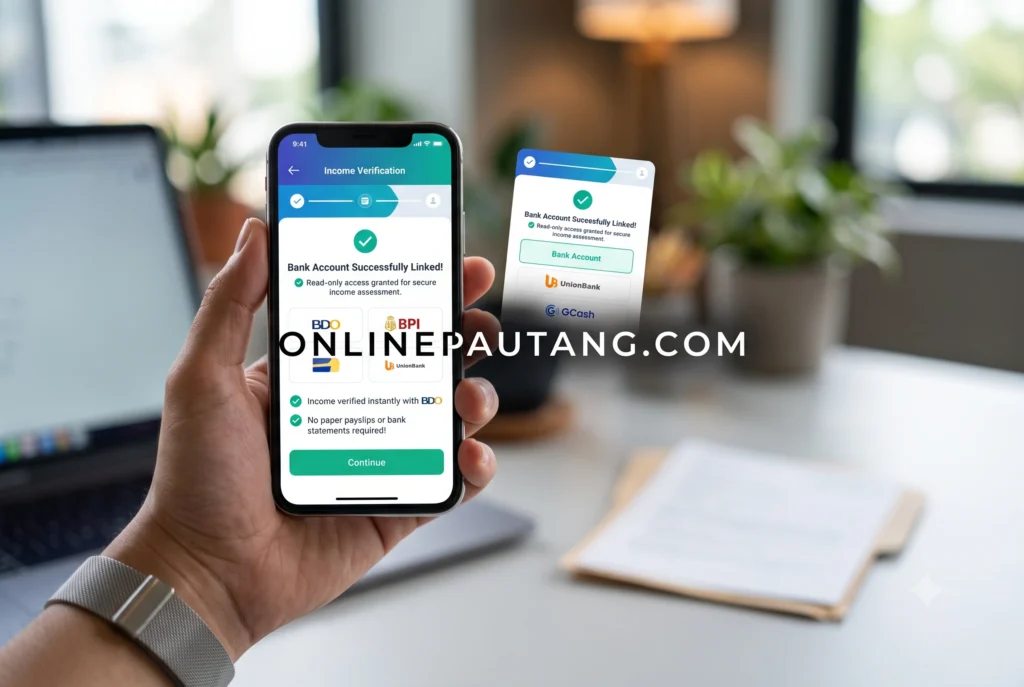
Yes, BillEase is highly accessible for gig workers because it allows applicants to link their online banking or e-wallets directly to the platform, using actual cash flow history as a substitute for a formal payslip.
BillEase takes a slightly different operational approach. While they don’t force you to upload a physical Certificate of Employment (COE) or payslip, they do require evidence of income. They solve this friction by letting you log securely into your bank or e-wallet through a read-only portal. The system scans your recent deposits – perfect for freelancers who receive payments from Upwork, Fiverr, or direct clients.
What Makes JuanHand Accessible for Unbanked Filipinos?
JuanHand focuses on rapid, automated eKYC (Electronic Know Your Customer) using primary government IDs, allowing unbanked citizens to bypass income documentation entirely for micro-loans.
JuanHand aggressively targets the unbanked sector by minimizing friction. In our live testing, the entire registration to disbursement process took roughly seven minutes. They rely heavily on the validity of your government ID and an automated facial recognition scan. As long as your face matches the ID securely, you gain access to a starter credit line. It is one of the more reliable first-time borrower platforms because the entry barrier is strictly limited to identity verification rather than financial history.
How Do You Apply for Direct to GCash Loans Without a Payslip?
You can access immediate funds without income documents by utilizing built-in mini-apps like GLoan, which relies entirely on your internal GScore, or by linking authorized third-party lending apps directly to your GCash number.
For many Filipinos, GCash has functionally replaced the traditional bank account. If you need direct to GCash loans without payslip requirements, your most friction-free route is inside the e-wallet ecosystem itself.
GLoan and GGives do not ask for external documents because they already possess your entire transaction history. Every time you buy prepaid load, pay your water bill, or receive money from a family member, your GScore fluctuates. If your score sits above a certain threshold (often around the 400-500 mark depending on the current risk appetite of the platform), a loan offer simply appears on your dashboard.
If you are using a third-party app like Tala or JuanHand, the process requires selecting “E-wallet” on the disbursement page. Be warned: the name on your loan application must match the registered name on your GCash account exactly. We have seen countless borrowers face 24-to-48-hour disbursement delays because their app profile used a nickname, while their GCash account used their formal legal name.
What Are the Top Reasons Valid IDs Get Rejected During eKYC?
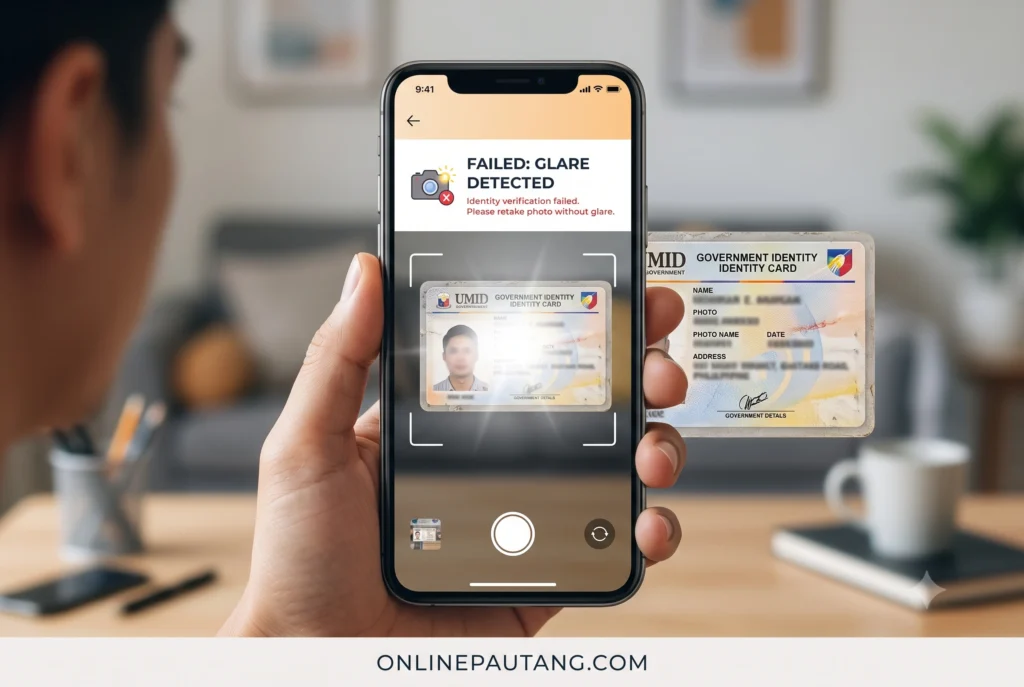
Applications are most frequently rejected because of automated system failures caused by camera glare, faded ID borders, or the submission of unsupported secondary documents like the PhilHealth ID or TIN card.
The most frustrating part of applying for digital credit is the eKYC (Electronic Know Your Customer) hurdle. You are stressed, you need funds, and the app keeps telling you to “retake photo.” Based on our granular analysis of these verification systems, the artificial intelligence scanning your ID is incredibly literal.
It searches for specific security features, barcodes, and edge alignments. The new PhilSys National ID and the UMID are the gold standards because their layouts are highly standardized. If you use an older ID, or one with a laminated surface that reflects your smartphone’s flash, the Optical Character Recognition (OCR) fails to read your name.
Furthermore, many borrowers attempt to use a PhilHealth ID or a TIN card. While these are government-issued, most major fintech platforms classify them as secondary IDs because they lack robust biometric security features and are historically easier to forge. If you only have a secondary ID, you will almost always be forced into a manual review queue, which defeats the purpose of an instant loan.
How Can Borrowers Safely Increase Their Credit Limits?
Borrowers can successfully raise their loan amounts by maintaining a flawless repayment streak on their initial micro-loans, which signals low credit risk to the platform’s algorithm.
You will rarely get approved for ₱10,000 on your first try without financial documents. Lenders manage their risk by starting you at a micro-tier – usually around ₱1,500. To borrow higher amounts without documents, you have to play the algorithmic game.
The secret is timing. Paying your loan back exactly on the due date, or a mere one to two days early, heavily positively impacts your internal credit rating with that specific app. Interestingly, paying a 30-day loan back on day two does not always result in a massive limit increase; algorithms sometimes flag this as erratic financial behavior or recognize that the platform isn’t earning enough interest off the transaction to justify a massive limit bump. Consistency over three to four loan cycles is the proven operational path to unlocking amounts upward of ₱15,000 to ₱20,000.
How Can First-Time Borrowers Avoid Predatory Online Lending Applications (OLAs)?
To avoid predatory lenders, borrowers must instantly reject any app that demands upfront processing fees, forces access to personal contact lists, or threatens public shaming for late payments.
This is the most critical advice we can impart. The digital lending space in the Philippines has a dark side. Unregistered, illegal OLAs prey on the financially vulnerable. They lure you in with promises of instant cash and zero requirements, but their business model is built on extortion, not lending.
A legitimate lender will never ask you to pay a “security deposit” or “processing fee” via GCash before they release your loan. If an app requires you to send money to get money, it is a scam.
Secondly, pay close attention to the app permissions when you install it on your Android or iOS device. Safe, NPC-compliant (National Privacy Commission) apps will ask for camera access (for your ID) and location data (for fraud prevention). Illegal OLAs will demand access to your Contacts list and Photo Gallery. If you fall behind on a payment, these illegal operators utilize contact scraping software to text your family, friends, and coworkers, falsely claiming you named them as co-makers on a debt.
Always cross-reference the app’s corporate name with the SEC’s publicly available list of registered financing and lending companies. If they are not on that list, delete the application immediately.
Making Smart Financial Decisions in a Crisis
When cash flow runs dry, the anxiety can severely cloud your judgment. The convenience of tapping a screen and receiving funds in minutes is a powerful tool, but it is one that requires immense respect. Apps that lend without payslips take on a higher risk, and they offset that risk by charging higher interest rates than standard bank loans.
Before confirming any digital loan, write down the exact repayment amount and the due date. Ask yourself truthfully if your expected gig income, freelance check, or business revenue will actually arrive by that date. Defaulting on digital loans damages your credit score with the Credit Information Corporation (CIC), making it harder to secure housing, car, or business loans in the future. Use these tools as temporary bridges during genuine emergencies, not as permanent crutches for everyday living expenses. Keep your data safe, verify the lender’s legitimacy, and always read the exact breakdown of fees before you sign the digital contract.
References
- Securities and Exchange Commission PhilippinesOrganization: SEC PhilippinesResource: List of Registered Lending CompaniesURL: https://www.sec.gov.ph/lending-companies-and-financing-companies-2/list-of-registered-lending-companies/
- Bangko Sentral ng PilipinasOrganization: BSPResource: Ceilings on Interest Rates and Other Fees for Specific LoansURL: https://www.bsp.gov.ph/Regulations/Issuances/2022/c1133.pdf
- National Privacy CommissionOrganization: NPC PhilippinesResource: Guidelines on the Processing of Personal Data for Loan-Related TransactionsURL: https://www.privacy.gov.ph/2020/09/npc-circular-no-20-01-guidelines-on-the-processing-of-personal-data-for-loan-related-transactions/
Disclaimer:This article contains affiliate links. We may earn a small commission if you apply for a loan through our links, at no extra cost to you. The information provided is for educational purposes only and does not constitute professional financial advice. Please borrow responsibly.
Last Updated on August 12, 2026 by Elena Reyes
