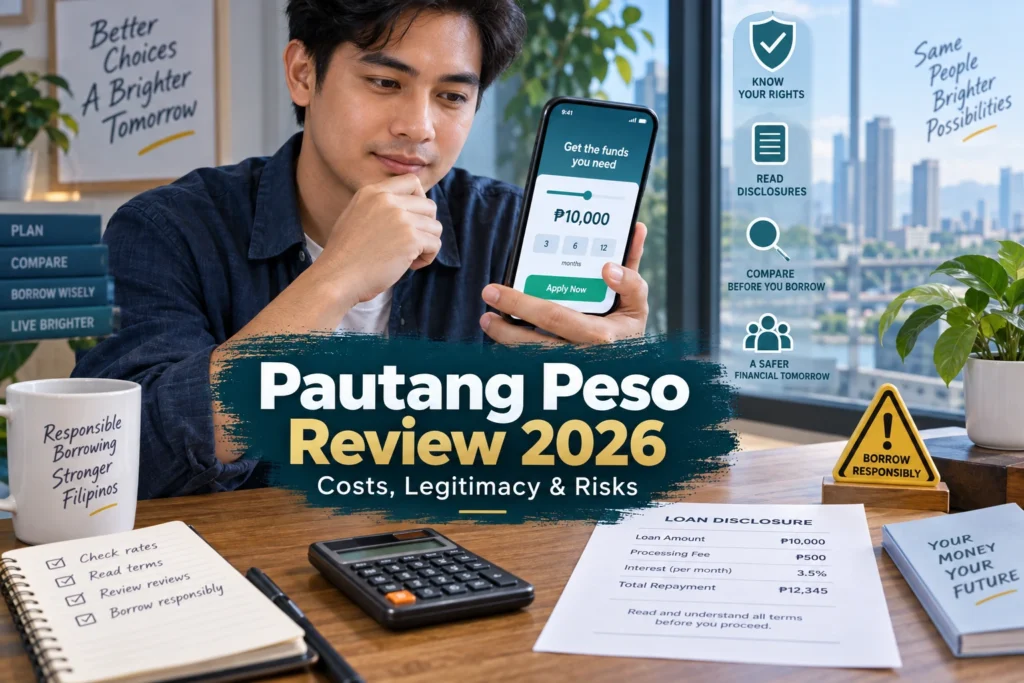
Pautang Peso is relatively easy to connect to an identifiable Philippine lending company. The harder question is whether the specific loan offer shown on your phone is transparent enough to accept.
That distinction matters because the public record is mixed. SEC records connect Pautang Peso to LHL Online Lending, Inc., with SEC registration number CS201916699 and Certificate of Authority No. 3119. At the same time, the company was fined by the SEC in 2025 over misleading loan-term disclosures. Its current public website also does not provide enough detail to independently calculate the full cost of a typical 2026 offer before entering the application flow.
This review examines the legal operator, current regulatory rules, published privacy practices, cost transparency, approval claims, credit reporting, borrower complaints, and the specific information a borrower should verify before accepting an offer. No hands-on borrowing test or actual 2026 Pautang Peso loan offer was supplied for this review. The editorial scope identifies the product as Pautang Peso for a Philippine 2026 review.
Pautang Peso is associated in SEC records with LHL Online Lending, Inc., a lending company listed with Certificate of Authority No. 3119. That regulatory identity should not be confused with a guarantee that every loan offer is inexpensive or problem-free: the SEC fined LHL ₱129,000 in July 2025 over misleading loan-term disclosures. For 2026, certain unsecured general-purpose loans of ₱10,000 or less with terms of four months or less are subject to specific SEC interest, effective-rate, penalty, and total-cost ceilings. Before accepting a Pautang Peso offer, compare the cash actually received, all deductions, total repayment, payment dates, effective interest rate, and data permissions—not just the advertised principal or approval speed.
| Borrower question | Current finding | Why it matters |
|---|---|---|
| Who operates Pautang Peso? | SEC records associate the platform with LHL Online Lending, Inc., SEC Reg. No. CS201916699, CA No. 3119. | A borrower can identify the legal lending company instead of relying only on the app name. |
| Is it simply “SEC-approved”? | That wording is misleading. Company registration, lending authority, and an online lending platform record are different regulatory concepts. | Check the actual legal company and Certificate of Authority. |
| Has the operator faced regulatory action? | Yes. The SEC imposed a ₱129,000 fine in July 2025 concerning misleading information in loan agreements. | Regulatory authorization does not guarantee that every disclosure or loan offer is problem-free. |
| What are the current loan amounts and rates? | The current public homepage does not show a complete 2026 pricing schedule sufficient to verify a typical offer. | Use the Disclosure Statement and loan agreement shown before acceptance. |
| How fast is approval? | The website advertises an 85% pass rate and “maximum 2 minutes loan,” but these are marketing claims that this review could not independently verify. | A fast application claim is not the same as guaranteed approval or actual cash settlement time. |
| What data may be collected? | The privacy policy describes collection of identity, employment, SMS transaction, installed-app, location, device, photo, and emergency-contact information. | Borrowers should review permissions as carefully as the price of the loan. |
| Can repayment affect credit records? | CIC documentation lists LHL/Pautang Peso as a submitting entity in production from February 2026. | Loan performance may become part of the formal Philippine credit-information ecosystem. |
| What if the loan is late? | Certain small short-term loans are subject to a 5% monthly late/nonpayment penalty ceiling and other cost caps under the rule effective April 1, 2026. | The protection applies only when the loan meets the rule’s scope conditions. |
Is Pautang Peso legitimate and properly authorized in the Philippines?
SEC records identify LHL Online Lending, Inc. as a lending company with SEC registration number CS201916699 and Certificate of Authority No. 3119, and earlier SEC online-lending-platform records identify Pautang Peso under LHL. That establishes an identifiable regulated operator, but it is not the same as saying every individual loan offer is automatically compliant or affordable.
Who legally operates Pautang Peso?
The current Pautang Peso website names LHL ONLINE LENDING, INC. and displays the same company registration and Certificate of Authority details found in SEC records. The site also provides an email address, telephone numbers, and a Malate, Manila business address.
This is a more meaningful legitimacy indicator than app-store availability alone. Under Republic Act No. 9474, a lending company must obtain authority from the Securities and Exchange Commission to conduct lending business. Corporate registration by itself should therefore not be presented as proof that a company is authorized to lend.
A useful borrower check is to make sure the contract, Disclosure Statement, payment instructions, and app all identify the same legal entity. The words “Pautang Peso” alone are not enough.
What does the 2025 SEC penalty mean?
In July 2025, the SEC’s financing and lending regulator fined LHL Online Lending ₱129,000 for violations associated with misleading information in loan agreements. According to reporting on the SEC order, disclosure statements referred to terms of 150, 180, or 210 days, while borrowers were allegedly required to repay on shorter schedules that could trigger additional charges. The SEC also warned that subsequent violations could result in more serious sanctions.
That regulatory action deserves weight because it is not simply an anonymous internet complaint. It also needs to be interpreted accurately: a fine is not the same as revocation of a Certificate of Authority.
In the public SEC materials reviewed for this article through September 18, 2026, I did not find a later notice establishing that LHL’s lending authority had been revoked. Borrowers should still verify current status directly against the SEC’s latest records when applying, particularly because regulatory status can change.
How much can you borrow, and what does a Pautang Peso loan really cost?
A reliable current 2026 loan range, rate, fee schedule, and repayment term could not be established from Pautang Peso’s public homepage. The decisive numbers are therefore the ones shown in your individual Disclosure Statement: principal, deductions, net proceeds, EIR, installment amounts, due dates, late charges, and total repayment.
This is an important limitation. Archived third-party copies of older app descriptions do not even agree with each other. One historical listing described a range of approximately ₱1,500 to ₱8,000 and a maximum APR of 18%, while another referred to a limit as high as ₱20,000 and a different maximum APR. Those archived figures should not be treated as Pautang Peso’s current 2026 terms.
For a borrower, an actual offer on the app is more important than an old search result.
What are the 2026 legal cost limits?
From April 1, 2026, SEC Memorandum Circular No. 14, Series of 2025 introduced revised ceilings for a defined category of consumer loans. The rule applies to unsecured, general-purpose loans offered by lending or financing companies when the loan amount is ₱10,000 or less and the tenor is four months or less.
For loans within that scope, the ceilings include:
| Cost component | 2026 ceiling for covered loans |
|---|---|
| Nominal interest | 6% per month, approximately 0.20% per day |
| Effective interest rate | 12% per month, approximately 0.40% per day |
| Late/nonpayment penalty | 5% per month on the outstanding scheduled amount due |
| Aggregate lifetime cost | Total interest, fees, charges and penalties generally cannot exceed 100% of the amount borrowed |
These are not universal caps for every loan in the Philippines. A larger loan, longer-tenor product, secured loan, or a product outside the circular’s defined scope requires a separate legal analysis.
The effective rate is particularly important because a low-looking nominal interest figure can understate the real price when processing or service fees are deducted before the money reaches the borrower.
Why does the cash you actually receive matter so much?
A public Philippine government FOI record dated June 30, 2026 contains a complaint involving Pautang Peso. The complainant alleged a ₱3,000 loan, but said only ₱1,935 was received. The complaint further alleged three monthly payments of ₱1,725, or ₱5,175 in total. The SEC response directed the person to its complaint channel; the publicly available record does not show a regulatory finding on the merits of those allegations.
Those figures nevertheless demonstrate why borrowers should calculate costs from net proceeds:
| Calculation based on the complaint | Amount |
|---|---|
| Stated principal | ₱3,000 |
| Alleged cash actually received | ₱1,935 |
| Difference deducted before receipt | ₱1,065 |
| Upfront deduction as % of stated principal | 35.5% |
| Alleged total repayment | ₱5,175 |
| Repayment above stated principal | ₱2,175 |
| Cost above stated principal | 72.5% |
| Difference between total repayment and cash received | ₱3,240 |
A borrower receiving ₱1,935 but committing to repay ₱5,175 is facing a very different economic cost from what the phrase “₱3,000 loan” suggests.
This calculation does not establish that the particular loan violated the 2026 SEC ceiling. The public complaint does not provide enough verified contractual information—such as precise origination dates, fee classifications, repayment timing and the official Disclosure Statement—to calculate the legally applicable EIR with confidence.
The lesson is simpler: never judge an offer from the approved principal alone.
How fast are Pautang Peso approval and disbursement?
Pautang Peso’s current homepage advertises an “85%” pass rate and a “maximum 2 minutes loan.” These are promotional claims, not independently verified approval statistics. The public material reviewed does not establish that every qualified borrower receives approval or that money reaches a bank or e-wallet within two minutes.
An “approval time” can also mean several different things: automated screening, a final credit decision, creation of a loan agreement, initiation of a transfer, or actual availability of funds.
Pautang Peso’s public material reviewed for this article does not provide enough detail to determine which event the two-minute statement measures.
Borrowers should also expect an actual credit decision to depend on the information provided and the lender’s underwriting. Pautang Peso does not publicly disclose its complete scoring model, so claims about precisely how salaried workers, freelancers, gig workers, self-employed applicants, or repeat borrowers are scored would be speculation.
If speed is the reason for considering the loan, check the actual amount available for withdrawal and the exact repayment obligation before accepting. A quick approval is not useful if the repayment schedule does not fit your salary or income cycle.
What personal information does Pautang Peso collect?
Pautang Peso’s current privacy policy describes broad data collection. Depending on permissions and the application process, this can include identity and employment information, SMS transaction information, installed-app metadata, location, photographs, device identifiers and emergency-contact details.
The published policy states that personal information may include name, email address, postal address, mobile number, date and place of birth, photographs, payslips and certificates of employment. With additional permission, it describes collection of SMS financial-transaction information and location data.
It also describes collecting information about installed applications, including app names and package information, for creditworthiness assessment. Device information may include operating-system details, carrier information, SIM-related identifiers, Wi-Fi information and other technical data. The policy also discusses ID images, personal photos and emergency-contact information.
For a borrower, these permissions are part of the price-risk decision even though they are not denominated in pesos.
Can a lending app use your contacts for collection?
Philippine National Privacy Commission rules restrict the processing of borrower and third-party data by online lenders. NPC Circular No. 20-01 provides that app permissions should be necessary and proportionate to legitimate purposes such as identity verification, creditworthiness assessment and fraud prevention. It prohibits harvesting a borrower’s contact list, email list or social-media contacts for debt collection or harassment. Later NPC amendments reinforced restrictions on excessive processing of information involving character references and guarantors.
This does not mean every use of a voluntarily supplied emergency or character reference is automatically prohibited. It means consent to install a lending app is not unlimited permission to collect or use unrelated third-party information in any manner the lender chooses.
Pautang Peso’s current policy says emergency-contact information can be collected. Borrowers should therefore read exactly what the app requests and distinguish a deliberately entered reference from access to an entire address book.
Can you delete your Pautang Peso account?
The privacy policy describes an account-cancellation process and says account information can be permanently deleted after cancellation, subject to stated conditions. It also describes a 90-day cooling period, during which logging in again can interrupt the cancellation process. The policy gives [email protected] as a data-protection contact.
That language should also be read alongside legal retention requirements. A lender may have legitimate obligations to retain certain transaction records even when an account is being closed, so “delete account” should not automatically be interpreted as instantaneous erasure of every record held under a legal retention duty.
What happens if you pay Pautang Peso late?
Your specific consequences depend on the signed loan agreement and whether the loan falls within the 2026 SEC price-cap rules. For covered loans of ₱10,000 or less with terms of four months or less, late or nonpayment penalties are capped at 5% per month of the scheduled amount outstanding, subject to the circular’s other cost limitations.
Late payment can involve more than a penalty. The lender may pursue lawful collection, and payment history may be relevant to future credit decisions.
In February 2026, Credit Information Corporation documentation listed LHL Online Lending, Inc. doing business under Pautang Online and Pautang Peso as a newly onboarded submitting entity in production. That means the company participates in the Philippine credit-information reporting framework. The public onboarding list does not establish exactly how every individual Pautang Peso account or delinquency is reported, so it would be too strong to say that every late payment automatically produces a specific credit-score effect.
Can you be jailed simply for an unpaid Pautang Peso loan?
The Philippine Constitution states that no person shall be imprisoned for debt. Ordinary inability to repay a consumer debt is therefore not, by itself, grounds for imprisonment.
That should not be misunderstood as saying a debt can simply be ignored. The lender can pursue lawful civil remedies, collection activity may continue within regulatory limits, and a borrower’s credit record may be affected. Conduct that independently constitutes a criminal offense—such as fraud under applicable circumstances—is a separate legal issue from ordinary nonpayment.
What are borrowers saying about Pautang Peso?
Public complaints show recurring concerns involving large differences between stated principal and cash received, unexpectedly short repayment schedules, aggressive collection messages and alleged contact with third parties. These are anecdotal reports, not proof that every borrower experiences the same problem. The strongest independent concern is the SEC’s separate 2025 finding involving misleading loan-term information.
The June 2026 FOI complaint is particularly useful because it provides concrete numbers, but it remains a complainant’s allegation. The SEC response visible in the public record did not adjudicate whether the reported ₱3,000 transaction violated the law; it directed the borrower toward the formal SEC complaint mechanism.
Older public complaints have raised similar themes about shortened repayment periods or amounts received being substantially lower than the nominal loan. Individual complaints should not be treated as representative statistics, but repeated themes become more relevant when an independent regulator has separately identified a disclosure problem involving repayment terms.
For decision-making, the best response is not to assume either that every online complaint is true or that every complaint is meaningless. Compare the allegations against the contract shown to you.
What are the main advantages and disadvantages of Pautang Peso?
| Potential advantage | Evidence-based limitation |
|---|---|
| The consumer brand can be connected to an identifiable Philippine lending company with SEC registration and a Certificate of Authority. | Regulatory identification does not guarantee favorable pricing or error-free disclosures. |
| The official website publishes company identity and contact information. | The public homepage does not provide a sufficiently complete current 2026 pricing table for an independent full-cost calculation. |
| The privacy policy provides detailed descriptions of many data categories collected. | The scope of data described—including SMS transaction data, installed-app information, location and device identifiers—deserves careful review before permission is granted. |
| Covered small short-term loans benefit from specific 2026 regulatory cost ceilings. | Those protections have defined eligibility conditions and should not be assumed to apply to every possible loan offer. |
| LHL participates in the formal CIC credit-information system. | Delinquency may have consequences beyond collection, depending on what is reported and how future lenders use the information. |
| An identifiable complaint route exists through Philippine regulators. | LHL’s 2025 SEC fine is a material regulatory-history issue borrowers should consider. |
Who may find Pautang Peso relevant, and who should be especially cautious?
Pautang Peso may be relevant to someone considering a relatively small, short-term loan who has seen the complete Disclosure Statement, knows the exact net proceeds, understands every repayment date, and has a realistic source of repayment that does not depend on another loan.
The more serious warning sign is not simply “high interest.” It is an offer where the approved amount, actual amount received and total repayment are far apart, especially when the borrower cannot explain every deduction from the disclosure documents.
A borrower should be particularly cautious when repayment would require borrowing from another app, when income timing does not match the installment dates, when large fees are deducted before disbursement, or when an app requests device permissions that the borrower does not understand.
Short-term digital credit can solve a timing problem only when the repayment obligation is smaller than the financial problem it creates.
What should you verify before accepting a Pautang Peso loan?
| Check | What to look for before tapping “accept” |
|---|---|
| Legal lender | The agreement should identify LHL Online Lending, Inc. or otherwise clearly explain the licensed entity responsible for the loan. |
| Approved principal | The nominal loan amount displayed in the offer. |
| Net proceeds | The exact pesos that will actually reach your bank account or e-wallet after deductions. |
| Upfront fees | Every processing, service, convenience, insurance or other charge deducted before disbursement. |
| Effective interest rate | Not just a daily or monthly nominal rate; check the disclosed EIR and whether fees are included correctly. |
| Total repayment | Add every scheduled installment rather than focusing on the first due amount. |
| Due dates | Confirm the actual dates rather than relying only on a stated term such as “90 days” or “180 days.” |
| Late-payment formula | Check the rate, the amount to which it applies, and whether the loan falls within the SEC’s 2026 capped-loan category. |
| Data permissions | Review SMS, installed-app, location, camera, device and emergency-contact access before granting permission. |
| Repayment evidence | Save the Disclosure Statement, signed agreement, screenshots of the offer, transfer receipt and every repayment confirmation. |
If the Disclosure Statement says one term but the payment screen shows another, resolve the discrepancy before accepting or disbursing the loan.
FAQ
Is Pautang Peso SEC-registered?
SEC records reviewed for this article identify LHL Online Lending, Inc., SEC registration number CS201916699, with Certificate of Authority No. 3119. SEC online lending records have identified Pautang Peso as one of LHL’s platforms. That is more precise than calling the app simply “SEC approved.”
Does Pautang Peso report loans to the Credit Information Corporation?
CIC documentation shows LHL Online Lending, Inc. d/b/a Pautang Online and Pautang Peso as an onboarded submitting entity in production from February 19, 2026. This supports the possibility that qualifying credit information may enter the CIC system, but the public list does not describe the reporting treatment of every individual account.
Where can I complain about Pautang Peso?
The SEC’s iMessage system includes complaints involving financing and lending companies. Privacy-related complaints can also fall within the National Privacy Commission’s complaint process when the issue concerns personal-data processing. Keep copies of your Disclosure Statement, agreement, screenshots, payment records, messages and evidence of any alleged third-party contact.
Does Pautang Peso guarantee two-minute approval?
No verified guarantee was found. The official homepage uses an “85%” pass-rate statement and “maximum 2 minutes loan” language, but it does not publish the methodology behind the percentage or establish that every borrower receives funds within two minutes.
Can I repay early?
The public sources reviewed did not provide enough current 2026 information to confirm Pautang Peso’s exact early-repayment procedure, whether fees are recalculated, or whether any charges are refundable. Check the current loan agreement and obtain confirmation of the final settlement amount before paying early.
A practical decision framework before you accept
The most useful question is not simply, “Is Pautang Peso legit?” The public record shows an identifiable lending company with a Certificate of Authority, but it also shows a regulator-confirmed disclosure violation and public borrower complaints that make careful contract checking important.
Start with five numbers: the principal shown, cash actually received, all upfront deductions, total repayment, and exact due dates. Then compare the disclosed effective rate and penalties with the rules applicable to your particular loan.
Next, look beyond price. Read the app permissions, decide whether the requested data is proportionate to the service you are receiving, and save copies of the documents before the loan is disbursed.
If the repayment schedule is unclear, the net proceeds are materially lower than the headline amount, or the only way to meet the first installment is to borrow again, stopping before acceptance may be financially safer than trying to solve the problem after disbursement.
References
- Pautang Peso Official Website
Organization: LHL Online Lending, Inc.
Resource: Pautang Peso official homepage and company information
URL: Pautang Peso official website - Pautang Peso Privacy Policy
Organization: LHL Online Lending, Inc.
Resource: Pautang Peso Privacy Policy
URL: Pautang Peso Privacy Policy - Registered Lending Companies List
Organization: Securities and Exchange Commission Philippines
Resource: SEC list identifying LHL Online Lending, Inc., SEC Reg. No. CS201916699 and CA No. 3119
URL: SEC lending-company record - Recorded Online Lending Platforms
Organization: Securities and Exchange Commission Philippines
Resource: SEC online lending platform list identifying Pautang Peso under LHL Online Lending, Inc.
URL: SEC online lending platform record - SEC Advisory Record — LHL Online Lending Inc.
Organization: Securities and Exchange Commission Philippines
Resource: SEC advisory listing dated July 17, 2025 concerning LHL Online Lending Inc. doing business under Pautang Online and Pautang Peso
URL: SEC advisory listing - SEC Fine Against LHL Online Lending
Organization: Manila Bulletin, reporting on the SEC FinLend order
Resource: Report on the ₱129,000 penalty for misleading loan-agreement information
URL: Report on SEC action against LHL - Memorandum Circular No. 14, Series of 2025 — Loan Cost Ceilings
Organization: Securities and Exchange Commission Philippines / published regulatory copy
Resource: Revised ceilings on interest rates and other fees charged by lending and financing companies
URL: SEC Memorandum Circular No. 14 regulatory text - 2026 Small-Loan Interest Cap Coverage
Organization: BusinessWorld
Resource: Report on the SEC’s revised interest and fee ceilings effective April 1, 2026
URL: 2026 SEC lending-rate rule coverage - NPC Circular No. 20-01
Organization: National Privacy Commission
Resource: Guidelines on the Processing of Personal Data for Loan-Related Transactions
URL: NPC Circular No. 20-01 - Amendments to NPC Circular No. 20-01
Organization: National Privacy Commission
Resource: NPC Circular No. 2022-02 and related amendments concerning online lending data processing
URL: NPC amendment on lending-related data processing - CIC Submitting Entity Onboarding Record
Organization: Credit Information Corporation
Resource: 2026 record listing LHL Online Lending, Inc. d/b/a Pautang Online and Pautang Peso as a submitting entity in production
URL: CIC 2026 submitting-entity record - Public Pautang Peso Complaint — June 2026
Organization: Philippine Government Freedom of Information portal
Resource: Complaint and SEC response concerning alleged Pautang Peso disbursement, repayment and collection practices
URL: June 2026 Pautang Peso FOI complaint record - 1987 Philippine Constitution
Organization: Lawphil / Government of the Philippines
Resource: Article III, Section 20 — prohibition against imprisonment for debt
URL: 1987 Philippine Constitution - SEC iMessage Complaint Guidance
Organization: Securities and Exchange Commission Philippines
Resource: SEC iMessage manual covering complaints on financing and lending companies
URL: SEC iMessage complaint guidance - National Privacy Commission Complaint Process
Organization: National Privacy Commission
Resource: Filing a privacy complaint
URL: NPC complaint process
Disclaimer:This article contains affiliate links. We may earn a small commission if you apply for a loan through our links, at no extra cost to you. The information provided is for educational purposes only and does not constitute professional financial advice. Please borrow responsibly.
Last Updated on September 18, 2026 by Elena Reyes
