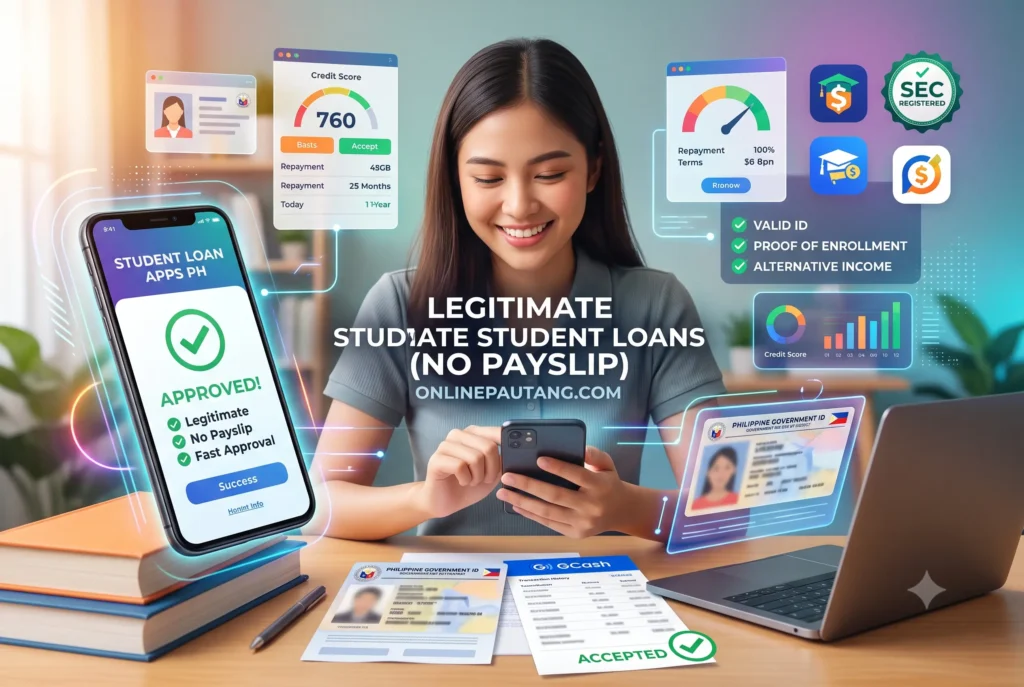
Take a deep breath. If you are reading this because your laptop screen just cracked two weeks before midterm exams, or you suddenly found yourself short on your thesis defense fee, I know exactly how heavy that panic feels. You are 19, surviving on a weekly allowance, and the thought of proving your “income” to a bank feels impossible when you do not even have a formal job.
First, let me offer you some immediate peace of mind: you are not out of options, you are not alone in this exact financial bind, and no matter what scare tactics unregulated debt collectors might text you, nobody goes to jail for unpaid civil debts in the Philippines. As someone who has analyzed the Philippine fintech sector for over a decade, I have watched the system finally start to adapt to your reality. Today’s legitimate lending platforms understand that freelance gigs, small online selling side-hustles, and consistent student allowances are actual cash flows.
Summary:
For college students 18 and above without traditional payslips, legitimate loan options exist through alternative credit scoring. E-wallets like GCash and Maya evaluate your transaction history instead of asking for employment documents. Micro-lenders like Tala accept self-declared allowance income to grant initial small limits. For specific academic needs, platforms like Bukas fund tuition directly to your school, while BillEase provides gadget financing. Always rely strictly on SEC-registered apps and avoid any platform requiring access to your phone contacts.
Quick Comparison: Top Legitimate Options for Students
| Platform | Minimum Age | Income Proof Required | Best Used For |
| Tala | 18 | Self-declared (Allowance/Gigs accepted) | Emergency cash bridging, sudden small expenses |
| GCash (GLoan) | 18 | None (Relies entirely on GScore) | General cash needs for active app users |
| Maya Credit | 18 | None (Based on Maya transaction history) | Paying bills, buying load, or QR merchant payments |
| Bukas.ph | 18 | Co-borrower (if student has zero income) | Tuition fees paid directly to partner universities |
| BillEase | 18 | E-wallet history, freelance proof | Gadget financing (e.g., replacement laptops) |
How Do I Prove Income If I Only Receive an Allowance?
You can prove income without a payslip by maintaining consistent cash-in patterns on e-wallets like GCash or Maya, or by declaring your monthly allowance as freelance or remittance income on digital platforms.
The biggest hurdle students face is the phrase “Proof of Income.” Traditional banks want a Certificate of Employment or three months of payslips. Fintech apps, however, use behavioral data. When an app asks for your income source during registration, declaring “Remittance,” “Allowance,” or “Freelance” is completely acceptable. The system is designed to check if money flows into your life regularly, not necessarily if it comes from a corporate payroll account.
Can I Use GCash or Maya Transaction History as Proof of Income?
Yes, platforms like GCash and Maya use alternative credit scoring algorithms that analyze your daily transaction volume, bills payment history, and wallet balances instead of requiring traditional employment documents.
If you are a student, your e-wallet is your financial resume. Your GScore or Maya credit standing is built entirely on your digital footprint. Every time your parents send your allowance to your GCash, every time you pay for a fast-food meal via QR code, and every time you buy mobile load, the algorithm logs you as an active, reliable user.
Practical Tip: Do not just receive your allowance in cash and keep it in your wallet. Cash it in at a convenience store immediately, then use the app to pay for your daily expenses. This creates a highly visible paper trail of “income” and responsible spending, which triggers your eligibility for features like GLoan or Maya Credit faster.
What Are the Limits for Zero-Income Declared Profiles?
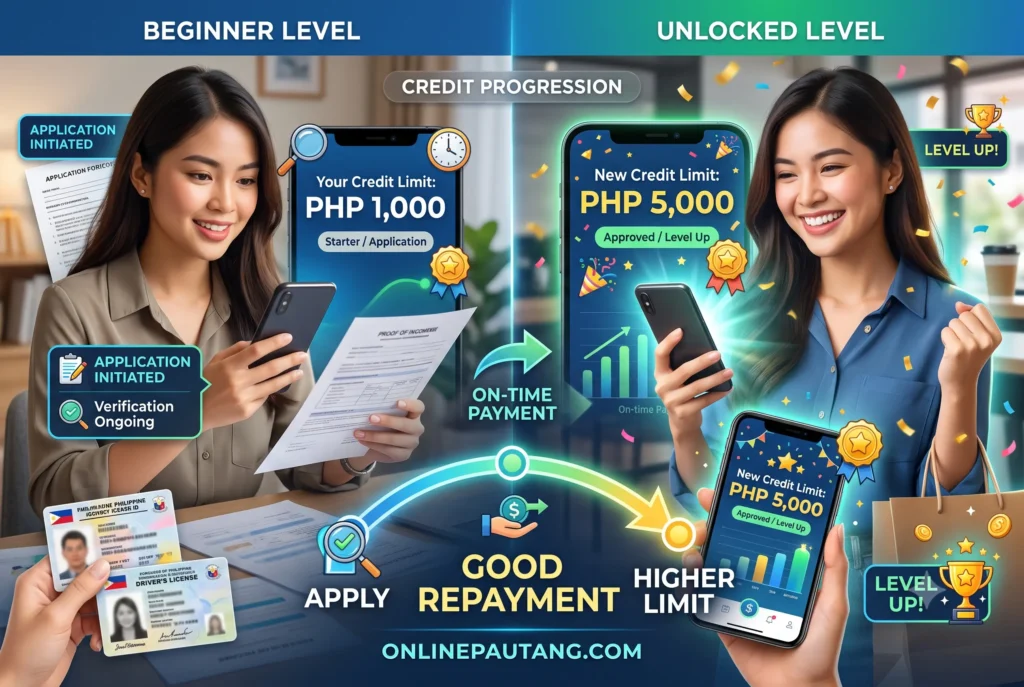
Students with zero formal income usually start with micro-limits ranging from PHP 1,000 to PHP 2,000, which can gradually increase as they build a positive repayment history.
Do not expect a PHP 20,000 credit line on your first try. Risk management teams at these fintech companies are highly conservative with 18-to-20-year-old profiles. If you use an app like Tala and declare a moderate allowance, the system will likely test your reliability with a PHP 1,000 starter limit. The secret here is velocity: borrow the PHP 1,000, pay it back precisely on time, and the algorithm automatically upgrades your risk profile, unlocking higher tiers for your next emergency.
Which Loan Apps Accept 18-Year-Old Students in the Philippines?
Tala, GCash, and Maya accept 18-year-old borrowers, provided they pass identity verification with a National ID. Apps like BillEase and Bukas also cater to 18-year-olds for specific education or gadget purchases.
The legal age to enter into a binding financial contract in the Philippines is 18. However, age alone does not guarantee approval. The platforms that cater to 18-year-olds specialize in micro-lending and alternative data. They know you are young, so they evaluate your digital behavior rather than your nonexistent credit history.
How Does Tala Evaluate Students Without Formal Employment?
Tala bypasses traditional payslips by assessing your mobile device data, digital footprint, and self-declared allowance or part-time income to build a localized trust score for initial micro-loans.
Tala is arguably the most accessible platform for a college freshman. During the application, you will fill out a short survey. Be honest. If your income comes from selling thrifted clothes online or receiving a weekly allowance from your province, state exactly that. The app’s backend connects the dots between your self-declared status and the basic device metadata you allow it to see, rendering a decision in minutes.
Why Do Some Apps Require Borrowers to Be 21 Years Old?
Many traditional banking apps set their minimum age to 21 to mitigate default risks, aligning with older credit policies that assume individuals under 21 lack stable earning capacity.
You might notice that bank-backed apps (like CIMB or Tonik) strictly gatekeep their personal loans for users aged 21 and older. From a risk analyst’s perspective, 21 is typically the age of college graduation and entry into the formal workforce. These institutions operate on thinner margins and cannot afford the higher default rates statistically associated with teenagers. Do not take a rejection from these specific banks personally; your demographic simply falls outside their current risk appetite.
What Is the Difference Between Cash Loan Apps and Tuition Installment Platforms?
Cash loan apps disburse money directly to your e-wallet for any expense, while tuition platforms like Bukas pay your school directly and you repay the platform in monthly installments.
When you are short on funds, you need to match the type of loan to your exact problem. If you need PHP 1,500 for groceries and a sudden laboratory fee, a cash app is appropriate. But if you are short PHP 15,000 for your enrollment, relying on high-interest, short-term cash loans will trap you in a severe debt cycle. This is where purpose-built platforms come in.
How Does Bukas.ph Work for College Tuition Funding?
Bukas partners with universities to cover up to 100% of your tuition fees upfront. You then repay Bukas over 12 months, avoiding sudden cash-out pressure during enrollment periods.
Bukas is a game-changer for the Philippine education sector. Instead of handing you cash, they settle your balance directly with their partner university’s cashier. Since you are a student without a payslip, Bukas will require a co-borrower—usually a parent, older sibling, or guardian with verifiable income. This structure allows you to secure large tuition funds safely, spreading the heavy burden across manageable monthly payments while keeping interest rates strictly regulated.
When Should I Use BillEase for Gadgets Instead of Cash Loans?
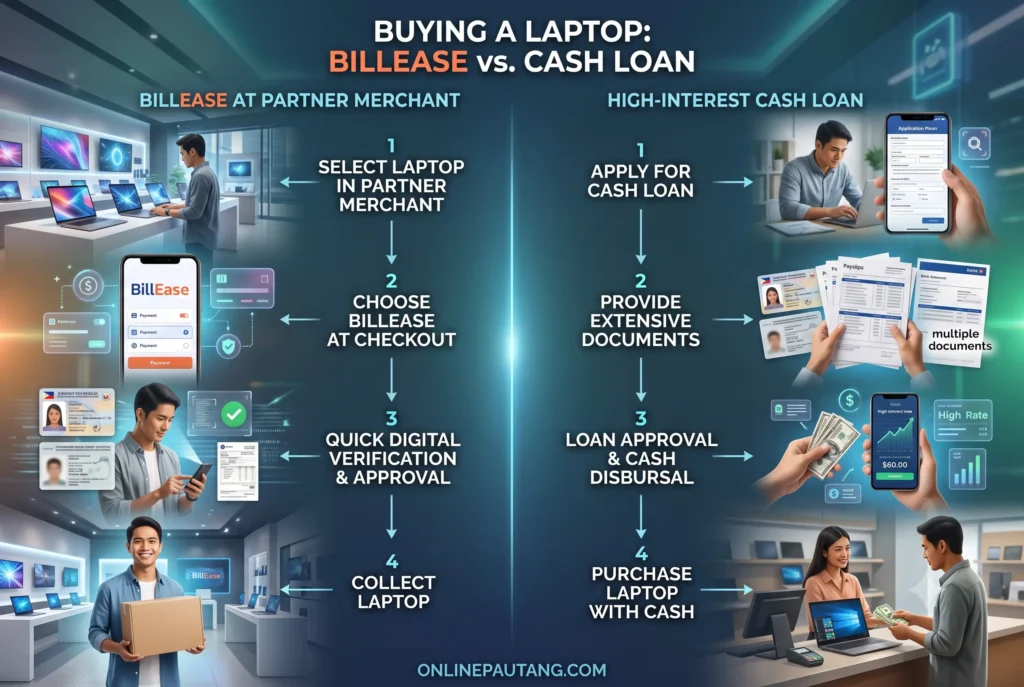
Use BillEase when you need to buy a specific item, like a thesis laptop, because they offer lower interest rates and direct merchant checkout compared to high-interest general cash loans.
Imagine your laptop dies entirely. Taking out a fast cash loan to buy a new one means you are paying a high premium for cash liquidity. BillEase, as a “Buy Now, Pay Later” (BNPL) provider, integrates directly with stores like DataBlitz or Kimstore. Because the funds never touch your hands and go straight to the merchant, the risk is lower for the lender, which translates to much lower interest rates for you.
Can I Use My School ID for an Online Loan Application?
Most SEC-regulated lending apps do not accept school IDs. You must present a government-issued National ID, Passport, or Driver’s License to comply with the central bank’s strict Know Your Customer (KYC) rules.
I frequently see students trying to upload their university IDs to financial apps, only to face immediate rejection. The Bangko Sentral ng Pilipinas (BSP) mandates rigorous verification protocols to prevent identity theft and money laundering. A school ID simply does not hold the biometric and centralized database weight of a government document. Before searching for legit fast loan apps, ensure your identity documentation is fully in order.
What Are the Usually Accepted Valid IDs for Student Borrowers?
The most reliable valid IDs for student borrowers include the PhilSys National ID (or ePhilID), Passport, Postal ID, and UMID, as these contain verifiable biometric data and signatures.
If you are 18, prioritize getting your PhilSys National ID. Even the paper version (ePhilID) is legally mandated to be accepted by all financial institutions in the country. If you are waiting on that, a Postal ID is the fastest secondary option you can acquire without needing formal employment. Keep in mind that PhilHealth and TIN cards are generally classified as secondary IDs and are rarely accepted on their own by automated apps. Reviewing the list of accepted valid IDs before applying will save you days of frustrating rejections.
Why Do eKYC Systems Reject Valid IDs and How Can I Fix It?
Automated eKYC systems reject IDs due to camera glare, faded borders, or mismatched information. Fix this by wiping your camera lens, finding natural light, and ensuring your registered name matches exactly.
Electronic Know Your Customer (eKYC) technology relies on optical character recognition (OCR). It is a machine reading your ID, not a human. If you take a photo of your UMID under a bright bedroom light, the glare will white out your birthdate, and the system will automatically drop your application.
Practical Tip: Go outside or stand near a window during daytime. Wipe your smartphone camera lens. Place your ID on a dark, flat surface to create high contrast. Ensure all four corners of the card are visible in the frame. If you have a suffix like “Jr.” or “III,” ensure you type it exactly as it appears on your physical card.
How Can Students Spot Predatory Lenders and Avoid Harassment?
You can spot predatory lenders if they ask for access to your contacts, charge upfront processing fees, or do not appear on the official SEC list of registered lending companies.
The desperation of needing school funds quickly makes students prime targets for illegal “7-day loan” apps floating around social media. These are loan sharks operating under the guise of fintech.
Here is exactly how they operate: you download the app, and a pop-up asks for permission to read your contacts and photo gallery. If you click ‘Allow’, they scrape your phonebook. If you miss a payment by even one hour, they will text your professors, classmates, and family members, falsely claiming you named them as guarantors.
A legitimate, SEC-registered app will never resort to public shaming, nor will they ask you to pay a “processing fee” via a personal GCash number before releasing your funds. If an app promises zero requirements and instant approval in two minutes, delete it immediately. Always verify the app developer’s name against the Securities and Exchange Commission’s official list of registered lending companies.
Managing your finances as a student is incredibly challenging, especially when unexpected expenses threaten your education. By leaning on regulated alternative-scoring apps and keeping a clean digital footprint, you can bridge those gaps safely without compromising your mental health or future financial standing. Borrow exactly what you need, plan your repayment from your next allowance cycle, and protect your identity fiercely.
References
- Securities and Exchange Commission PhilippinesOrganization: SEC PhilippinesResource: List of Registered Lending CompaniesURL: https://www.sec.gov.ph/lending-companies-and-financing-companies-2/list-of-registered-lending-companies/
- Bangko Sentral ng PilipinasOrganization: BSPResource: Financial Consumer Protection FrameworkURL: https://www.bsp.gov.ph/Pages/InclusiveFinance/ConsumerAssistance/Default.aspx
- Philippine Identification SystemOrganization: Philippine Statistics Authority (PSA)Resource: ePhilID Acceptance and GuidelinesURL: https://philsys.gov.ph/ephilid/
- Bukas Finance CorpOrganization: BukasResource: How Bukas Tuition Installment WorksURL: https://bukas.ph/how-it-works/
Disclaimer:This article contains affiliate links. We may earn a small commission if you apply for a loan through our links, at no extra cost to you. The information provided is for educational purposes only and does not constitute professional financial advice. Please borrow responsibly.
Last Updated on July 3, 2026 by Elena Reyes
