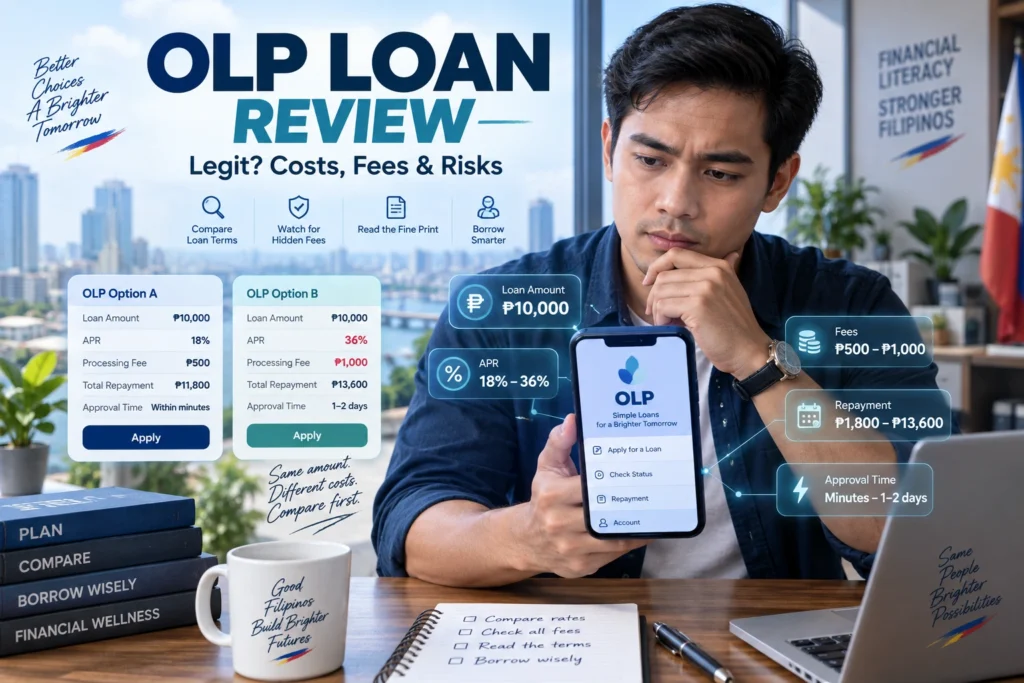
The most important issue in an OLP loan review in 2026 is not whether the app can send money quickly. It is whether the borrower can identify the legal lender, understand the exact amount that will arrive, and verify the total repayment before accepting the offer.
Online Loans Pilipinas presents an unusual problem for borrowers researching those questions: its current website and its Google Play listing publish materially different product limits, repayment periods, APRs, eligibility ages, and processing timelines. The differences are large enough that a borrower should not treat either marketing page as a substitute for the individual Disclosure Statement shown before accepting a loan.
This review was researched on September 22, 2026 using SEC records, OLP’s current website and contractual documents, its privacy notice, current app-store information, National Privacy Commission guidance, Credit Information Corporation records, and public borrower reviews. It was not based on a hands-on borrowing test, so no approval, loan limit, or disbursement speed in this article should be read as a guaranteed personal outcome.
Online Loans Pilipinas is operated by Online Loans Pilipinas Financing, Inc., which appears in SEC records under registration number CS201726430 and Certificate of Authority 1181; SEC records also identify Online Loans Pilipinas as its online lending platform. The bigger 2026 concern is disclosure consistency. OLP’s website states loans of ₱1,000 – ₱20,000, 61 – 183 days and maximum APR of 143%, while Google Play states ₱1,000 – ₱30,000, 90 – 720 days and maximum APR of 180%. Before borrowing, rely on the actual Disclosure Statement – not an advertisement – and check net proceeds, EIR, total repayment, payment dates, late charges, and data permissions.
| Borrower question | Current finding | Why it matters |
|---|---|---|
| Who is the lender? | Online Loans Pilipinas Financing, Inc. | The legal lender is identifiable rather than an unnamed app operator. |
| SEC status | SEC Reg. No. CS201726430; CA No. 1181 | A Certificate of Authority is more relevant than corporate registration alone. |
| Is OLP an identified online platform? | An SEC list identifies “Online Loans Pilipinas” under the company. | Helps connect the consumer brand with the financing company. |
| Advertised loan range | Website: ₱1,000 – ₱20,000; Google Play: ₱1,000 – ₱30,000 | Public disclosures currently conflict. |
| First-time amount | Google Play states ₱1,000 – ₱7,000 | The headline ₱30,000 maximum should not be assumed for a new borrower. |
| Advertised tenor | Website: 61 – 183 days; Google Play: 90 – 720 days | The difference affects both affordability and which regulatory rate ceilings may apply. |
| Published maximum APR | Website: 143%; Google Play: 180% | Borrowers should verify the offer-specific EIR rather than relying on a headline APR. |
| Approval timing | Homepage says minutes; another OLP application page says 1 – 2 working days after complete requirements | “Fast approval” is not a guaranteed application-to-cash time. |
| First-loan promotion | OLP advertises 0% for qualifying first-time borrowers during the initial period | Late payment can change the cost substantially. |
| Credit reporting | OLP’s terms say it submits basic credit data to CIC; the company appears on CIC’s registered FinLend list | Repayment history may matter beyond the current loan. |
| Contact list | Current privacy notice says it does not access the borrower’s contact list or call logs | This should be checked against the permissions actually requested on the device. |
| Other device data | Privacy notice says OLP may collect SMS data, in-use location, device information and limited installed-app metadata | Privacy exposure is broader than simply submitting an ID. |
Is OLP legitimate and properly authorized in the Philippines?
Online Loans Pilipinas has an identifiable financing company behind it. SEC records list Online Loans Pilipinas Financing, Inc. under registration number CS201726430 and Certificate of Authority No. 1181, while an SEC online-platform list associates “Online Loans Pilipinas” with that company.
Who legally provides the loan?
OLP’s own Credit Terms and Conditions define the “Lender” as Online Loans Pilipinas Financing, Inc. They also define the loan amount, net loan proceeds, approval notice, disclosure form and credit agreement as parts of the lending transaction.
That distinction matters. OLP is not simply a comparison website forwarding applications to an unidentified third-party lender. Its published contractual documentation names the financing company itself as lender.
The legal details displayed by the current Google Play listing match the company information found in SEC records: Online Loans Pilipinas Financing, Inc., SEC Registration No. CS201726430, CA No. 1181, with an address at Summit One Office Tower on Shaw Boulevard in Mandaluyong.
This does not mean the SEC “approves” every OLP loan offer, price or collection action. Corporate registration, authority to operate as a financing company, recording of an online lending platform, and approval of an individual loan product are different concepts.
It also does not mean an authorized loan is automatically affordable. Legitimacy and cost are separate questions.
Why do OLP’s current public loan terms contradict each other?
OLP’s website and Google Play currently give different answers for the maximum loan, loan tenor, maximum APR and minimum applicant age. The differences are material enough that the borrower’s individual Disclosure Statement should be treated as the decision document.
Here is what the two public sources showed during this review:
| Product detail | OLP website | Google Play listing |
|---|---|---|
| Loan amount | ₱1,000 – ₱20,000 | ₱1,000 – ₱30,000 |
| First-time limit | Not clearly stated in product disclosure | ₱1,000 – ₱7,000 |
| Loan period | 61 – 183 days | 90 – 720 days |
| Maximum advertised APR | 143% | 180% |
| Applicant age | 22 – 70 | 18+ |
| Employment | Employed / selected professionals | Employed or self-employed |
| Approval language | Decision “in a few minutes” | SMS/call after application |
| Disbursement claim | Less than 5 minutes via InstaPay | Five minutes after approval |
| ₱10,000 / 3-month example | ₱13,565 total repayment | ₱14,500 total repayment |
The website’s product disclosure says a ₱10,000 three-month loan at its stated 143% APR would produce a total repayment of ₱13,565, including ₱3,565 of overpayment.
Google Play gives a substantially different example for the same ₱10,000 and three-month term: ₱14,500 total repayment, or ₱4,833 per month, and labels the APR 180%.
There is no good borrower-safety reason to average those two numbers or guess which one will appear in an actual offer. The relevant figures are the ones in the Disclosure Statement and credit agreement presented for the specific loan.
There is another sign that some public documentation may span different product generations. The current Terms and Conditions still contain provisions referring to loans with 7-, 10-, 15-, 21- and 30-day terms, even though the public website now advertises a 61-day minimum and Google Play a 90-day minimum.
That does not by itself prove that an improper product is being offered. It does mean borrowers should avoid assuming every public OLP page describes the same current loan structure.
What does an OLP loan really cost in pesos?
Published OLP examples show why the total repayment matters more than a promotional interest headline. A public ₱10,000 three-month example costs either ₱3,565 or ₱4,500 above principal depending on which OLP source is used.
Comparing the two ₱10,000 examples
| Public example | Cash principal assumed | Stated total repayment | Peso borrowing cost | Cost as % of principal |
|---|---|---|---|---|
| OLP website | ₱10,000 | ₱13,565 | ₱3,565 | 35.65% |
| Google Play | ₱10,000 | ₱14,500 | ₱4,500 | 45.00% |
Those percentages are not annualized rates. They simply show how many extra pesos would be repaid over the stated three-month period.
A second check is useful. If we assume the borrower receives the entire ₱10,000 immediately and then makes three equal month-end payments, the website example produces a simplified monthly internal rate of return of about 16.9%, while the Google Play example produces about 21.2%.
These are analytical estimates, not legal determinations of the contractual EIR. Exact EIR calculation depends on the actual dates, payment schedule, deductions and charges appearing in the Disclosure Statement.
How does the 2026 SEC rate ceiling affect this?
SEC Memorandum Circular No. 14, Series of 2025 took effect for covered transactions beginning April 1, 2026. It applies to unsecured, general-purpose loans from financing or lending companies when the amount does not exceed ₱10,000 and the tenor does not exceed four months. For that defined category, the circular sets a nominal-interest ceiling of 6% per month, an EIR ceiling of 12% per month including applicable fees and charges, a late/nonpayment penalty ceiling of 5% per month on the outstanding scheduled amount, and a 100% total-cost cap.
This scope is important: the 12% monthly EIR ceiling is not a blanket ceiling for every OLP loan. An amount above ₱10,000 or a tenor longer than four months falls outside this particular numerical cap, although other consumer-protection, disclosure and contract rules still apply.
The two public OLP representative examples are therefore difficult to reconcile with the current ceiling if they are intended to represent new, unsecured, general-purpose ₱10,000 three-month loans contracted after April 1, 2026. The simplified rates above exceed 12% per month.
That is a disclosure red flag to verify, not a finding that a specific signed OLP loan violates the law. Public calculators or marketing examples may be outdated, and a legal EIR assessment requires the actual offer’s cash flows.
For a borrower, the practical response is straightforward: ask what EIR appears in the Disclosure Statement for the actual loan, not what maximum APR appears on a website.
How much can you actually borrow from OLP?
Google Play currently states ₱1,000 – ₱7,000 for first-time applicants and up to ₱30,000 for repeat borrowers in good standing. OLP’s website, however, publishes a maximum of ₱20,000, and the lender expressly reserves the right to approve less than requested.
OLP’s contractual terms are particularly important here. They state there is no guarantee that the amount applied for will be granted. The lender may reject the application or approve a reduced amount at a lower tier.
That means a ₱20,000 or ₱30,000 headline should not be interpreted as the amount a new applicant will receive.
OLP does not publicly disclose its full proprietary scoring model. Its privacy documentation indicates that credit evaluation can involve declared income, employment or livelihood information, existing obligations, credit information, bank or e-wallet information and external credit-scoring sources. It also describes fraud and credit-risk uses of certain device data.
Approval should therefore be viewed as underwriting, not merely completion of an online form.
How fast is OLP approval and disbursement in 2026?
OLP advertises a decision within minutes and money in under five minutes through InstaPay, but another current OLP application page says complete applications may take one to two working days to process. The five-minute message should not be treated as guaranteed application-to-cash time.
This is another public disclosure conflict worth noticing.
On OLP’s main page, the process says the application takes about three minutes, the decision arrives in a few minutes, and disbursement through InstaPay takes less than five minutes.
The separate “Apply for a Loan” page says OLP can process applications one to two working days after receiving documentary requirements and tells applicants to expect a call, email or SMS one to two days after submitting complete requirements.
Those claims can coexist only if some applications are automated while others require additional review, or if the pages describe different workflows. OLP does not provide enough public detail to establish which applicants fall into each path.
The Terms and Conditions also permit the lender to request additional documents when necessary.
For emergency borrowing, the safe assumption is therefore that “five minutes” refers to a best-case payout after approval, not a guaranteed period from starting an application to having usable cash.
How does OLP repayment work?
OLP documents several repayment channels, including e-wallets and online banking through Dragonpay, 7-Eleven and multiple payment-center networks. Borrowers should always use the loan reference number and retain proof until the payment is reflected in the OLP account.
Google Play currently lists GCash and other e-wallets or online banking through Dragonpay, 7-Eleven Cliqq through Dragon Loans, and payment locations including Bayad Center, LBC, Cebuana, SM, Robinsons, RD Pawnshop and Palawan Express.
The current Terms and Conditions also describe an optional direct-debit feature supporting BPI, UnionBank, ShopeePay and Maya. They warn that using direct debit does not guarantee that an installment was successfully settled; the borrower remains responsible for confirming payment.
That detail matters because payment initiation and payment posting are not necessarily the same event.
Can you cancel after the money has been disbursed?
OLP’s current terms provide a three-business-day cooling-off period after receipt of loan proceeds. The borrower must notify customer support within that period. OLP then instructs the borrower to return the proceeds, with its terms specifying return within two calendar days after confirmation of the cancellation notice and submission of proof of return.
Outside the cooling-off window, a cancellation may instead be treated as prepayment. For installment loans, the terms also mention conditions and a possible early-repayment fee if repayment occurs outside the stated permitted timing.
Anyone considering immediate repayment should therefore check the actual loan agreement rather than assuming early repayment is automatically free.
What happens if you pay OLP late?
OLP’s terms allow late-payment charges and, depending on the product, continuing service charges or a prolongation arrangement. For loans covered by SEC MC No. 14, late/nonpayment penalties are capped at 5% per month on the outstanding scheduled amount due.
For first-time applicants, OLP states that initial interest and its service fee may be 0% during the initial granted period. If the loan remains unpaid after that period, the terms say a service fee may begin accruing according to the contractual rate. The agreement separately provides for a Late Payment Fee when payment is not made by the due date.
For a covered small short-term loan, contractual wording cannot simply be read without considering the SEC’s current ceilings. From April 1, 2026, MC No. 14 caps the late/nonpayment penalty at 5% per month on the outstanding scheduled due amount and places a 100% ceiling on total interest, fees, charges and penalties for loans falling within the circular’s scope.
Can an overdue OLP loan affect your credit record?
OLP’s terms state that, pursuant to Republic Act No. 9510, it submits basic credit data and updates or corrections to the Credit Information Corporation and CIC-accredited credit reporting agencies. Online Loans Pilipinas Financing, Inc. also appears in CIC’s published list of registered FinLend companies.
That does not mean one late payment automatically produces a particular credit score reduction. Credit scoring depends on the information reported and the model used by the relevant credit bureau or lender. It does mean nonpayment should not be treated as having no consequence beyond collection calls.
Ordinary inability to pay a debt is not, by itself, a basis for imprisonment: Article III, Section 20 of the 1987 Philippine Constitution states that no person shall be imprisoned for debt or nonpayment of a poll tax. Separate conduct that independently constitutes a criminal offense is a different legal issue.
What personal data does the OLP app collect?
OLP’s current privacy notice says it may process identity, biometric, financial and credit information as well as SMS data, location while the app is in use, device information and limited installed-app metadata. It explicitly says it does not access the customer’s contact list or call logs.
The SMS provision deserves particular attention. OLP says it may periodically collect and transmit sender names, SMS body content and received time to its servers and third parties to assess income, spending patterns, affordability and fraud risk.
It also says it may request location while the app is being used during onboarding, verification or disbursement, while stating that it does not collect location in the background.
For installed applications, OLP’s notice says it may collect limited metadata such as the application name and category after explicit consent, for fraud, security and credit-risk assessment, using technology provider Credeau. The policy says it does not collect app content, login credentials, personal messages or usage activity through that particular installed-app process.
Google Play’s developer-provided Data Safety disclosure separately says the app may share location, personal information and several other categories with third parties, and may collect personal and financial information plus other categories. Google notes that this Data Safety information is supplied by the developer.
Can OLP contact people stored in your phone?
OLP’s current policy says: the customer contact list is not accessed, and the company says it does not collect call logs.
Philippine privacy rules provide another protection. The NPC says lenders and financing companies must not require unnecessary app permissions, and expressly prohibits contacting people in a borrower’s contact list for debt collection other than persons who were actually declared as guarantors. Character references are also not automatically guarantors.
If the installed app requests permissions that appear inconsistent with the published privacy notice, document the permission screen before granting access and ask why that permission is necessary.
OLP’s policy also says personal information may be shared where appropriate with regulators, credit bureaus, payment partners, IT/cloud providers, collection agencies and legal or compliance service providers. Certain records may be retained for at least five years where legal or regulatory requirements apply.
What are borrowers reporting about OLP?
OLP has more than 100,000 Google Play reviews and 5 million-plus downloads, but store ratings alone do not establish loan quality. Detailed public complaints visible during this review repeatedly mention pre-due payment reminders, payment-posting delays and customer-service friction. These reports remain anecdotal.
The most useful reviews are those describing a specific transaction rather than simply saying “good app” or “easy approval.”
On Apple’s Philippine App Store, a September 2025 reviewer alleged receiving repeated calls and messages several days before the due date and continuing calls after early payment. OLP’s developer response directed the reviewer to live-chat support.
Another July 2025 App Store reviewer reported that a Dragonpay/InstaPay payment had been confirmed by the payment provider but had not yet appeared in the OLP account several hours later. A separate July review reported an approved loan shown as disbursed before the money was received. These are individual reports and cannot establish how often either problem occurs.
A more recent surfaced App Store review complained about reminders beginning several days before the due date and payment information taking time to update. OLP’s developer response stated that its payment-reminder system may call clients one to four days before the due date.
Older Google Play reviews also contain complaints about frequent reminder calls and approved terms differing from what applicants expected, but because those reviews date back to 2021 and 2023, they should not be treated as evidence that the same workflow operates unchanged in 2026.
The more defensible takeaway is narrower: posting time and pre-due reminder practices are worth checking before borrowing, and payment receipts should be retained until the account status updates.
What are the main advantages and disadvantages of OLP?
OLP has a clearly named legal financing company, established repayment channels and a published cooling-off procedure. Its main 2026 weaknesses are inconsistent public loan disclosures, conflicting approval-time claims and fairly broad data processing described in its privacy notice.
| Potential advantage | Why it matters |
|---|---|
| Legal lender and CA are identifiable | Easier to verify who holds the debt and which regulator handles lending complaints. |
| First-time 0% promotion is documented | A qualifying borrower who meets the promotion’s conditions may avoid initial interest/service fees. |
| Multiple repayment channels are disclosed | Borrowers have alternatives to a single bank-transfer method. |
| Three-business-day cooling-off process is published | Provides a documented route to rescind shortly after receiving proceeds. |
| Privacy notice expressly says no contact-list or call-log access | Gives borrowers a clear policy against which actual permission requests can be checked. |
| Potential drawback | Why it matters |
|---|---|
| Website and Google Play publish different limits, tenors and APRs | Makes marketing information unreliable as a final basis for an affordability decision. |
| ₱10,000/three-month examples differ by ₱935 in total repayment | Demonstrates why an offer-specific Disclosure Statement is necessary. |
| Public pricing examples are difficult to reconcile with the 2026 capped-loan rule if applied to a covered loan | Borrowers should verify EIR before accepting. |
| “Minutes” approval marketing conflicts with a 1 – 2-working-day application page | Emergency borrowers should not depend on an advertised best-case timeline. |
| SMS, location, device and app-metadata processing may be used | Applicants should decide whether the data exchange is proportionate to the credit they are seeking. |
| Public reviews describe reminder-call and posting friction | Borrowers may need to keep strong payment records and resolve posting problems quickly. |
Who might find OLP relevant, and who should be especially cautious?
OLP may be relevant when the actual offer is fully understood and repayment can come from expected income without taking another loan. Greater caution is warranted when a borrower is relying on the maximum advertised amount, an instant-payout promise, or future refinancing to meet the due date.
A small emergency loan can solve a timing problem, but only when the repayment obligation fits within the next available cash flow. The important comparison is not “Can I obtain ₱5,000 today?” It is “After receiving the net proceeds, can I pay every scheduled peso on time without sacrificing essential expenses or borrowing again?”
A first-loan 0% promotion can look particularly attractive. Yet the relevant risk begins when the initial period expires and the borrower cannot settle according to the agreement. OLP’s own terms provide for charges after the initial first-borrower period when a loan remains unpaid.
Repeat borrowing also deserves caution. A higher repeat limit is increased access to debt, not evidence that the larger loan is more affordable.
What should you verify before accepting an OLP loan?
Do not accept based on the ₱20,000 or ₱30,000 headline, the 0% banner, or the five-minute claim. The offer should be assessed from its net proceeds, contractual EIR, total repayment, exact due dates, late-payment exposure and data permissions.
| Check before accepting | What to look for |
|---|---|
| Legal lender | “Online Loans Pilipinas Financing, Inc.” and the correct account/reference details |
| Approved principal | The actual amount approved, not the amount originally requested |
| Net loan proceeds | Cash that will actually reach the bank/e-wallet after any deductions |
| Upfront deductions | Service, third-party, insurance or disbursement charges, if any |
| EIR | The offer-specific effective interest rate in the Disclosure Statement |
| Total repayment | The full peso amount over all installments |
| Payment schedule | Exact dates and amounts, not merely “3 months” |
| Regulatory scope | For an unsecured general-purpose loan ≤₱10,000 and ≤4 months contracted from April 1, 2026, compare the offer with SEC MC No. 14 |
| Late charges | Late-payment fee, continuing service charges and any extension/prolongation charge |
| Early repayment | Whether an early-payment fee or timing restriction applies |
| Payment channel cost | Any third-party convenience or transfer fee |
| Data permissions | SMS, location, device and installed-app access actually requested |
| Credit reporting | Assume repayment data can be reported to CIC |
| Cancellation | Save the three-business-day cooling-off instructions before accepting |
| Proof | Download the Disclosure Statement, agreement and repayment confirmation |
The SEC states that failure by a financing or lending company to provide a Disclosure Statement before consummation of the loan can raise an issue under the Truth in Lending Act. Complaints involving registered financing/lending companies and their OLPs are filed through the SEC iMessage Portal; data-privacy complaints, including unauthorized contact access, fall within the National Privacy Commission’s domain.
OLP Loan Review FAQ
Can OLP approve less than the amount I requested?
Yes. OLP’s Terms and Conditions expressly say there is no guarantee the requested amount will be granted and that it may approve a lower tier. Google Play also states that first-time applicants currently have a published range of ₱1,000 – ₱7,000 even though repeat borrowers may qualify for more.
Can I cancel an OLP loan after receiving the money?
OLP’s current terms provide a three-business-day cooling-off period measured from receipt of the loan proceeds. The borrower must notify OLP within that period and follow the company’s instructions to return the proceeds. Beyond the period, the transaction may be treated as a prepayment instead.
Does OLP access my phone contacts?
Its current Privacy Notice says it does not access the customer’s contact list or call logs. The same policy does, however, describe possible processing of SMS data, in-use location, device information and installed-app metadata.
Does OLP report loans to the Credit Information Corporation?
OLP’s contractual terms say it is mandated under RA 9510 to submit basic credit data and updates or corrections to CIC. Online Loans Pilipinas Financing, Inc. also appears in CIC’s published registered FinLend list.
Where can I complain about an OLP lending issue?
The SEC says complaints against registered financing and lending companies and their online platforms are filed through SEC iMessage, with supporting evidence and proof that remedies with the company were first exhausted. Privacy breaches and unauthorized access to contacts should be brought to the National Privacy Commission.
How should a borrower decide whether to accept an OLP offer?
The strongest reason to stop before accepting is uncertainty about what you will receive or repay. If the Disclosure Statement does not clearly show net proceeds, EIR, total repayment, payment dates and all charges, resolve those figures first rather than relying on OLP’s public marketing pages.
Online Loans Pilipinas is not an anonymous loan app: its financing company and Certificate of Authority can be traced through SEC records. That answers an important identity question, but it does not settle the affordability question.
The more significant finding in this 2026 review is the gap between OLP’s own public disclosures. A website maximum of ₱20,000 versus an app maximum of ₱30,000, 61 – 183 days versus 90 – 720 days, 143% versus 180% maximum APR, and two different repayment amounts for the same ₱10,000 three-month example are differences a borrower should not ignore.
Before pressing the final acceptance button, the useful decision test is whether the specific signed offer works: the legal lender is correct, the money arriving is enough for the intended need, the total peso repayment is affordable from existing income, the EIR is appropriate under the rules that apply to that loan, the due dates fit the borrower’s cash flow, and repayment does not require another loan.
If those numbers do not work without refinancing, a fast disbursement does not fix the underlying affordability problem.
References
- Securities and Exchange Commission – Registered Financing Companies
Organization: Securities and Exchange Commission Philippines
Resource: List of Registered Financing Companies as of 31 August 2024
URL: https://www.sec.gov.ph/wp-content/uploads/2024/09/2024List_Registered-Financing-Companies-31-August-2024.pdf - Securities and Exchange Commission – Online Lending Platforms
Organization: Securities and Exchange Commission Philippines
Resource: List of Financing and Lending Companies Registered with the SEC and their Online Lending Platforms
URL: https://www.sec.gov.ph/wp-content/uploads/2021/12/2021_1129ListLCFCApps.pdf - SEC Memorandum Circular No. 14, Series of 2025
Organization: Securities and Exchange Commission Philippines
Resource: Recalibrated Ceilings on Interest Rates and Other Fees Charged by Financing Companies and Lending Companies
URL: https://www.sec.gov.ph/mc-2025/sec-mc-no-14-series-of-2025recalibrated-ceilings-on-interest-rates-and-other-fees-charged-by-financing-companies-and-lending-companies/ - SEC Memorandum Circular No. 14, Series of 2025 – Full-Text Mirror
Organization: Securities and Exchange Commission Philippines / RegAlert
Resource: Recalibrated Ceilings on Interest Rates and Fees for Financing and Lending Companies
URL: https://regalert.today/document/sec-memorandum-circular-no-14-series-of-2025-recalibrated-ceilings-on-interest-r-2355d3fb-9836-4eb6-9b88-d45d4ca4891b - Online Loans Pilipinas
Organization: Online Loans Pilipinas Financing, Inc.
Resource: Official Website and Loan Product Details Disclosure
URL: https://onlineloanspilipinas.ph/ - Online Loans Pilipinas Credit Terms and Conditions
Organization: Online Loans Pilipinas Financing, Inc.
Resource: Credit Terms and Conditions
URL: https://onlineloanspilipinas.ph/terms-and-conditions - Online Loans Pilipinas Privacy Notice
Organization: Online Loans Pilipinas Financing, Inc.
Resource: Privacy Notice – Online Loans Pilipinas Financing Inc.
URL: https://onlineloanspilipinas.ph/desktop_privacy_policy - Online Loans Pilipinas Application Process
Organization: Online Loans Pilipinas Financing, Inc.
Resource: Apply for a Loan Online at Online Loans Pilipinas
URL: https://onlineloanspilipinas.ph/apply-for-loan - Online Loans Pilipinas – Google Play
Organization: Google Play / Online Loans Pilipinas Financing, Inc.
Resource: Online Loans Pilipinas App Listing
URL: https://play.google.com/store/apps/details?gl=PH&hl=en&id=ph.onlineloans.mobile.android - Online Loans Pilipinas – Apple App Store Reviews
Organization: Apple App Store
Resource: Online Loans Pilipinas Ratings & Reviews
URL: https://apps.apple.com/ph/app/online-loans-pilipinas/id6477775943?platform=iphone&see-all=reviews - NPC Circular Guidance for Loan-Related Transactions
Organization: National Privacy Commission
Resource: NPC Amends Circular on the Processing of Personal Data for Loan-Related Transactions
URL: https://privacy.gov.ph/npc-amends-circular-on-the-processing-of-personal-data-for-loan-related-transactions/ - Financing and Lending Company Complaints
Organization: Securities and Exchange Commission Philippines
Resource: Complaints – Lending Companies and Financing Companies
URL: https://www.sec.gov.ph/lending-companies-and-financing-companies/complaints/ - CIC Registered FinLend Companies
Organization: Credit Information Corporation
Resource: List of FinLend Companies Registered in CIC as of May 2025
URL: https://www.creditinfo.gov.ph/sites/default/files/List%20of%20FinLend%20Companies%20Registered%20in%20CIC%20as%20of%20May%202025.pdf - 1987 Philippine Constitution
Organization: The LawPhil Project
Resource: 1987 Constitution of the Republic of the Philippines – Article III, Section 20
URL: https://lawphil.net/consti/cons1987.html
Disclaimer:This article contains affiliate links. We may earn a small commission if you apply for a loan through our links, at no extra cost to you. The information provided is for educational purposes only and does not constitute professional financial advice. Please borrow responsibly.
Last Updated on September 22, 2026 by Elena Reyes
