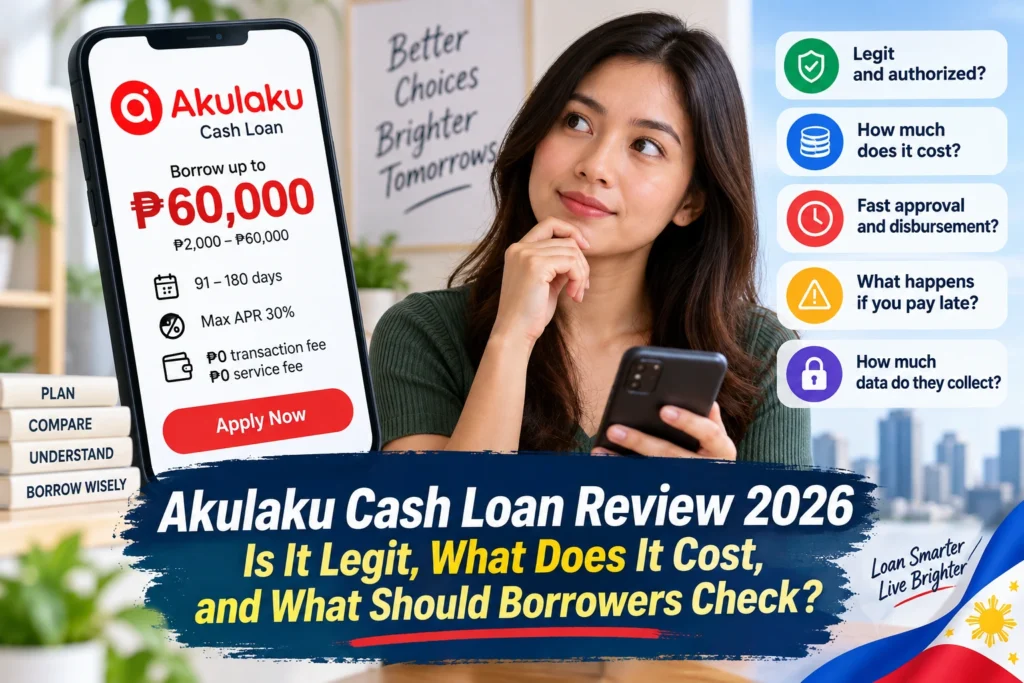
The attractive part of Akulaku Cash Loan is easy to see: the current app listing advertises ₱2,000 to ₱60,000, terms of 91 to 180 days, a maximum APR of 30%, and no transaction or service fee. The harder question for a Filipino borrower is whether those headline figures match the offer that will actually appear in the app – and what happens once repayment, privacy, and late-payment terms enter the picture. (Google Play)
Our review found an identifiable Philippine lending company behind Akulaku. It also found a notable issue worth checking before accepting any loan: Akulaku’s current 2026 app-store disclosures are materially different from some older contractual documents that remain publicly accessible on its website. Those older pages show different rates, fees, limits, and late-payment provisions. That does not establish that the old terms apply to today’s Cash Loan product, but it makes the transaction-specific disclosure statement and loan agreement especially important. (Akulaku)
This review covers Akulaku Cash Loan in the Philippines using an evidence-led 2026 research scope. No test loan application was submitted, no money was borrowed, and no approval or disbursement time was personally measured. The analysis instead uses SEC records, current app-store disclosures, Akulaku’s published documents, BSP and NPC rules, and recent borrower feedback.
Akulaku Cash Loan is operated by Streetcorner Lending Corp. doing business as Akulaku. The SEC’s August 31, 2024 registered-lending-company list records Streetcorner under SEC registration CS201606603 and Certificate of Authority No. 1830, and the September 2026 Google Play listing displays the same details. The current app advertises ₱2,000 – ₱60,000 for 91 – 180 days, a maximum 30% APR, and zero transaction and service fees. The biggest point to verify is the actual contract: older Akulaku documents still online contain different pricing and late-payment language. Read the disclosure statement shown for your specific offer before accepting it. (Securities and Exchange Commission)
| Borrower question | Current finding | Why it matters |
|---|---|---|
| Who operates Akulaku? | Streetcorner Lending Corp., doing business as Akulaku | Identifies the legal lending entity |
| SEC status | SEC Reg. No. CS201606603; CA No. 1830 in SEC’s Aug. 31, 2024 list | A Certificate of Authority is more meaningful than corporate registration alone |
| Advertised loan amount | ₱2,000 – ₱60,000 | ₱60,000 is a maximum, not a promised limit |
| Advertised tenor | 91 – 180 days | Short repayment periods can create high monthly cash-flow pressure |
| Current advertised pricing | Maximum APR 30%; transaction fee 0; service fee 0 | Check whether your actual disclosure matches these figures |
| Published ₱10,000 example | ₱1,479.45 interest; ₱11,479.45 total repayment over 180 days | Shows the peso cost, not just a percentage |
| Approval speed | “Apply in 5 minutes” and “high approval rate” are app marketing claims | Neither statement guarantees approval or a five-minute disbursement |
| Late-payment cost | No current Cash Loan late fee is stated in the app-store description; older Akulaku pages conflict | Verify the exact penalty in your current agreement |
| Privacy | Policy covers identity, employment, five character references, location and device/log information | Data collection can extend beyond the “ID and phone” marketing message |
| Borrower feedback | Mixed recent App Store experiences; some praise speed, others report low limits or inability to obtain a loan after receiving a limit | A displayed credit limit should not be treated as guaranteed cash availability |
Product figures and app information are current to the sources checked in September 2026. (Google Play)
Is Akulaku Cash Loan legitimate and properly authorized in the Philippines?
Akulaku is linked to an identifiable Philippine lending company. The SEC’s August 31, 2024 list records Streetcorner Lending Corp. doing business as Akulaku with registration CS201606603 and Certificate of Authority No. 1830. The current 2026 app listing uses those same identifiers. (Securities and Exchange Commission)
Who legally provides the loan?
The legal entity identified in both SEC records and the app listing is Streetcorner Lending Corp. doing business under the name and style of Akulaku. This matters because the consumer-facing app name and the regulated lender should not be treated as separate unidentified entities when evaluating the product. (Securities and Exchange Commission)
The distinction between incorporation and lending authority is important. The SEC states that a lending company cannot conduct lending business merely because it is incorporated; it must also receive authority to operate from the SEC. Streetcorner’s CA No. 1830 is therefore the relevant authorization record, rather than its corporate registration number alone. (SEC Appointment)
It would still be inaccurate to describe Akulaku as an “SEC-approved loan” in the sense that the government endorses a particular loan offer or certifies that it is inexpensive. Regulatory authorization establishes the lender’s legal status; it does not decide whether a particular loan is affordable for an individual borrower.
There is also a currency limitation to this verification. The newest official SEC master list of registered lending companies located during this review was dated August 31, 2024. Akulaku’s app was updated on September 13, 2026 and continues to display the same company, registration number and Certificate of Authority. Borrowers should nevertheless recheck the SEC’s current registered-lender and recorded-OLP pages immediately before transacting, particularly because regulatory status can change. (Securities and Exchange Commission)
How much can you actually borrow from Akulaku?
Akulaku currently advertises cash loans from ₱2,000 to ₱60,000 with terms of 91 to 180 days. The ₱60,000 figure is an advertised ceiling, not evidence that a new or returning applicant will receive that amount. (Google Play)
The Google Play and Philippine App Store descriptions both publish the same range and term. They identify eligible applicants as Filipino citizens aged 18 or older with a valid government-issued ID. The listing describes the application as requiring “only an ID and a phone.” (Google Play)
That simple front-end description should not be interpreted to mean underwriting is based on only two pieces of information. Akulaku’s privacy policy contemplates collection of employment information, residence and contact information, spouse information where applicable, and five character references and their contact details. It also says information may be used for credit checks and risk-management processes, including possible telco-derived scores. (Akulaku)
Akulaku does not publicly disclose its complete scoring algorithm, so there is no reliable basis for claiming that salaried workers, freelancers, self-employed applicants or gig workers have a particular approval probability.
Recent App Store reviews illustrate another distinction. One July 2026 reviewer reported receiving an initial limit of only ₱500, while another May reviewer complained that a limit remained low even after repeat borrowing. Such reports are anecdotal, and a ₱500 “initial limit” may not be directly comparable with the app’s currently advertised ₱2,000 Cash Loan minimum. They do show why the advertised ₱60,000 maximum should not be used to plan an emergency budget before an actual offer appears. (App Store)
What does an Akulaku Cash Loan really cost?
The September 2026 listing states a maximum APR of 30%, with zero transaction and service fees. In Akulaku’s published ₱10,000/180-day example, total interest is ₱1,479.45 and total repayment is ₱11,479.45. Your own disclosure statement may produce a different cost. (Google Play)
Akulaku’s current example is unusually useful because it gives actual peso figures rather than only advertising a percentage:
| Item | Published example |
|---|---|
| Principal | ₱10,000.00 |
| Term | 180 days |
| Stated annual rate | 30% |
| Transaction fee | ₱0 |
| Service fee | ₱0 |
| Published total interest | ₱1,479.45 |
| Published monthly repayment | ₱1,913.24 |
| Published total repayment | ₱11,479.45 |
| Cost relative to ₱10,000 proceeds | About 14.79% over 180 days |
Akulaku calculates its example using ₱10,000 × 30% ÷ 365 × 180 days. If the borrower truly receives the full ₱10,000 with no upfront deduction, the published finance cost is therefore about 14.79% of the cash received during the 180-day term. (Google Play)
Why the advertised 30% figure is not the whole cost story
The published example describes a 30% APR, but it also requires monthly repayments rather than allowing the borrower to retain the entire ₱10,000 for a full year.
The BSP explains that an Effective Interest Rate reflects the true cost of borrowing by considering the loan’s cash flows and that borrowers should obtain the actual EIR from the creditor together with disclosure of fees and charges. (Bureau of Soils and Water Management)
Using Akulaku’s published example purely as a cash-flow illustration – ₱10,000 received initially followed by six monthly payments of approximately ₱1,913.24 – the periodic internal rate of return is roughly 4.09% per month, equivalent to approximately 61.8% effective annually if six equal payments occur at monthly intervals.
That 61.8% figure is our calculation, not a rate published by Akulaku, and it should not be substituted for the contractual EIR. Exact payment dates, rounding, the precise amortization method, and any offer-specific charges can change the result. Its purpose is to show why comparing loans only through a headline annual percentage can be misleading when principal is being repaid throughout the term.
Does the Philippine small-loan interest cap apply?
BSP Circular No. 1133 does not impose one blanket ceiling on every consumer loan. Its specific caps apply to unsecured, general-purpose loans of no more than ₱10,000 with a tenor of up to four months offered by lending companies, financing companies and their online lending platforms. (Bureau of Soils and Water Management)
For loans inside that defined scope, the circular sets a nominal-interest ceiling equivalent to 6% per month, an effective-rate ceiling equivalent to 15% per month including applicable fees other than late charges, a 5%-per-month late/nonpayment penalty ceiling on the outstanding scheduled amount due, and a total-cost cap of 100% of the amount borrowed.
An Akulaku offer of ₱10,000 or less may therefore fall within those rules only if the other coverage requirements are also met, including the tenor limitation. A six-month Akulaku loan is not within the “up to four months” scope merely because its amount is ₱10,000.
For recency, the SEC’s current 2026 advisories still reference the existing interest-cap framework, while the SEC page lists the October 2025 proposal for “recalibrated ceilings” as a request for comments. No final replacement for Circular 1133 was located in the sources reviewed for this article. (Securities and Exchange Commission)
How fast are Akulaku approval and disbursement?
Akulaku says applicants can “apply in 5 minutes” and advertises a “high approval rate,” but the current listing does not provide a guaranteed approval time or a guaranteed time for money to reach the borrower. Application speed and actual funding speed are different questions. (Google Play)
The app says funds can be transferred to e-wallets or bank accounts and names GCash, Maya and BPI as examples. It also advertises 24/7 availability. These statements establish the available type of disbursement channel, but they do not establish that every approved borrower receives money instantly. (Google Play)
The words “Apply in 5 minutes” should therefore be read narrowly: they describe Akulaku’s marketed application process, not a five-minute approval guarantee.
Recent App Store feedback is mixed in a way that reinforces this distinction. One July 2026 reviewer described approval as fast, while a May reviewer said a later application was not approved. Individual reviews cannot establish an approval rate, and they do not reveal each applicant’s underwriting circumstances. (App Store)
A borrower who needs a specific amount by a specific hour should not commit another payment on the assumption that an advertised credit limit, successful registration or short application form guarantees disbursement.
What happens if you pay Akulaku late?
The current September 2026 Cash Loan app description does not state a late-payment fee. Older Akulaku documents that remain online contain conflicting penalty structures, so the current transaction-specific disclosure statement should be checked before acceptance rather than assuming an old web-page penalty still applies. (Google Play)
This is the clearest documentation problem found in the review.
An older Akulaku Philippines User Agreement says cash loans have a ₱50 processing fee, 5% interest and a late charge of 1% of the total past-due amount compounded daily. Those figures do not match the September 2026 app listing, which says transaction and service fees are zero and maximum APR is 30%. (Akulaku)
A separate Akulaku “Loan and Disclosure Agreement” page contains still another structure. Its template leaves the actual penalty rate blank, while an appendix lists older 36% – 48% APR ranges and a late-payment schedule beginning with two days without a fee, followed by 5% of outstanding principal and interest on the third day and later cumulative charges, capped at 50% of principal. (Akulaku)
These documents appear to come from different product generations or contractual structures. They should not be combined into a made-up 2026 Akulaku Cash Loan penalty.
Before accepting, the borrower needs the current disclosure showing the actual late penalty applicable to that specific transaction. If the current in-app contract differs from an old website page, save a copy or screenshot of the contract and payment schedule shown at acceptance.
The SEC itself advises online-lending borrowers to read the loan agreement, including interest, charges, payment obligations and due dates, and to retain a copy of the agreement and proof of full payment. (Securities and Exchange Commission)
What about collection messages?
Akulaku’s privacy policy states that information may be used for payment collection through its own collection department or a debt-collection agency. Its published loan-agreement template also contemplates collection communications following default. (Akulaku)
One August 2026 Reddit poster claimed to have received aggressive or threatening text messages after missing an Akulaku payment date and said the balance was then paid. This is an unverified individual borrower report, not proof of a systematic Akulaku practice. (Reddit)
Philippine privacy rules still constrain collection methods regardless of what a borrower post alleges. The NPC says processing must not become excessive, disproportionate or harassing, and persons in a borrower’s contact list who were not declared guarantors cannot be contacted for debt collection merely because their details are stored on the phone. (National Privacy Commission)
How much personal information does Akulaku collect?
Akulaku’s privacy policy is broader than the app-store phrase “only an ID and a phone required.” It contemplates identity, residence, employment, spouse details where applicable, five character references, location information, device/log information and data used for credit and risk evaluation. (Google Play)
The published privacy policy lists information including complete name, phone number, address, email, age and date of birth, civil status, employment data and five character references with contact information. It also describes potential collection of GPS or other location information, IP address, device identifiers and certain usage/log information. (Akulaku)
Akulaku says the information may be used for identity verification, application processing, profiling and analytics, fraud prevention, credit checks, risk management and collection. The policy even contemplates the use of telco scores derived from mobile-phone usage data for credit evaluation. (Akulaku)
The policy also says Akulaku and its affiliates may share information with service providers, contractors and agents for specified operational purposes. By contrast, Google Play’s developer-supplied Data Safety section currently says “No data shared with third parties.” (Google Play)
Those statements look inconsistent at first glance. They do not necessarily prove a violation because app-store privacy labels can apply particular definitions and exceptions to service-provider processing. For a borrower, however, the practical lesson is clear: the full privacy policy gives a more detailed picture than the store’s short Data Safety label.
Apple’s privacy disclosure provides another angle. It says the developer has indicated that identifiers and usage data may be used for tracking, while payment information and diagnostics may also be collected in specified ways. Apple explicitly notes that those developer-reported privacy practices have not been independently verified by Apple. (App Store)
Can Akulaku access everyone in your phone contacts?
The reviewed Akulaku policy identifies character references, but that should not be confused with a lawful right to harvest an applicant’s entire address book.
NPC rules prohibit unnecessary app permissions and specifically prohibit accessing, harvesting, copying or saving phone-contact lists, email lists or social-media contacts for debt collection or harassment. The NPC’s 2023 amendment also states that, for debt collection, lenders may not contact people in the borrower’s contact list other than declared guarantors. Character references are not automatically guarantors.
Google Play currently says users can request deletion of their data. Akulaku’s policy also recognizes data-subject rights, but a deletion request should not be interpreted as an automatic right to erase every record immediately where lawful retention obligations or an outstanding transaction apply. (Google Play)
What are borrowers saying about Akulaku in 2026?
Recent public feedback is mixed rather than uniformly positive or negative. Apple’s Philippine listing showed a 3.6/5 rating from 249 ratings when checked, with recent comments praising application speed but also complaints about low limits and the gap between having a credit facility and getting another loan approved. (App Store)
A September reviewer described the application as fast and easy and considered the interest competitive. A May 2026 reviewer said repeated borrowing had not produced the desired increase in credit limit. A July reviewer praised fast processing but reported an initial limit of only ₱500. (App Store)
These comments are useful for identifying friction points, but they have major evidentiary limitations. App-store reviews are self-selected, cannot normally be independently verified, and do not reveal applicants’ income, existing debt, credit history or exact product version.
The most defensible pattern is therefore not “Akulaku always approves quickly” or “Akulaku always gives low limits.” It is that published maximums and marketing speed should not be treated as individual guarantees.
The Reddit complaint about aggressive collection messaging is worth knowing about because collections are a high-impact borrower concern, but one anonymous report cannot establish prevalence or misconduct. (Reddit)
What are the main advantages and disadvantages of Akulaku Cash Loan?
Akulaku’s strongest documented features are an identifiable licensed lending company, relatively clear current headline pricing and a published peso-cost example. Its main transparency weakness is the coexistence of current app disclosures with older public Akulaku documents showing materially different pricing and late-payment terms.
| Potential advantage | Why it matters |
|---|---|
| Identifiable legal lender and Certificate of Authority | Lets borrowers verify who is contractually responsible |
| Current listing publishes amount, tenor and maximum APR | Easier to compare headline terms before applying |
| Current listing states zero transaction and service fees | Reduces uncertainty about these two particular fee categories |
| ₱10,000 example gives interest and total repayment in pesos | More useful than a rate alone |
| Bank/e-wallet disbursement channels are disclosed | Relevant for borrowers using GCash, Maya or bank accounts |
| Data-deletion request is supported in Google Play disclosure | Provides a defined privacy-control route |
| Potential drawback | Why it matters |
|---|---|
| Older public terms conflict with current store pricing | Borrowers need to rely on the actual 2026 agreement, not a generic webpage |
| Current app listing does not publish the Cash Loan late fee | Late-payment exposure cannot be reliably calculated before seeing the contract |
| “Apply in 5 minutes” is not a funding guarantee | Urgent borrowers could misjudge timing |
| Advertised ₱60,000 maximum may be far above an individual’s available limit | Planning around the maximum can create a funding gap |
| Privacy policy contemplates broader data collection than the short application marketing suggests | Applicants should review permissions and references before consent |
| Recent user feedback includes low-limit and approval-friction complaints | A displayed limit or prior borrowing history does not guarantee a new loan |
The documented positives should not be interpreted as a recommendation to borrow, just as the drawbacks do not establish that every borrower will experience a problem.
Who may find Akulaku relevant, and who should be especially cautious?
The product may be relevant where the actual disclosure is affordable, the borrower has a predictable repayment source and the required amount is within the confirmed offer. Extra caution is warranted when repayment depends on another loan, income is unstable, or contract terms remain unclear.
A ₱10,000 loan that looks manageable when described as “30% APR” looks different when viewed as approximately ₱1,913 each month for six months. The repayment amount must fit the borrower’s actual salary or cash-flow calendar without requiring another short-term loan to cover the installment.
The same principle applies to the maximum loan. Someone who needs ₱30,000 for a fixed obligation should not assume the ₱60,000 advertised ceiling means at least ₱30,000 will be offered.
Privacy tolerance matters too. An applicant uncomfortable providing employment information, location-related information or character references should review the permission and consent screens before submitting personal data.
What should you check before accepting an Akulaku loan?
The most important document is not the advertisement; it is the disclosure statement for the exact loan being offered. Compare what appears there with the current advertised terms and stop before acceptance if a material charge or repayment condition is unclear.
- Confirm that the lender shown in the agreement is Streetcorner Lending Corp. doing business as Akulaku, and recheck its current SEC/OLP status.
- Write down the approved principal and the exact net amount that will reach your account.
- Check every deduction – not only interest – including processing, service, insurance, transfer or other charges.
- Record the total amount repayable, number of installments, exact installment amount and every due date.
- Find the disclosed EIR or effective borrowing cost, rather than comparing products using the headline rate alone.
- Read the current late-payment penalty, grace period if any, collection charges and default provisions.
- Confirm which bank or e-wallet will receive the funds and which official channels can be used for repayment; keep receipts.
- Review app permissions, character-reference disclosures, data-sharing language and the privacy policy before granting consent.
- Save the loan agreement and disclosure statement as they appeared when you accepted the offer.
- If the current agreement materially differs from the 2026 app-store advertisement, get clarification before borrowing rather than assuming the more favorable figure applies.
That approach closely reflects the SEC’s own guidance to online-lending borrowers: verify the lender, read all charges and due dates, avoid unnecessary contact/social-media permissions, and retain the loan agreement and payment records. (Securities and Exchange Commission)
FAQ
Is the ₱60,000 Akulaku limit guaranteed?
No. ₱60,000 is the advertised maximum loan amount. Akulaku does not state that every qualified applicant receives the maximum, and recent borrower reviews report considerably smaller limits in some cases. (Google Play)
Can an Akulaku loan be repaid early?
Akulaku’s publicly available loan-agreement template says borrowers may prepay the outstanding balance without a prepayment premium or penalty. Because that webpage contains terms that do not fully match the current 2026 Cash Loan listing, verify the prepayment clause in your own current agreement before relying on it. (Akulaku)
Is Akulaku a BSP-licensed bank or digital bank?
The evidence reviewed identifies Streetcorner Lending Corp. as an SEC-regulated lending company, not a BSP-licensed bank or digital bank. The BSP has statutory authority to prescribe certain rate ceilings for lending and financing companies, while the SEC is identified as the primary regulator responsible for implementing and enforcing the specific Circular 1133 framework. (SEC Appointment)
Does Akulaku guarantee approval in five minutes?
No verified source reviewed establishes that guarantee. The app says “Apply in 5 minutes!” and separately advertises a “high approval rate.” It does not state that every application is approved within five minutes or that funds will arrive within that time. (Google Play)
Can you delete your Akulaku data?
Google Play says users can request data deletion, and Akulaku’s privacy documentation recognizes data-subject rights. Philippine privacy rules also require reasonable retention policies and say personal data should not simply be retained forever for an undefined future use. Actual deletion can still be subject to lawful retention requirements. (Google Play)
A practical decision framework before you tap “Accept”
The central question is not simply whether Akulaku has a recognizable company behind it. Streetcorner Lending Corp. is identifiable in official SEC records, and the current app-store disclosures are substantially more informative than those of many opaque loan-app advertisements. (Securities and Exchange Commission)
The more important decision is whether your exact offer makes sense.
Start with four peso figures: how much you asked for, how much you will actually receive, how much each payment is, and how much you will repay in total. Then check the dates and the late-payment formula. A low-looking headline rate is less useful than knowing what leaves your wallet every payday.
Akulaku’s current listing says zero transaction and service fees, but older Akulaku pages still display materially different terms. That documentation gap makes it especially important not to borrow from screenshots, old blog posts or remembered terms from a previous Akulaku product. Use the disclosure generated for the current transaction.
Finally, consider whether the repayment can be made from normal income rather than from another loan. If paying Akulaku would require borrowing elsewhere, rolling over another obligation, or sacrificing essential expenses, the problem is no longer whether the app can approve the loan – it is whether the debt is affordable in the first place.
References
- SEC Registered Lending CompaniesOrganization: Securities and Exchange Commission Philippines
Resource: List of Registered Lending Companies as of 31 August 2024
URL: SEC Registered Lending Companies – 31 August 2024 - About Lending Companies and Financing CompaniesOrganization: Securities and Exchange Commission Philippines
Resource: About Lending Companies and Financing Companies
URL: SEC – About Lending Companies and Financing Companies - Akulaku Cash Loan – Google PlayOrganization: Google Play / Streetcorner Lending Corp.
Resource: Akulaku Cash Loan App Listing
URL: Akulaku Cash Loan on Google Play - Akulaku Cash Loan – Apple App Store PhilippinesOrganization: Apple / Streetcorner Lending Corp.
Resource: Akulaku Cash Loan App Listing, Ratings, Reviews and Privacy Disclosures
URL: Akulaku Cash Loan on the Philippine App Store - Akulaku Privacy PolicyOrganization: Akulaku / Streetcorner Lending Corp.
Resource: Privacy Policy
URL: Akulaku Philippines Privacy Policy - Akulaku User Agreement – PhilippinesOrganization: Akulaku / Streetcorner Lending Corp.
Resource: User Agreement-Philippines
URL: Akulaku User Agreement – Philippines - Akulaku Loan and Disclosure AgreementOrganization: Akulaku / Streetcorner Lending Corp.
Resource: Loan and Disclosure Agreement
URL: Akulaku Loan and Disclosure Agreement - BSP Circular No. 1133Organization: Bangko Sentral ng Pilipinas
Resource: Ceiling/s on Interest Rates and Other Fees Charged by Lending Companies, Financing Companies, and their Online Lending Platforms
URL: BSP Circular No. 1133, Series of 2021 - BSP Loan Calculator and EIR GuidanceOrganization: Bangko Sentral ng Pilipinas
Resource: Loan Calculator
URL: BSP Loan Calculator and EIR Guidance - NPC Guidelines for Loan-Related Personal DataOrganization: National Privacy Commission
Resource: NPC Amends Circular on the Processing of Personal Data for Loan-Related Transactions
URL: NPC Loan-Related Data Privacy Guidance - SEC Advisory for Online Lending Platform BorrowersOrganization: Securities and Exchange Commission Philippines
Resource: Advisory for Online Lending Platforms Borrowers
URL: SEC Borrower Advisory for Online Lending Platforms - Recent Akulaku Borrower ReportOrganization: Reddit / r/ola_harassment
Resource: “Akulaku OLA” – anecdotal borrower report, August 2026
URL: Reddit borrower report concerning Akulaku collections
Disclaimer:This article contains affiliate links. We may earn a small commission if you apply for a loan through our links, at no extra cost to you. The information provided is for educational purposes only and does not constitute professional financial advice. Please borrow responsibly.
Last Updated on September 18, 2026 by Elena Reyes
