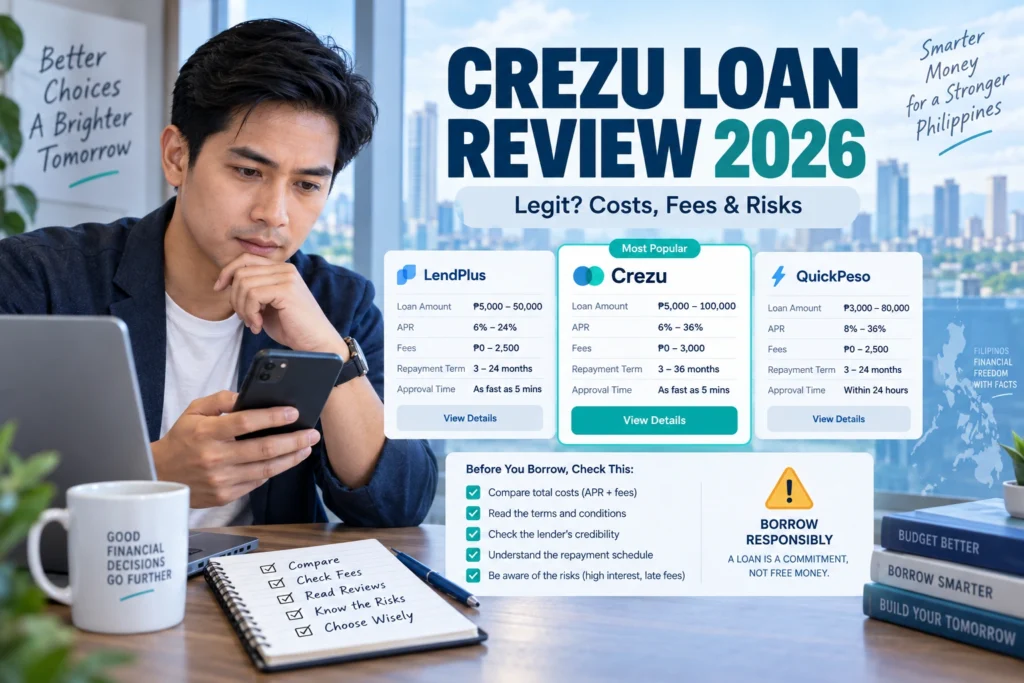
The most important fact about Crezu is easy to miss: Crezu is not the company lending you the money. Its Philippine website describes the service as a loan-matching platform that sends an application to third-party lenders or credit providers. That distinction affects almost every question a borrower should ask—from SEC authorization and interest charges to late fees, credit reporting, and debt collection. (CREZU)
Our review of Crezu’s current website also found several disclosure issues worth checking carefully. The homepage advertises loans from ₱500 to ₱25,000, 91- to 120-day terms, rates described as 12% to a maximum 36% APR, and a possible 0% first loan. Yet its own ₱10,000 example shows ₱15,000 total repayment after three months—a ₱5,000 cost that does not obviously reconcile with the stated 36% APR. The site also displays differing approval-rate figures on the same page. (CREZU)
Crezu is an identifiable loan-comparison business operated by Estonia-registered Fininity OÜ, not a direct Philippine lender. Its service is advertised as free to borrowers, but the actual lender, final interest rate, fees, repayment rules, collection practices, and possible CIC reporting depend on the partner you select. Crezu’s current marketing contains numerical inconsistencies, including a ₱10,000/₱15,000 repayment example that deserves clarification before signing. Before accepting any matched offer, confirm the lender’s exact corporate name, SEC Certificate of Authority and recorded online platform, net cash proceeds, total repayment, due dates, penalties, and privacy terms.
| Borrower question | Current finding | Why it matters |
|---|---|---|
| Is Crezu the lender? | No. Crezu says it is a matching/intermediary service. | Your actual loan contract is with a third-party lender. |
| Who operates Crezu? | Fininity OÜ, Estonia registry code 14523902. | An overseas corporate registration is not the same thing as a Philippine SEC lending license. |
| Loan amount advertised | ₱500–₱25,000 | Your actual approved amount is determined by the matched lender. |
| Advertised term | 91–120 days | Individual lender contracts still control the real repayment schedule. |
| Crezu service fee | Crezu says its matching service is free to borrowers. | Partner lenders may still charge interest and other permitted fees. |
| Rate claim | Website states 12% to maximum 36% APR. | Do not treat this as your personal quotation. |
| Cost disclosure concern | ₱10,000 example becomes ₱15,000 after three months. | A 50% three-month cost does not readily reconcile with the advertised 36% APR. |
| Approval speed | Crezu advertises minutes-level matching/approval claims. | The actual lender still performs assessment and controls disbursement. |
| Privacy | Application data may be shared with lenders and credit brokers. | One form can expose your information to multiple potential providers. |
| Late payment | Depends on the actual lender; statutory caps apply only within defined scope. | Identify the legal lender before assuming what penalties are allowed. |
How was this Crezu review researched?
This review is based on current public documentation rather than a fabricated borrowing test. We reviewed Crezu’s Philippine homepage, terms, privacy policy and application information, checked the operator against Estonia’s official business register, and compared its disclosures with current Philippine consumer-lending and privacy rules.
No actual Crezu application, approval, loan offer or disbursement was performed for this review. Where Crezu makes speed, approval or customer-volume claims, those statements are treated as company marketing rather than independently verified outcomes.
The regulatory review reflects information checked in September 2026.
Is Crezu legit and SEC-registered in the Philippines?
Crezu is connected to an identifiable foreign company, but that is different from saying Crezu itself is a Philippine SEC-licensed lender. Crezu expressly says it does not lend money and instead connects applicants with third-party lenders. The lender behind any offer must therefore be checked separately.
Who legally operates Crezu?
Crezu’s website identifies its operator as Fininity OÜ, registration number 14523902, at Paadi tee 3, Haabneeme, Estonia. Some Crezu wording still uses “Fininity Ltd,” but the footer identifies the legal company as Fininity OÜ. (CREZU)
The official Estonian e-Business Register confirms that Fininity OÜ, registry code 14523902, is entered in the register as a private limited company and was registered on July 11, 2018. (e-Äriregister)
There is one current registry detail borrowers should not ignore. The same official record states that the company has non-submitted annual reports and that a deletion notice concerning the legal person has been published, although its current status remains “entered into the register.” (e-Äriregister)
That registry notice does not, by itself, prove fraud or invalidate a particular loan offer. It is simply a corporate-status issue worth factoring into due diligence.
Does an Estonian registration mean Crezu is authorized to lend in the Philippines?
No.
Under Republic Act No. 9474, a Philippine lending company may not conduct lending business without authority to operate from the Philippine SEC. (Lawphil)
Crezu, however, says it does not provide financing directly. Its terms describe a process in which the application is presented to lenders or financial-service providers and, when a provider accepts the application, the user may be redirected to that provider. (CREZU)
The practical consequence is more important than the label:
Do not ask only, “Is Crezu registered?” Ask, “Which legal company is actually offering me this loan, and is that company properly authorized?”
The Philippine SEC specifically advises borrowers to verify lending companies, financing companies and recorded online lending platforms before transacting. (Securities and Exchange Commission)
How does a Crezu loan actually work?
You submit information to Crezu, Crezu attempts to match the application with third-party providers, and any actual loan is completed with a provider—not with Crezu itself. Approval, underwriting, contract terms and disbursement are ultimately controlled by that provider.
Crezu describes a three-stage process:
- Complete its online form.
- Receive loan offers.
- Select a lender, sign that lender’s agreement and receive funds into a bank account. (CREZU)
Its eligibility page currently asks whether the applicant is over 18, resident in the Philippines, has valid identification, a valid phone number and a bank account. (CREZU)
These are not necessarily the full underwriting requirements of the eventual lender. Crezu’s own terms state that a lender may carry out a background assessment and that this may include a review of credit history. (CREZU)
Crezu does not publicly disclose the proprietary scoring models used by its partner lenders, so claims that applicants with a particular employment type, credit score or income level will be approved would be speculative.
How much can you borrow through Crezu?
Crezu currently displays a requested-loan range of ₱500 to ₱25,000, but this is a marketplace range—not a guaranteed credit limit. The lender that accepts the application determines whether to offer credit and on what amount and terms.
The current homepage lets users request between ₱500 and ₱25,000. Crezu’s terms warn that displayed amounts, rates and repayment periods should not be treated as a guaranteed personal quotation. (CREZU)
This distinction matters for first-time borrowers. Selecting ₱25,000 on a comparison form does not mean a lender has approved ₱25,000.
A proper comparison should therefore use three separate numbers:
Requested amount → approved principal → net cash actually received
If the lender deducts any mandatory charge before disbursement, the third figure can be smaller than the second. Crezu does not provide enough universal partner-level information to calculate those deductions in advance.
What does a Crezu loan really cost?
There is no single “Crezu interest rate” because Crezu does not issue the loan. Its homepage advertises 12% to 36% APR and says its matching service is free, but its own repayment example raises a material disclosure question that borrowers should resolve before accepting an offer. (CREZU)
Crezu’s advertised rates versus its repayment example
The current homepage states:
- Crezu charges no service fee for using its matching service.
- Loans shown on the site have repayment periods of 91 to 120 days.
- Lending rates range from 12% to a maximum 36% APR.
- A first loan “can” be free for a new customer.
- Its representative example says a ₱10,000 loan repaid over three months results in ₱15,000 total repayment. (CREZU)
The last point requires scrutiny.
For that example:
Total repayment: ₱15,000
Principal: ₱10,000
Peso borrowing cost: ₱5,000
Cost relative to principal: 50%
Formula:
(₱15,000 − ₱10,000) ÷ ₱10,000 = 50%
A 50% borrowing cost over three months does not readily reconcile with a stated maximum 36% annual percentage rate.
For comparison only—not as a quotation—a simple 36% annual rate applied proportionally over three months would imply roughly 9% interest before other charges, or around ₱900 on ₱10,000.
We cannot calculate the true effective rate of Crezu’s ₱15,000 example because the page does not provide enough information about installment timing, net proceeds or fee structure. It would therefore be inappropriate to invent an APR.
The useful takeaway is simpler: the figures on the marketing page are not sufficiently consistent to substitute for the actual lender’s Disclosure Statement and loan agreement.
What is the Philippine rate cap in 2026?
Since April 1, 2026, SEC Memorandum Circular No. 14, Series of 2025 applies updated ceilings to a defined category of loans: unsecured, general-purpose loans of no more than ₱10,000 with terms of up to four months. For covered loans, the rules provide a 6% monthly nominal-interest ceiling, a 12% monthly effective-interest ceiling, a 5% monthly late-payment penalty cap on the outstanding scheduled amount due, and a 100% total-cost cap. (RegAlert)
That is not a universal rate ceiling for every Philippine loan. Amount, tenor, product type and lender classification matter.
Crezu’s ₱10,000 three-month example falls within the amount and tenor normally associated with this category, but the homepage alone does not contain enough cash-flow information to determine whether a particular partner offer complies with the EIR calculation required by the rule.
The calculation should be made from the actual lender’s contract—not from Crezu’s generic example.
How fast are Crezu approval and disbursement?
Crezu markets a very fast process, but its speed claims should be treated as promotional estimates rather than guaranteed lender performance. Crezu only matches applicants; the provider must still assess the borrower and decide whether to lend.
The homepage currently advertises language including:
- “Decision in 2 min”
- “money in 15 min”
- an “approval time” of up to seven minutes. (CREZU)
Its terms are more cautious. They say the provider performs its own assessment and independently decides whether to extend credit. (CREZU)
Real processing can therefore depend on the partner’s identity checks, information verification, credit assessment and payment method. Bank processing, weekends or payment-system issues can also affect settlement generally, but Crezu does not publish enough lender-specific evidence to assign a reliable universal disbursement time.
Be cautious with the approval percentages
Crezu’s current homepage is internally inconsistent here as well.
Near the top, it advertises “up to 90% approval rate.” Further down, the same page displays “95% approval rate from our partners.” It also says it works with 47 partners while its FAQ refers to comparing offers from “hundreds of lenders.” (CREZU)
These are company claims. We found no independent audit in the reviewed sources validating those percentages.
They should not be interpreted as your personal probability of approval.
What information does Crezu collect and share?
Crezu’s privacy policy indicates that applicants provide substantial identity, financial and behavioral information and that application data can be shared with lenders and credit brokers. Borrowers should therefore read both Crezu’s policy and the eventual lender’s separate privacy notice.
Crezu says it may collect information including:
- name;
- address and residential status;
- date of birth;
- email and phone number;
- income;
- bank-account details;
- IP address;
- website activity;
- application and quote information; and
- in some circumstances employer-related financial information. (CREZU)
The policy says information may be shared with its panel of lenders and credit brokers so they can prepare quotations. It also states that partners may carry out soft credit checks. (CREZU)
Crezu also describes telephone, SMS, email, automated messages and potentially marketing communications. It provides an unsubscribe route and a process for requesting deletion of personal information. (CREZU)
One point that deserves editorial attention is the age of some documentation: Crezu’s Terms & Conditions page states “Last updated October 2019.” Philippine online-lending and consumer-protection rules have changed significantly since then. (CREZU)
Can a lender contact people in your phone?
Philippine privacy rules restrict this practice.
A March 2026 joint DICT-NPC-SEC advisory reiterated that unnecessary or excessive processing of borrower data is prohibited and that, for debt collection, lenders must not contact people in a borrower’s contact list other than a properly declared guarantor. (National Privacy Commission)
The NPC also states that unnecessary access to contacts, social-media contacts or similar information is prohibited and that app permissions must be necessary and proportionate to a legitimate purpose. (National Privacy Commission)
Crezu’s website policy does not establish that every partner follows the same technical permission model. Check the privacy notice and permissions of the actual lender or lending app before continuing.
What happens if you pay a Crezu loan late?
You do not become late “with Crezu” unless Crezu itself is somehow a contractual party to a specific transaction. Its published model says the debt belongs to the partner lender, so that lender’s contract determines the due dates, collection process and applicable penalties.
For covered small loans under the 2026 SEC ceiling described earlier, late-payment or non-payment penalties are capped at 5% per month on the outstanding scheduled amount due, with the total-cost cap also applying. (RegAlert)
Do not assume those figures apply to every loan displayed through Crezu. The statutory definition of a covered loan matters.
Before signing, locate these items in the lender’s disclosure:
due date, installment amount, grace-period rule if any, late charge, payment channel, payment-posting rule, collection contact and total amount payable.
Philippine financial-consumer law also requires appropriate disclosure and prohibits abusive collection or debt-recovery practices. (Lawphil)
Can a partner lender report you to the CIC?
Potentially, yes, depending on the lender. Crezu itself is not the relevant credit provider; the key question is whether your partner lender is a CIC submitting entity and how it reports the account.
The Credit Information Corporation states that entities providing credit facilities that fall within the definition of submitting entities are required to register and submit borrowers’ basic credit data. (Credit Information Corporation)
CIC data are used to build credit histories that lenders may consult when assessing future applications. (Credit Information Corporation)
Therefore, do not assume that an online loan is invisible to formal credit reporting simply because it originated from a comparison website.
Ask the actual lender whether and how it reports to CIC.
What are borrowers saying about Crezu?
Independent Crezu-specific borrower evidence in the Philippines is relatively thin. Public comments show both successful-use claims and complaints or confusion about approval, rejection and 0% expectations, but the available sample is too small and uncontrolled to treat as representative.
Crezu publishes several positive testimonials on its own website, including claims of quick matching and successful funding. Because those testimonials are hosted by Crezu itself, they should not be treated as independently verified evidence. (CREZU)
A third-party review page contained 18 user submissions when checked. Comments included applicants reporting rejection, uncertainty after receiving an apparent approval message, and one older reviewer saying the loan they received was not at the 0% rate they expected. Other reviewers described the service positively. (PLoan)
The stronger pattern is not that Crezu is universally good or bad. It is that some users appear to misunderstand the separation between Crezu’s matching service and the lender actually making the credit decision.
That is the issue borrowers should resolve before submitting sensitive information.
What are the main advantages and disadvantages of Crezu?
Crezu’s main practical benefit is comparison: one application may surface multiple potential lenders. Its main limitation is the same feature in reverse—the borrower does not know the final lender, cost or contract until the matching process progresses.
Potential advantages supported by current disclosures include Crezu charging no stated borrower matching fee, the ability to compare multiple offers, and clear language in its legal footer that Crezu itself is not the lender. (CREZU)
The more material drawbacks are that application data may be distributed to lenders or brokers, the advertised cost figures are internally difficult to reconcile, approval statistics vary within the same page, final charges depend on third parties, and some core terms documentation still carries a 2019 update date. (CREZU)
The Estonian corporate registry’s current annual-report/deletion notice is another fact a cautious borrower may reasonably want to monitor. (e-Äriregister)
Who may find Crezu useful, and who should be especially cautious?
Crezu may be relevant for a borrower who specifically wants a comparison tool and is prepared to independently verify every lender before signing. It is less suitable for someone who expects Crezu’s headline figures to represent a guaranteed loan offer.
A borrower is in a stronger position when there is already a clear repayment source, the lender’s legal identity has been verified, the total repayment is affordable without borrowing again, and all deductions are known before acceptance.
Extra caution is warranted when the repayment plan depends on another future loan, when the lender name is unclear, when the cash actually received is materially lower than the principal shown in the contract, or when the provider requests an unexplained advance payment.
The SEC specifically warns borrowers about advance-fee scams and advises them to obtain and understand the loan agreement. (Securities and Exchange Commission)
What should you check before accepting a Crezu-matched loan?
Do not decide from Crezu’s front-page interest rate or approval percentage. Make the decision from the final lender’s legal identity, Disclosure Statement, net proceeds, payment schedule and privacy terms.
Before pressing “accept,” verify the following in the actual offer:
- The lender’s complete corporate name—not only its app or brand name.
- Its Philippine SEC registration and appropriate Certificate of Authority.
- Whether its online lending platform appears in the current SEC records where applicable.
- The approved principal.
- Every deduction before disbursement.
- The net amount that will reach your bank or e-wallet.
- Every installment and due date.
- The total peso repayment.
- The effective interest rate and mandatory fees.
- Late-payment charges and collection rules.
- Whether the lender submits credit information to CIC.
- What personal information and device permissions it collects.
- How to file complaints or request correction/deletion of data.
The most useful calculation is often not the advertised rate but:
Real borrowing cost = total amount you must repay − cash you actually receive
If an offer says the principal is ₱10,000 but only ₱8,500 reaches you and the contract requires ₱11,500 back, your economic cost is ₱3,000 relative to ₱8,500 of usable cash—not merely ₱1,500 relative to the stated principal.
Do that calculation before signing.
FAQ
Does Crezu guarantee approval?
No. Crezu’s terms state that the lender or provider decides whether to extend credit. The website’s approval percentages are marketing claims, not a guarantee for an individual applicant. (CREZU)
Is the first Crezu loan really 0%?
Crezu states that a first loan can be free of charge for new clients. It does not say every new applicant will receive 0%. The final lender’s written offer controls. (CREZU)
Does Crezu charge an application fee?
Crezu currently states that its own matching service is free. This does not mean the eventual loan has no interest or fees. (CREZU)
Can I ask Crezu to delete my information?
Crezu’s terms provide a deletion/request-to-be-forgotten mechanism and its privacy policy identifies a compliance contact for data-related requests. Philippine privacy rights may also apply depending on how the information is processed. (CREZU)
Is a “Crezu” app in an app store necessarily official?
Do not assume so from the name alone. Current searches show app-store listings using similar Crezu/Crezul branding under developers whose listings do not establish that they are Fininity OÜ. The safest starting point is Crezu’s own published website and the legal identity shown there. (App Store)
Final borrower checklist
Crezu is best evaluated as a lead-generation and comparison layer, not as the loan itself.
Before accepting any offer it produces, answer six questions with figures taken from the lender’s actual contract: Who is lending the money? How much cash will I receive? How much will I repay? When exactly is each payment due? What happens if I miss one? Who receives and processes my personal data?
If any one of those answers remains unclear, there is little reason to rush simply because the matching page says funds may arrive in minutes.
A fast match can save time. It cannot replace lender verification, an accurate cost calculation or a realistic repayment plan.
References
- Crezu Philippines
Organization: Fininity OÜ / Crezu
Resource: Fast Personal Loans – Philippine Homepage
URL: Crezu Philippines homepage - Crezu Terms & Conditions
Organization: Fininity OÜ / Crezu
Resource: Terms & Conditions
URL: Crezu Terms & Conditions - Crezu Privacy Policy
Organization: Fininity OÜ / Crezu
Resource: Privacy Policy
URL: Crezu Privacy Policy - Crezu – How It Works
Organization: Fininity OÜ / Crezu
Resource: How does Crezu work?
URL: Crezu application process - Fininity OÜ Registry Record
Organization: Estonian e-Business Register
Resource: Fininity OÜ, Registry Code 14523902
URL: Official Estonian registry record - Republic Act No. 9474
Organization: Lawphil / Republic of the Philippines
Resource: Lending Company Regulation Act of 2007
URL: Republic Act No. 9474 - Republic Act No. 11765
Organization: Lawphil / Republic of the Philippines
Resource: Financial Products and Services Consumer Protection Act
URL: Republic Act No. 11765 - SEC Memorandum Circular No. 14, Series of 2025
Organization: Securities and Exchange Commission Philippines
Resource: Recalibrated Ceilings on Interest Rates and Other Fees Charged by Financing Companies and Lending Companies
URL: SEC MC No. 14 text accessed via RegAlert - Advisory for Online Lending Platform Borrowers
Organization: Securities and Exchange Commission Philippines
Resource: Advisory for Online Lending Platforms Borrowers
URL: SEC borrower advisory - Public Advisory on Online Lending Platforms
Organization: DICT, National Privacy Commission and SEC
Resource: Advisory on Online Lending Platforms
URL: 2026 DICT-NPC-SEC advisory - Loan-Related Personal Data Guidelines
Organization: National Privacy Commission
Resource: NPC Circular No. 20-01 and amendment information
URL: NPC online lending privacy guidance - Credit Information Guidelines
Organization: Credit Information Corporation
Resource: CIC Circular No. 2023-04 – Compliance of Submitting Entities
URL: CIC submitting-entity guidelines
Disclaimer:This article contains affiliate links. We may earn a small commission if you apply for a loan through our links, at no extra cost to you. The information provided is for educational purposes only and does not constitute professional financial advice. Please borrow responsibly.
Last Updated on September 18, 2026 by Elena Reyes
