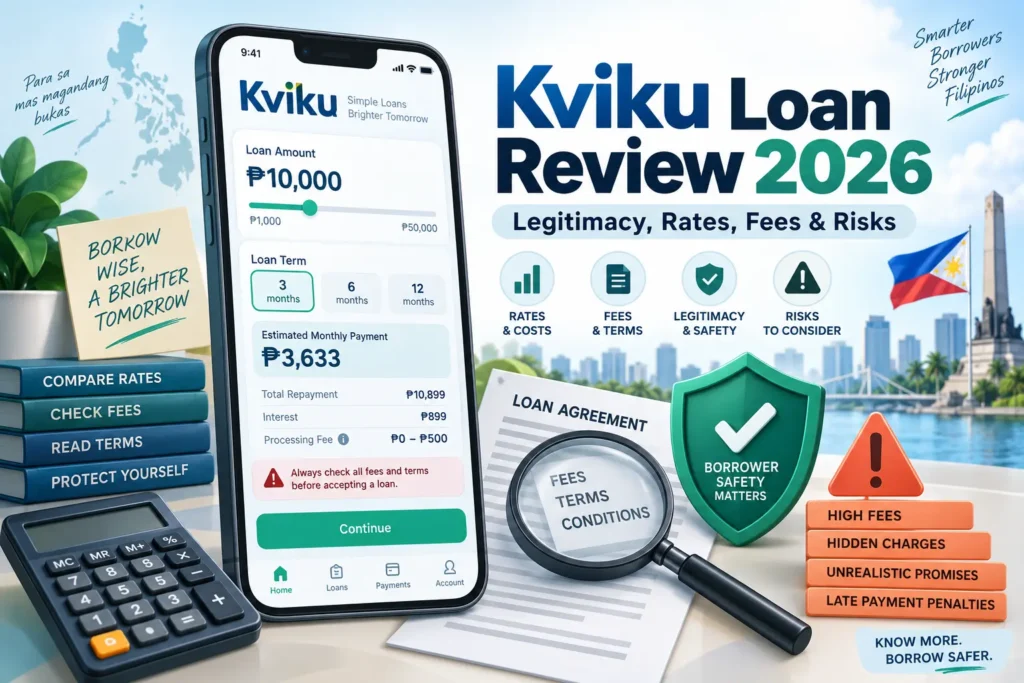
With Kviku, the difficult question is not simply whether the lender exists. The more important issue in 2026 is that Kviku’s own public channels currently publish materially different loan amounts, tenors, rates, and processing timelines. That makes the disclosure shown immediately before contract confirmation more important than any headline number on a website or app-store page.
This Kviku loan review checks the legal lending entity against Philippine SEC records, compares Kviku’s website, FAQ and current Google Play disclosures, examines the arithmetic behind its advertised borrowing costs, reviews its privacy language, and separates borrower allegations from regulatory findings. No borrowing application or hands-on loan test was performed for this review.
| Borrower question | Current finding | Why it matters |
|---|---|---|
| Legal lender | Kviku Lending Co. Inc. | The brand can be tied to an identifiable Philippine lending company. |
| SEC details | CS201918702; CA No. 3169 in SEC records reviewed | A Certificate of Authority is more relevant than corporate registration alone. (SEC Philippines) |
| Online platform | kviku.ph appears in the SEC’s November 2021 OLP list |
This links the website to the recorded lender, although borrowers should still re-check current SEC records before applying. (SEC Philippines) |
| Published amount | Website/FAQ: up to ₱25,000; Google Play: up to ₱50,000 | Kviku’s public product disclosures are not aligned. (Kviku) |
| Published tenor | Public pages variously describe 60 days, up to 135 days, and 61–180 days | Your actual contract, not a marketing page, controls the obligation. (Kviku) |
| Published rate | FAQ: 0.16% daily for its installment loan; app: 0%–2% daily, maximum 730% annual | The difference is too large to ignore when comparing offers. (Kviku) |
| Approval | Kviku advertises minutes or up to 24 hours depending on the page | Approval speed is a lender claim, not a guarantee. (Kviku) |
| Disbursement | Website says within 60 minutes; FAQ says bank settlement can take 1–2 days | Approval and actual receipt of cash are separate events. (Kviku) |
| Privacy | Kviku’s policy describes broad personal/device-data processing; Play says some data may be shared | Borrowers should inspect requested permissions before granting access. (Kviku) |
| Repayment | GCash, Maya, Coins.ph, payment centers and bank payment are documented | Using the wrong reference number can delay validation. (Kviku) |
Is Kviku legit and properly authorized in the Philippines?
Kviku has an identifiable lending entity. SEC records reviewed for this article list Kviku Lending Co. Inc. with SEC registration CS201918702 and Certificate of Authority No. 3169. An SEC list of online lending platforms also associates kviku.ph with that company. (SEC Philippines)
That distinction matters. An SEC corporate registration number by itself does not establish authority to operate a lending business. In Kviku’s case, the SEC lending-company list also records a Certificate of Authority.
The most recent directly accessible SEC company list found during this review was dated 31 August 2024. It records:
- Company: Kviku Lending Co. Inc.
- SEC Registration: CS201918702
- Certificate of Authority: 3169
- Date registered: 9 January 2020. (SEC Philippines)
Separately, the SEC’s list of financing and lending companies with reported online platforms, updated in November 2021, names kviku.ph as Kviku Lending Co. Inc.’s online lending platform. (SEC Philippines)
Kviku itself also publishes an NPC registration number, PIC-001-791-2021, but this review did not independently match that number to a current NPC registry entry. It should therefore be treated as a company-published disclosure rather than an independently confirmed status. (Kviku)
Kviku is also not being reviewed here as a bank or digital bank. BSP guidance states that lending companies outside BSP supervision are regulated by the SEC. (Bureau of the Treasury)
The useful distinction for borrowers is therefore:
Identifiable and recorded lender? Yes, based on the SEC records above.
Does that automatically mean every Kviku offer is inexpensive, suitable or compliant with every applicable pricing ceiling? No. Those are separate questions.
What loan terms does Kviku actually advertise in 2026?
There is no single consistent set of public Kviku terms. Its website and FAQ describe loans of up to ₱25,000, while the Google Play listing updated 5 August 2026 advertises up to ₱50,000. Published tenors and rates also differ materially. (Kviku)
The discrepancies are easier to see side by side:
| Kviku source | Amount | Term | Published rate |
|---|---|---|---|
| Main website | ₱1,000–₱25,000 | Selector shows up to 135 days | Not clearly reconciled with the other pages |
| FAQ | ₱1,000–₱25,000 | First-time borrowers: up to 60 days; repeat borrowers: up to 180 days | 0.16% daily for the installment loan |
| Google Play, updated Aug. 5, 2026 | Up to ₱50,000 | 61–180 days | 0%–2% daily; maximum annual rate 730% |
(Kviku)
The app-store disclosure is the most recently dated of these sources, but that does not make the older-looking website disclosures irrelevant. A borrower can reach Kviku through more than one public interface, and inconsistent pre-application information increases the importance of checking the actual Disclosure Statement and loan agreement before confirming via SMS or another electronic method.
Eligibility is clearer. The current app listing says applicants must be Filipino citizens aged 20 to 55, with a government-issued ID, mobile phone and bank account. It says no guarantor, collateral or income certificate is required and that self-employed or informal workers may apply. Kviku’s FAQ adds that documents such as a payslip, Certificate of Employment, ITR, company ID or DTI documentation may support an application. (Google Play)
Kviku does not publicly disclose its full underwriting formula. Its site says the automated system analyzes a large volume of client data, but that should not be interpreted as a published explanation of how individual approval or limits are determined. (Kviku)
What does a Kviku loan really cost?
The exact cost cannot safely be inferred from Kviku’s headline rate because its public disclosures conflict. Most importantly, the worked example in its current Google Play listing does not mathematically match the 2% daily rate shown immediately beside it. (Google Play)
Kviku’s Google Play page gives this example:
- Principal: ₱5,000
- Daily rate: 2%
- Claimed daily interest: ₱100
- Term: 135 days
- Published total interest: ₱9,906
- Published total repayment: ₱14,906. (Google Play)
There is a basic arithmetic problem.
If the interest is really ₱100 per day for 135 days:
₱100 × 135 = ₱13,500 interest
That would produce:
₱5,000 + ₱13,500 = ₱18,500 total repayment
—not ₱14,906.
Working backward from Kviku’s published ₱9,906 interest produces an implied simple daily rate of roughly 1.47%, not 2%.
That does not prove what rate an individual borrower will receive. It does show why the app-store example should not be used as a substitute for the actual contract calculation.
The FAQ creates a second pricing picture. It says Kviku’s installment loan can run for 60 days at 0.16% daily interest. On a hypothetical ₱5,000 principal, assuming simple interest and no additional charge:
₱5,000 × 0.16% × 60 = ₱480
That would make the total ₱5,480. But this is only a mathematical illustration of the published rate—not a quotation from Kviku—and it should not be used if the contract includes other mandatory fees or a different calculation method. (Kviku)
Principal approved is not always the same as cash received
The number borrowers should write down first is not merely “loan amount.” It is:
Cash actually received = approved principal − upfront deductions
Then compare that with:
True peso cost = total required repayment − cash actually received
This matters because several public complaints allege that borrowers received less cash than the nominal amount associated with the loan.
For example, an FOI request submitted on 3 September 2026 alleged that a borrower requested ₱2,000, received ₱1,500, and was asked to make two payments totaling ₱2,784. This is a borrower allegation, not a finding by the AMLC, SEC or another regulator. Using only the complainant’s figures, repayment exceeded the cash allegedly received by ₱1,284, equivalent to 85.6% of the ₱1,500 received. (FOI Philippines)
That is exactly the kind of discrepancy a borrower should resolve before confirming a contract.
Does the 2026 Philippine interest-rate cap apply to Kviku?
It can, depending on the individual loan. From 1 April 2026, SEC Memorandum Circular No. 14, s. 2025 applies to unsecured, general-purpose loans from lending or financing companies when the principal is no more than ₱10,000 and the tenor is no more than four months. (RegAlert)
For loans inside that specific scope, the 2026 ceilings are:
| Cost element | Ceiling for covered loans |
|---|---|
| Nominal interest | 6% per month |
| Effective interest, including applicable mandatory fees | 12% per month |
| Late/nonpayment penalty | 5% per month on the outstanding scheduled amount due |
| Cumulative interest, fees, charges and penalties | 100% of the amount borrowed |
(RegAlert)
The scope is important. These numbers should not be presented as a universal ceiling for every loan in the Philippines.
A ₱20,000 Kviku loan, for example, falls outside the ≤₱10,000 amount condition. Likewise, a loan longer than four months falls outside this particular small-loan ceiling.
But Kviku’s own Google Play range includes loans beginning at 61 days. A Kviku loan of, say, ₱5,000 with a tenor that remains within four months would fall within the circular’s defined amount-and-tenor bracket if the other coverage conditions are met.
That creates an important checkpoint: Kviku’s advertised maximum of 2% per day should not be assumed to be a legally chargeable rate on every Kviku contract. If that rate were actually applied to a covered small, short loan, the borrower should compare the contract against the applicable SEC ceilings. The app listing alone does not establish which borrowers, amounts or tenors receive the maximum advertised rate. (Google Play)
How fast are Kviku approval and disbursement?
Kviku markets a very fast application process, but its own pages distinguish imperfectly between approval, lender-side transfer and bank settlement. The current app says approval takes no more than three minutes, while the FAQ warns that actual receipt may take one or two days depending on the bank. (Google Play)
The main website says borrowers may receive an SMS decision “in a few minutes” and says money can be transferred to a bank account within 60 minutes. The same page also uses broader “24-hour approval” language. (Kviku)
Kviku’s FAQ is more cautious. It says the lender sends funds after contract confirmation, but a receiving bank can take one to two days to credit the transfer. It also says approvals made at night may settle the next morning and weekend approvals may not arrive until Monday. (Kviku)
That means “approved in minutes” should not be interpreted as “cash available in minutes.”
One product-specific friction point is also documented: Kviku says incorrect bank information can cause the transfer to fail because the bank-account details do not correspond with the ID information. Its FAQ says the funds may take up to two weeks to return to Kviku before the loan is cancelled. (Kviku)
How does Kviku handle personal information?
Kviku’s published privacy language is broad. Its policy describes processing identity, financial, device and potentially contact-related information, while its Google Play declaration says the app may collect and share personal information, app activity and additional data categories. (Kviku)
Kviku’s website privacy policy describes information including identity details, bank information, photographs, device information and, where permission is given, information stored on a device. It also discusses potential collection of address-book information and social-media-related data, as well as disclosures to service providers, fraud-prevention services, credit-reference agencies, analytics services and advertising partners. (Kviku)
Some wording is unusually broad for a Philippine short-term lending page—for example, references to overseas credit agencies, stored-value transactions and cross-device advertising. Borrowers should therefore read the live consent screens rather than assuming every category described in the privacy policy is necessary for a Kviku loan.
The Google Play Data Safety disclosure says the app may collect and share data categories including personal information and app activity, encrypts data in transit, and allows users to request data deletion. (Google Play)
Philippine rules put meaningful limits on how online lenders may use phone data. A joint DICT-NPC-SEC advisory dated 18 March 2026 states that excessive or disproportionate processing of contact lists is prohibited. It says lenders may not contact people in a borrower’s contact list for debt collection unless they are guarantors, and app permissions should be limited to specified and legitimate purposes.
So, if an app asks for access to contacts, photos, camera or other device resources, the practical questions are:
- What exact purpose is stated?
- Is that permission necessary at this stage?
- Can it be revoked after KYC?
- Does the lender distinguish a character reference from a guarantor?
- Does the guarantor provide separate consent?
The 2026 government advisory specifically requires those distinctions.
How do you repay Kviku, and what can go wrong?
Kviku documents several repayment methods, including GCash, Maya, Coins.ph, over-the-counter channels and bank payment. The operational risk is payment posting: Kviku warns that an incorrect reference number can invalidate a transaction and that bank transfers may take several days. (Kviku)
Its repayment page instructs GCash and Maya users to select Dragon Loans, enter the appropriate Kviku Lifetime ID/reference details and specify the payment amount. Other documented payment locations include 7-Eleven and various over-the-counter channels. Direct bank payment to an account in the name of Kviku Lending Co. Inc. is also described. (Kviku)
Kviku’s FAQ says a bank transfer can sometimes take up to five days and advises sending proof of payment by email to prevent repayment delays. (Kviku)
For a borrower paying close to the due date, this distinction matters. Initiating a bank transfer on the due date is not necessarily the same as the lender having posted it on the due date.
Keep the payment receipt, screenshot the successful transaction and preserve any reference number until the account reflects the payment.
What happens if you pay Kviku late?
Kviku says payment delays can increase the debt through penalties and negatively affect credit history, but the public pages reviewed here do not provide a sufficiently clear current Kviku-specific penalty schedule to calculate a late balance reliably. Covered small loans are subject to the 2026 SEC penalty ceiling. (Kviku)
Do not estimate a late balance from an old review or another borrower’s contract. Check the penalty provision in your own Disclosure Statement and loan agreement.
Kviku’s FAQ states that delays can negatively affect credit history. This review did not independently confirm Kviku’s current reporting relationship or submission status with the Credit Information Corporation, so a specific CIC reporting outcome should not be assumed merely from that statement. If incorrect information does appear on a CIC credit report, CIC provides an online dispute process for erroneous, misleading, incomplete or outdated credit information. (Credit Information Corporation)
Debt collection is also regulated. SEC Memorandum Circular No. 18, s. 2019 prohibits unfair debt-collection practices, while the March 2026 joint government advisory reiterates prohibitions involving harassment, unlawful threats and contacting non-guarantor phone contacts to collect a debt. (SEC Appointment System)
The same 2026 advisory directs complaints about unfair debt collection to the SEC’s FINLEND unit through the SEC iMessage system and lists the 1-4732 (1-4SEC) hotline.
What are borrowers saying about Kviku?
The recurring issue in public complaints is not simply rejection or slow approval. Several complainants describe uncertainty about the amount received, the repayment obligation or deductions they say were not clear before disbursement. These accounts are anecdotal and should not be treated as regulatory findings.
A Philippine loan-review site currently displays multiple borrower submissions alleging large repayment amounts, deductions from proceeds and charges they believed were not clearly disclosed. Because these are user-submitted reviews, they establish that complaints exist—not that each allegation is accurate. (PLoan)
More significant from an evidence perspective is the September 2026 FOI request discussed earlier. It records a borrower’s allegation that ₱1,500 was received against a ₱2,000 loan request and that ₱2,784 was later due. The AMLC response shown on the FOI page requested further identification from the complainant; it did not make a finding that Kviku violated the law. (FOI Philippines)
Older government-hosted complaints also describe alleged confusion about loan terms and repayment amounts, but those likewise represent complainants’ statements rather than adjudicated SEC findings. (FOI Philippines)
The appropriate takeaway is not that every Kviku borrower will experience the same problem. It is that pre-contract disclosure deserves unusually careful attention, especially given the inconsistencies already visible across Kviku’s own published materials.
What are the main advantages and disadvantages of Kviku?
Kviku has an identifiable lending entity, publishes several repayment channels and provides an online application process. Against that, its public pricing and term disclosures are inconsistent, and its Google Play cost example contains arithmetic that does not reconcile with the stated daily rate.
| Potential advantage | Why it matters |
|---|---|
| SEC-listed lending entity with a recorded Certificate of Authority | Borrowers can identify the company behind the product. |
| Fully online application | No branch visit is required according to Kviku’s published process. |
| Government ID is the core stated document | The published entry requirements are relatively limited. |
| Multiple repayment channels | GCash, Maya, Coins.ph, bank and over-the-counter options are documented. |
| Early repayment is described as possible | Borrowers are not presented with a public rule saying they must always hold the loan to maturity. |
| Potential drawback | Why it matters |
|---|---|
| Website, FAQ and app publish different limits and tenors | Comparison shopping becomes harder. |
| 0.16% and up to 2% daily rates both appear in official material | A headline rate cannot safely predict your contract cost. |
| Google Play example does not reconcile mathematically | Borrowers should independently verify the disclosure statement. |
| Marketing speed and actual settlement time differ | Emergency borrowers could receive funds later than expected. |
| Broad privacy wording | App permissions and consent deserve review before submission. |
| Public complaints allege net-disbursement and disclosure issues | These are not proven violations, but they support checking deductions carefully before acceptance. |
Who should be especially cautious with a Kviku loan?
The greatest risk is not the application itself but accepting an offer without knowing the amount that will enter your account and the exact peso amount that must leave your account later.
Extra caution is warranted when repayment depends on borrowing again, when income before the due dates is uncertain, or when a lender deducts charges before disbursement. A ₱5,000 “loan” that produces substantially less than ₱5,000 usable cash should be evaluated against the cash received, not only against the nominal principal.
A borrower considering Kviku should be able to answer all of these before confirming:
- What is the contractual principal?
- Exactly how many pesos will reach my bank or e-wallet?
- What has been deducted before disbursement?
- What is each scheduled payment?
- What is the total repayment?
- What is the effective interest rate stated in the disclosure?
- Which late charge applies to this contract?
- How long can my chosen repayment method take to post?
- Which device permissions am I authorizing?
- Is the contract lender named Kviku Lending Co. Inc.?
- Can I make every payment from expected income without taking another loan?
If any amount is blank, contradictory or only revealed after money is sent, preserve screenshots and obtain clarification in writing.
FAQ
Can I cancel a Kviku application?
Kviku’s FAQ says cancellation is possible before the contract is confirmed. After confirmation, it says the funds are sent and the borrower would instead need to repay early, with the payable amount available through the account or customer service. (Kviku)
Can I repay Kviku early?
Kviku states that full or partial early repayment is possible. Because the FAQ refers to “minimal interest” after contract confirmation without giving a universal formula, request the exact early-settlement amount before making payment. (Kviku)
Can Kviku contact everyone in my phone if I am late?
Philippine authorities say online lending platforms must not use contact lists indiscriminately for debt collection. The March 2026 DICT-NPC-SEC advisory states that contacting people from a borrower’s contact list other than guarantors for collection is prohibited.
Can I ask for my Kviku app data to be deleted?
Google Play’s current Data Safety declaration says users may request data deletion. Data that must be retained for legal, contractual or claims-related reasons may be subject to lawful retention requirements rather than immediate deletion. (Google Play)
Where can I complain about unfair collection?
The March 2026 joint government advisory directs unfair-debt-collection complaints to the SEC Financing and Lending Companies Department through SEC iMessage and provides the SEC hotline 1-4732 (1-4SEC).
Before accepting a Kviku loan
Do not make the decision from “₱50,000 available,” “three-minute approval,” or a small-looking daily percentage.
Use the contract in front of you.
Start with the net cash that will actually arrive. Then total every scheduled payment. Check mandatory deductions and compare the applicable effective rate with the regulatory rules that cover your specific amount and tenor. Make sure the payment dates match your real income schedule rather than your hoped-for income schedule.
Then inspect the lender name and privacy permissions. The contract should clearly identify the legal creditor, and a loan app should not need unrestricted access to your personal contacts merely because you need short-term credit.
Kviku is identifiable in SEC records, but authorization and affordability are different questions. The current inconsistencies between Kviku’s FAQ, website and Google Play disclosures make the final Disclosure Statement especially important. If the offer does not clearly show what you will receive, what you will repay and when, there is good reason to stop before electronically confirming it.
References
- List of Registered Lending Companies as of 31 August 2024
Organization: Securities and Exchange Commission Philippines
Resource: List of Registered Lending Companies – 31 August 2024
URL: SEC registered lending companies list - List of Financing and Lending Companies Registered with the SEC and their Online Lending Platforms
Organization: Securities and Exchange Commission Philippines
Resource: Online Lending Platforms list updated 29 November 2021
URL: SEC online lending platforms list - Kviku Official Website
Organization: Kviku Lending Co. Inc.
Resource: Kviku Philippine loan homepage
URL: Kviku official website - Kviku FAQ
Organization: Kviku Lending Co. Inc.
Resource: Answers to Frequently Asked Questions
URL: Kviku FAQ - Kviku Repayment Instructions
Organization: Kviku Lending Co. Inc.
Resource: How to Repay
URL: Kviku repayment page - Kviku – Online Loans
Organization: Kviku Lending Co. Inc. / Google Play
Resource: Official Google Play App Listing, updated 5 August 2026
URL: Kviku Google Play listing - Kviku Privacy Policy
Organization: Kviku Lending Co. Inc.
Resource: Privacy Policy published on Kviku website
URL: Kviku privacy information - Advisory on Online Lending Platforms
Organization: Department of Information and Communications Technology, National Privacy Commission, Securities and Exchange Commission
Resource: Public Advisory on Online Lending Platforms, 18 March 2026
URL: 2026 government advisory on online lending platforms - SEC Memorandum Circular No. 14, Series of 2025
Organization: Securities and Exchange Commission Philippines
Resource: Recalibrated Ceilings on Interest Rates and Other Fees Charged by Financing Companies and Lending Companies
URL: Text of SEC MC No. 14, s. 2025 - MC No. 18 s. 2019 – Prohibition on Unfair Debt Collection Practices
Organization: Securities and Exchange Commission Philippines
Resource: Prohibition on Unfair Debt Collection Practices of Financing and Lending Companies
URL: SEC unfair debt collection rules - Concerns About Kviku Online Lending App – High Interest
Organization: Philippine Freedom of Information Portal / Anti-Money Laundering Council
Resource: FOI request published 3 September 2026
URL: FOI record concerning Kviku - CIC Dispute Resolution
Organization: Credit Information Corporation
Resource: Online Dispute Resolution System
URL: CIC credit-report dispute process
Disclaimer:This article contains affiliate links. We may earn a small commission if you apply for a loan through our links, at no extra cost to you. The information provided is for educational purposes only and does not constitute professional financial advice. Please borrow responsibly.
Last Updated on September 17, 2026 by Elena Reyes
