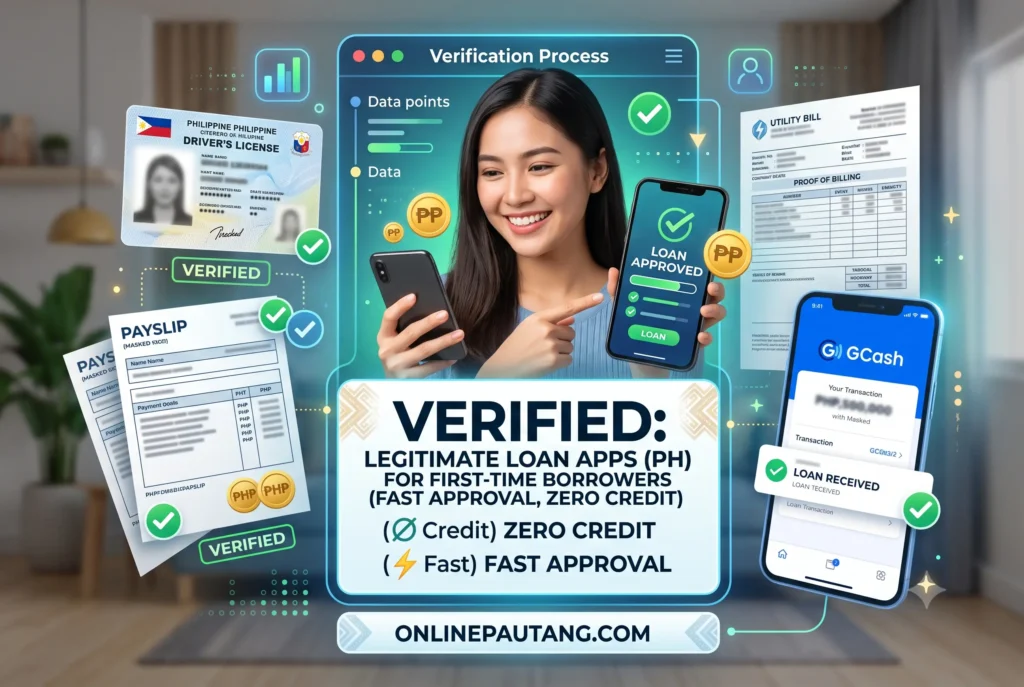
Applying for your very first loan is intimidating. You might be a fresh graduate needing funds to secure pre-employment requirements or a gig worker handling an unexpected medical bill. Without a formal credit history or a credit card, traditional banks will immediately turn you away. This rejection pushes many beginners toward digital lenders – a space overflowing with predatory operators and unauthorized debt collectors. Finding legitimate loan apps in the Philippines for first-time borrowers that offer fast approval without exploiting your lack of financial experience is difficult, but entirely possible if you know where to look.
Summary:
The safest loan apps for Filipinos with no credit history are SEC-registered platforms like Tala and BillEase. They use alternative data instead of credit scores to grant initial limits of PHP 1,000 to PHP 3,000, ensuring fast approval without requiring a bank account or credit card.
Quick Comparison: Top Safe Apps for Beginners
| App Name | Initial Starter Limit | Approval Speed | Key Requirement for First-Timers |
| Tala | PHP 1,000 – PHP 2,000 | Under 10 minutes | 1 Valid Government ID |
| BillEase | PHP 2,000 – PHP 5,000 | 24 – 48 hours | Proof of Income or Billing |
| Home Credit | Product-dependent | 10 – 20 minutes | 1 Primary ID, downpayment |
What Are the Most Trusted, Legitimate Loan Apps in the Philippines for First-Time Borrowers?
Summary: The most trusted digital lenders for beginners are Tala for quick cash, BillEase for flexible installments, and Home Credit for retail purchases. These apps hold valid SEC Certificates of Authority and report to the Credit Information Corporation (CIC), helping you build a real credit score.
When evaluating digital lenders, true legitimacy goes beyond just having an app on the Google Play Store. A legitimate app complies with the Bangko Sentral ng Pilipinas (BSP) interest rate caps and strictly follows the Data Privacy Act to prevent unauthorized collection of your contacts.
Tala: Best for True Beginners with No Bank Account
Summary:Tala is ideal for absolute beginners because it does not require proof of income, collateral, or a bank account. Approval takes minutes, and funds can be disbursed directly to e-wallets like GCash or Maya.
Tala has revolutionized micro-lending in the Philippines by looking at how you use your phone rather than relying on a banking history. Their risk assessment engine evaluates alternative data points. For a first-timer, the friction point usually lies in the ID verification phase. Tala’s automated eKYC system requires clear, well-lit photos. A UMID card with faded edges or glare might trigger a manual review, delaying the standard 5-minute approval to 24 hours. They maintain a strict transparent fee structure, completely avoiding hidden deductions so you receive your approved amount in full.
BillEase: Best for Starter Installment Plans
Summary:BillEase transitions beginners into structured credit by offering installment plans rather than single-payment payday loans. First-timers often receive a credit limit up to PHP 5,000, which grows through consistent, on-time repayments.
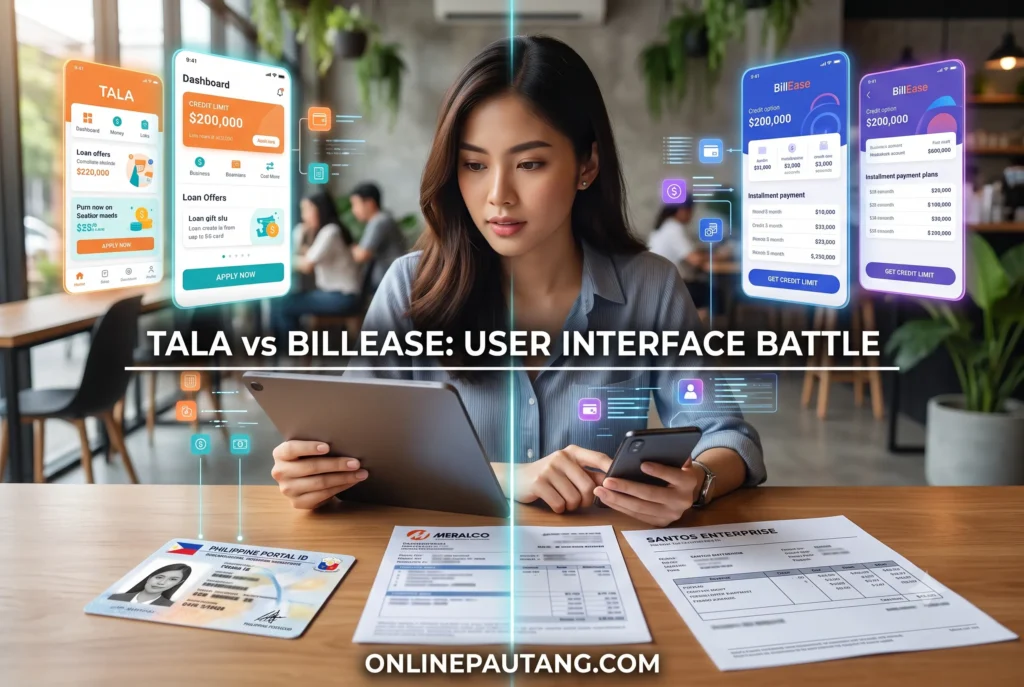
If you need to finance a larger purchase, such as a mid-range smartphone for work, BillEase is structurally safer than most cash-lending apps. Instead of requiring you to pay back the full amount plus interest in 15 days, they allow you to split payments over several months. The primary hurdle for a first-time user here is documentation. While Tala requires only an ID, BillEase demands stronger proof of capacity to pay. A common beginner mistake is submitting a generic barangay certificate instead of an official proof of billing or a recent payslip, which will severely limit your initial credit assignment.
How Do I Know if a Loan App is SEC-Registered and Safe?
Summary: You can verify a loan app’s safety by checking the Securities and Exchange Commission (SEC) official website for their Certificate of Authority (CA). Safe apps never ask for access to your contact list or photo gallery.
The Philippine digital lending market changes rapidly. Lenders frequently lose their operating licenses due to abusive collection practices, meaning an app that was safe last year might be blacklisted today. You must independently verify their legal standing before uploading any sensitive data.
Verifying the SEC Certificate of Authority (CA)
Summary: Every legitimate lending company must publicly display its SEC Registration Number and CA Number. You should cross-reference these numbers with the SEC’s updated List of Registered Lending Companies available online.
Do not trust a certificate just because it is displayed on the app’s loading screen; rogue developers often copy and paste regulatory logos. The most foolproof method is downloading the latest PDF list of authorized lending companies from the SEC website. Search for the corporate name of the app developer, not just the app name. For example, Tala operates legally under “Tala Financing Philippines Inc.” Having a CA means the company is legally bound by the Truth in Lending Act, meaning they must explicitly show you the Effective Interest Rate (EIR) before you sign the digital contract.
Red Flags: How to Spot Fake Lending Apps
Summary: Fake lending apps often demand advance processing fees, use threatening language, and require permission to read your SMS and phonebook. Legitimate lenders deduct fees from the loan proceeds, never asking for cash upfront.
Predatory lenders exploit the desperation of borrowers who need cash immediately. If you want to spot fake lending apps, look at the permissions they request during installation. A legitimate lender needs access to your camera to scan your ID and take a selfie. A predatory app will refuse to open unless you grant it permission to read your contact list. They do this to scrape your family’s phone numbers, which they will later use for harassment if you miss a payment. Furthermore, the SEC continues to warn the public about “clone apps” – malicious software using variations of established names like “Tala-Cash Loan Philippines” to deceive users and steal data.
Can I Get a Loan Without a Credit Card in the Philippines?
Summary: Yes, you can secure a loan without a credit card. Modern fintech lenders use alternative credit scoring, analyzing your e-wallet transaction history, utility payments, and mobile usage to determine creditworthiness.
Historically, Philippine banks operated on a strict exclusionary model: you needed credit to get credit. The rise of digital banking has dismantled this barrier, allowing millions of unbanked Filipinos to access formal financial systems.
The Shift to Alternative Data for Approval
Summary: Lenders now partner with telecom companies and e-wallets to build your profile. Consistent bills payment via GCash or Maya, regular load purchases, and verified e-commerce accounts serve as proof of financial responsibility.
When you lack a traditional banking footprint, your digital footprint becomes your resume. Algorithms can predict your capacity to repay based on the stability of your digital behavior. If you consistently pay your internet bill on the same day every month through an e-wallet, fintech companies view this as positive financial behavior. To maximize your chances of approval, ensure you are using the correct valid IDs for loan apps. A passport, Driver’s License, or National ID carries far more weight in an automated KYC system than a secondary ID like a PhilHealth card. Some platforms are even testing micro-loans for younger demographics, acting essentially as student loan apps, provided the applicant is at least 18 years old and has a verifiable allowance flow through digital channels.
Handling Loan App Rejection as a First-Timer
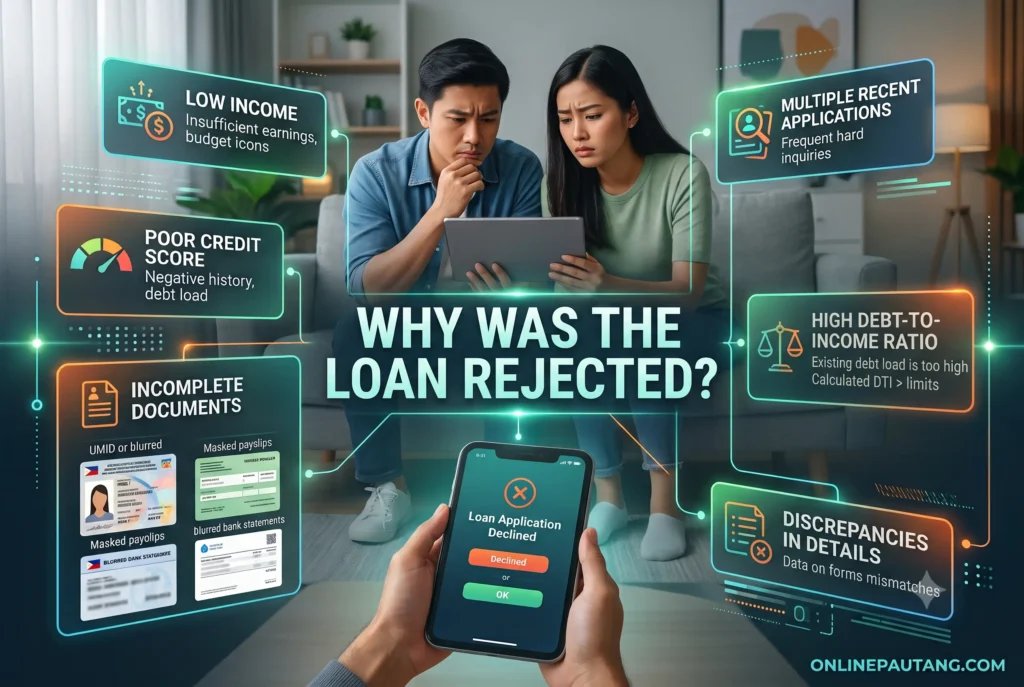
Summary: If rejected, do not immediately apply to multiple other apps, as this flags you as a high-risk borrower. Review your uploaded documents for clarity, check for mismatched names, and wait at least 30 days before reapplying.
A loan app rejection feels deeply personal, but it is purely algorithmic. The most frequent cause for denial among first-time borrowers is data mismatch. If your registered app name is “Maria D. Santos” but your government ID reads “Maria Dela Cruz Santos,” the system will instantly reject the application due to fraud protocols. Another common error is applying while unemployed without explaining alternative income sources. If rejected by a top-tier app like Tala, resist the urge to download unregulated, high-interest apps out of panic. Re-evaluate your submitted requirements, ensure your e-wallet accounts are fully verified, and try again after a month.
What to Expect: Realities of First-Time Starter Loans
Summary: First-time borrowers should expect low credit limits (PHP 1,000-PHP 3,000) and short repayment windows of 15 to 30 days. This acts as a trial period for the lender to test your repayment discipline.
Expectations rarely align with reality when you apply for your first digital loan. Advertisements often highlight maximum limits of PHP 25,000, but these amounts are reserved for repeat borrowers with flawless payment histories extending over several years.
Understanding Starter Limits (PHP 1,000 – PHP 3,000)
Summary: As a beginner, your initial approval will likely be between PHP 1,000 and PHP 3,000. These low limits mitigate the lender’s risk while allowing you to build a positive track record.
Do not view a low initial limit as an insult; it is standard industry practice. These first-time starter loans are essentially trust-building exercises. Lenders take a calculated risk on a borrower with zero formal data. If you borrow PHP 1,500 and repay it exactly on time, the algorithm updates your profile, often doubling your limit on the next application. Conversely, paying even one day late on your very first loan severely damages your internal trust score with that specific app, often capping your limit permanently or resulting in an outright ban on future borrowing.
Interest Rates, Processing Fees, and Late Loan Penalties
Summary: While the BSP caps nominal interest at 6% per month for small micro-loans, legitimate apps also deduct upfront processing fees. Failing to pay on time incurs strict, legally mandated late payment fees capped at 5% per month.
You must read the breakdown of funds before hitting the “Accept” button. If you are approved for PHP 2,000, you will likely only receive around PHP 1,850 in your e-wallet. The missing amount is the processing fee, which is entirely legal as long as it is disclosed beforehand. The real danger for beginners lies in missing the due date. Legitimate apps do not send goons to your house, but they do apply late loan penalties systematically. The BSP mandates that late fees on short-term micro-loans cannot exceed 5% per month of the outstanding balance. If an app attempts to charge you a 10% daily penalty, they are violating BSP Circular No. 1159 and should be reported immediately.
Moving Forward: Building a Healthy Credit Profile
Your first loan is merely the entry point into the formal financial system. The true value of using SEC-registered platforms like Tala or BillEase is not just the immediate cash, but the fact that these companies report your repayment behavior to the Credit Information Corporation (CIC). By borrowing small amounts and repaying them diligently, you transition from having zero credit history to possessing a positive credit footprint.
Treat these micro-loans as tools rather than a crutch. Borrow only what you can comfortably repay from your next income cycle, strictly avoid borrowing from one app to pay off another, and aggressively guard your personal data against unlicensed operators. Financial access in the Philippines is expanding rapidly, and navigating it safely requires skepticism, strict verification of regulatory compliance, and disciplined repayment habits.
References
- Bangko Sentral ng PilipinasOrganization: Bangko Sentral ng Pilipinas (BSP)Resource: Digital Lending Guidelines and Interest Rate Caps (Circular No. 1159)URL: https://www.bsp.gov.ph/Regulations/Issuances/2022/c1159.pdf
- Securities and Exchange CommissionOrganization: Securities and Exchange Commission Philippines (SEC)Resource: List of Registered Lending Companies and Revoked LicensesURL: https://www.sec.gov.ph/lending-companies-and-financing-companies-2/list-of-lending-companies-2/
- Tala PhilippinesOrganization: Tala Financing Philippines Inc.Resource: Official Application and User AgreementURL: https://tala.ph/user-agreement/
- Credit Information CorporationOrganization: Credit Information Corporation (CIC)Resource: Submitting Entities ListURL: https://www.creditinfo.gov.ph/list-submitting-entities-production
Disclaimer:This article contains affiliate links. We may earn a small commission if you apply for a loan through our links, at no extra cost to you. The information provided is for educational purposes only and does not constitute professional financial advice. Please borrow responsibly.
Last Updated on July 4, 2026 by Elena Reyes
